 Written by
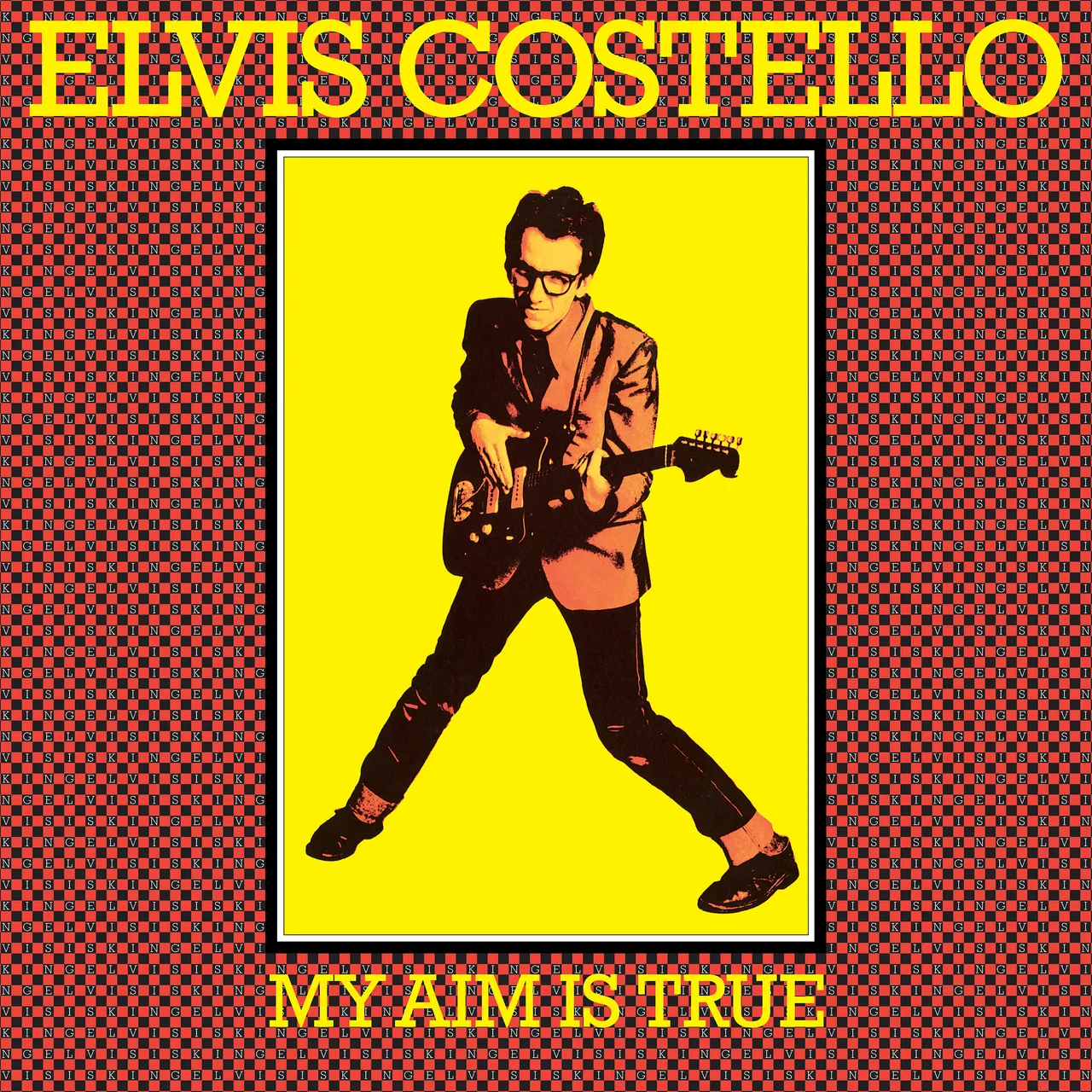
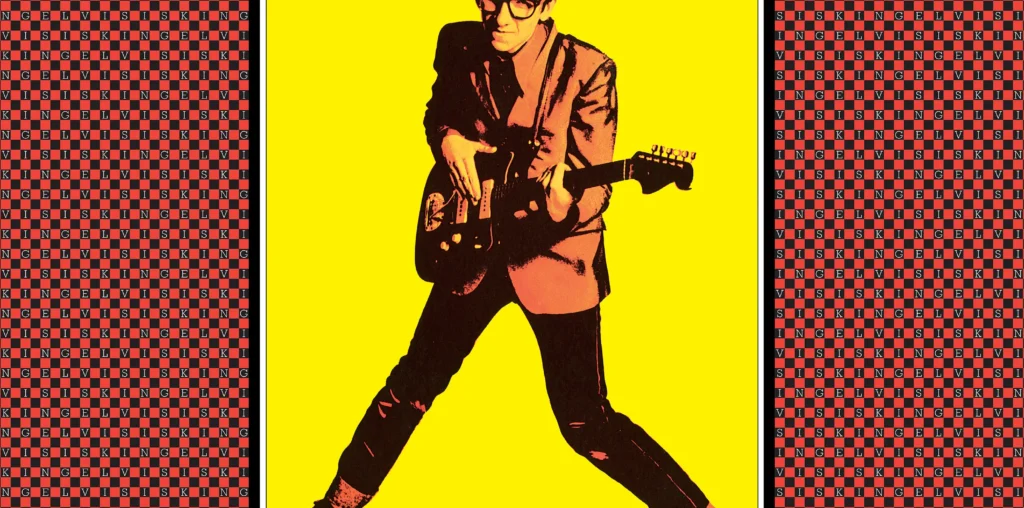
It is 1977 and a small man with a bulging bag of vexations has arrived at the door uninvited. With his strange name and Buddy Holly glasses, he seems vaguely ridiculous, and not the sort of person we’d be likely to discuss a half-century later. And yet his first LP is a masterpiece—one of a string of them that would elevate him to stratospheric prominence. With its fluttering Byrds riffs, Faustian bargains, and Oscar Wilde epigrams, My Aim Is True introduced the world to the brilliant songcraft and outsized neurosis of Elvis Costello. It begins with “Welcome to the Working Week,” a fantasy of opportunity and possession taken at a breakneck pace, an introduction to the fame he both fetishizes and fears. Over 90 seconds, Costello lays all his weapons on the table: chiming melodies played with Small Faces intensity and lashed together with Phil Spector backing vocals and the toxic hilarity of enfant-terrible Dylan.
“Now that your picture’s in the paper/Being rhythmically admired
You can have anyone you’ve ever desired
All you gotta tell me now/Is why, why, why?”
No score yet, be the first to add.
Why indeed? That’s what the new 5xCD edition of My Aim Is True—issued with light subversion on its 49th anniversary—is charged with finding out. This is a bildungsroman—the artist as a fidgety young man: trying on literal and figurative hats, channeling influences and then turning on them, his mind churning away with nervous poetry. Within the 104-song set there are demos and live shows, some new, some heard previously, some prosaic, some revelatory. This is not the first deluxe edition of My Aim Is True and I assume it won’t be the last. It’s tempting and maybe appropriate to grow cynical about the vulgar reissue-repackage cycle of rock’s major legacy acts, Costello included. And yet, the sheer welter of the new set manages to reopen the old case in fascinating ways, recasting Costello’s early years as a slow, thoughtful process of personal and aesthetic transformation that would pay off in spectacular fashion.
My Aim Is True is a doozy—song after tuneful song of uniquely catchy complaint-rock, spat out with the irritability of an exhausted (and exhausting) nightclub comic with a Liverpool twang. On the jangle-rock classic “(The Angels Wanna Wear My) Red Shoes” he sings: “I used to be disgusted/And now I try to be amused,” but he doesn’t try that hard. My Aim Is True positively marinates in social, romantic, and political outrage, overlapping into a mosaic of grievance that would take decades to fully untangle. “Miracle Man,” with its chirping, rootsy Little Feat riff and vocals shouted from the edge of despair, and the doo-wop ritual humiliation of “No Dancing” are taunting indictments of his own sexual inadequacy, a conscious refutation of the dick-swinging hard rock which dominated the charts in the early ’70s. “You want Bad Company?” he seems to be saying. “I’ll show you the meaning of bad company.”

Costello’s deep immersion in American music is evident throughout, with the influence of Randy Newman particularly apparent on rambling tracks like the murderous “Blame It on Cain” and the gloriously petulant “Pay It Back,” a laughline-packed deep cut from the edge of generational resentment: “They told me everything was guaranteed/Somebody, somewhere must have lied to me.” Elsewhere on My Aim Is True, he’s a sped-up prophet and a canny satirist of encroaching horrors, especially on a pair of reggae-tinged tracks which ably demonstrate both the breadth of his musical vision and the lethal poison of his pen. The lurching, arch “Less Than Zero” brutally satirizes Oswald Mosley, the influential far-right British figure of the 1920s and ’30s, a simpering aristocrat with a penchant for hate speech who serves here as a stand-in for imminent Thatcherism. The stuttering “Watching the Detectives” anticipates the desensitizing media blitzkrieg of the electronic age, a deranged feedback loop of meaningless commerce and erotically charged ultraviolence. The jumpy, apocalypse-curious “Waiting for the End of the World” sums up the essence of his predicament: If somebody doesn’t put a stop to all this, he’s going to have to keep singing about it.
My Aim Is True’s centerpiece is the great soul ballad “Alison,” a torch song for an ex-lover animated by a bone-deep longing which may or may not skate into restraining order territory. “Alison,” he sings, overcome with grief. “I know this world is killing you.” Chillingly, he sounds like he might be prepared to finish the job: “I think somebody better put out the big light/Because I can’t stand to see you this way.” It was a hit of sorts for Costello—Linda Ronstadt was impressed enough to record her own version—and it remained his best-known song for years. With studied contrarianism, he then proceeded to treat it as a kind of albatross, refusing requests to play it live. Five decades later, however, it remains the best thing on My Aim Is True: three minutes of mesmerizing obsession that wed Paul McCartney’s structural mastery to Warren Zevon’s switchblade menace.
The remaining four discs of the set zag between preamble and postscript. The second disc, subtitled The Blue Print, is the most eye-opening, filled with early demos and bedroom recordings that help to flesh out the seemingly out-of-nowhere brilliance of Costello’s debut. He was just 22 when My Aim Is True was recorded but, with his earlier band Flip City, had been a central figure in the pub-rock scene that grew up around the Hope & Anchor club in London. The 17 tracks on The Blue Print make a strong case for Costello as a craftsman rather than a bolt-from-the-blue genius. To a one, the songs are insinuating and accomplished, mostly country-tinged folk, replete with his signature wordiness and witty one-liners. What is absent, at least in musical terms, is any hint of the punk and new wave sensibilities that would assert themselves in his later work.
Instead, what we hear is an ambitious composer who sounds mostly inspired by the great L.A. songwriters of the era: Newman and Zevon, but also Bonnie Raitt and Lowell George. With its emphatic acoustic strumming and tales of vigilante girls in the ruins of the night, “Losing You” circles Van Morrison by way of early Springsteen. “Citizen Junction” sounds like Jackson Browne taking a tour of Tom Waits’ weird-jazzbo side of town, with its put-upon waitresses and evocative references to “the broken pieces of the crystal moon.” This version of Costello is more serene musically, but still highly attitudinal. “Wave a White Flag,” a paean to mutually assured romantic destruction, shares its pitch-black sense of humor with Richard Thompson. As proof of concept for Costello, The Blue Print is a compelling and persuasive listen. It’s also clear why, while everyone pretty much agreed on his talent, no one was quite sure what to do with it. Flip City never really caught on, and the hip label Stiff initially signed Costello—going by the name D.P. Costello at this point—to a deal as a songwriter rather than a performer.
The metamorphosis came gradually, and then all at once. Stiff impresario Jake Riviera—an old school raconteur—suggested the name Elvis and the great agit-prop visual artist Barney Bubbles provided an aesthetic framework for his evolution from sharp-tongued folkie to belligerent visionary. On Disc 3, entitled The Stranger in the House, we hear Costello further refining his writing and persona, his songs coming into sharper focus, abetted by boisterous new confidence on tracks like the swinging country-and-western outtake “Radio Sweetheart” and the strutting shuffle of “Exiles Road.” He was figuring it all out just as punk was coming into vogue, a fortuitous development for an artist whose intuitive truculence mapped perfectly onto the Year Zero ethos of the Sex Pistols and Clash. He wasn’t all the way there quite yet.
Before forming the epochal Attractions, Costello was backed by the Bay Area country band Clover, a nimble, versatile group whose members would go on to play with the Doobie Brothers and Huey Lewis & the News. It was a one-and-done arrangement—he would need superior firepower to go up against his Angry Young Man peers—but an utterly fascinating one, anticipating the panoramic, genre-hopping artist who would emerge in the early to mid ’80s. The remaining two discs on the 49th anniversary edition are fun, but less essential. Becoming the Attractions is pretty much what it sounds like—a chronicle of the band finding its footing on a series of concert tracks and radio appearances. Undoubtedly one of the great rock’n’roll units ever, the Attractions are a premium muscle car; hearing them attack the My Aim Is True material with martial ferocity makes for an interesting contrast with the proper album but doesn’t much advance the overall story. The final disc, Covered in Clover, commemorates a 2007 reunion performance at San Francisco’s Great American Music Hall, the first time that Costello had played with the surviving members of the house band from his first LP since they initially tracked it. The show is offhand and familiar, and the spirit of bonhomie is touching, as are Costello’s warm reflections in the set’s 72-page liner notes. It’s a fitting capstone to the box set’s narrative, if something of a hardcore fan’s curio.
The auspicious 1977 debut—an utterly sui generis, loose-limbed, exuberant, terrified, reverential, and cantankerous strain of American roots music—begat an astonishing run for Costello, whose first 10 years as a recording artist rivals Bob Dylan and the Beatles in scope and ingenuity. My Aim Is True marks the moment when Declan MacManus died so Elvis Costello could be born, and the new box set does a fine job of tracing the context and aftermath of that consequential exchange. It’s the loaded starter pistol that would leverage this odd man out of obscurity and onto the trajectory of a legend. It was a bullseye, and he wouldn’t miss again for years.