 Written by
For listeners new to experimental music, an early encounter with Jon Hassell is an epiphany. Perhaps, like me, you found him first on Fourth World, Vol. 1: Possible Musics, his 1980 album with Brian Eno. It’s a record that makes you feel like a participant—hear the rubbery bass, talking drums, gurgling synths, and Hassell’s electronically altered trumpet, and map onto it your own memories of jazz, film soundtracks, music from Africa, and classical minimalism. You’ve joined a process and completed the work simply by tuning in, and it’s thrilling. As you explore his output further, you begin to understand him as the embodiment of the accessible avant-garde in the past 50 years. His work took in Stockhausen, Terry Riley, La Monte Young, Pandit Pran Nath, the Bomb Squad, and many more, and his collaborations with Talking Heads, David Sylvian, and Tears for Fears put his ideas in front of curious listeners raised on pop.
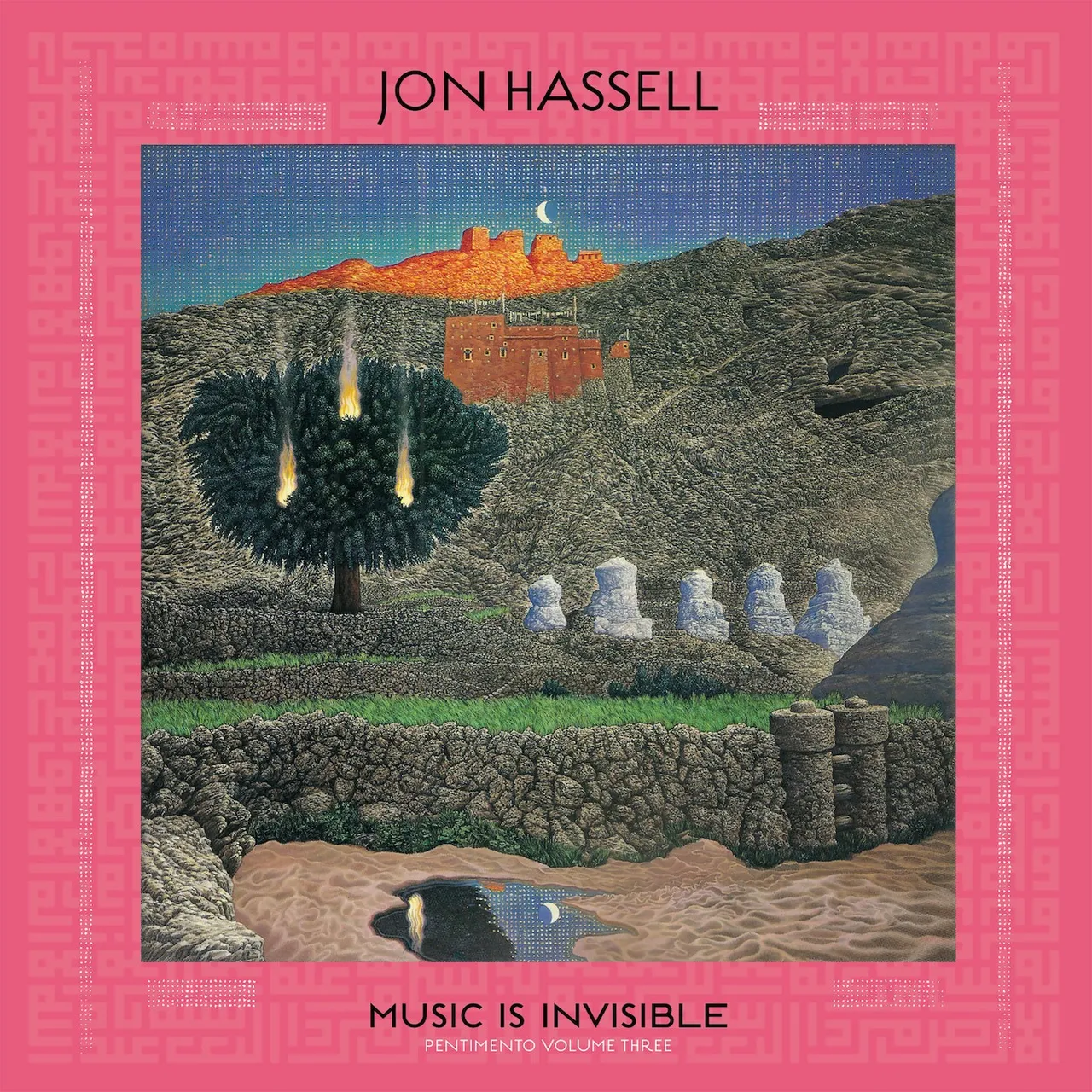
Music Is Invisible is the third and final entry in his painting-inspired Pentimento series, in which Hassell took a collage-like approach, mixing live, studio, and previously recorded material. The set was mixed and assembled by Jeff Rona—a member of Hassell’s band in the early ’90s—using as its primary source the trumpeter’s final live show in London in 2015 (he died in 2021). He played the date with multi-instrumentalists Rick Cox and John von Seggern, and by then his health was declining. Hearing the tape later and feeling uneasy about his own performance, he encouraged Rona to use the gig as a foundation for new pieces.
No score yet, be the first to add.
What strikes me most about Music Is Invisible is how distinctive and identifiable Hassell’s music remained even as his life as a performer was drawing to a close. The contexts and aesthetics of his records changed many times over the years—urban clatter inspired by hip-hop on City: Works of Fiction, the ultra-refined chill of Last Night the Moon Came Dropping Its Clothes in the Street—but his presence grounds the work and gives it a focal point. Some of that comes from the consistency of his phrasing and favored processing filters; it also has to do with how his sound reframes everything else that is happening around him. He listens and responds, and the ear goes to his instrument’s unforgettable texture. Hearing him play makes you think about biological realities, like what it means to be a mammal whose survival depends first on respiration—his breath becomes music, and your mind returns to your own.
Within Hassell’s records there are a number of different affective modes, from drowsy and drugged to peaceful and reflective to demonstrative. The mood here, though subtle, is one of coiled tension, a jittery nervousness where danger is lurking somewhere just out of view. “Blue Ba-Ya” has jazzy keyboard accents and slow-rolling synth drones that split the difference between cocktail elegance and new age drift while Hassell’s horn takes up space in the foreground, his tone round and commanding. At times, he seems to be playing over his past albums with the CD player’s fast-forward button held down, melodic glitches shimmering like sunlight on water.
The opening of “Club Gris-Gris,” where Hassell plays his trumpet with only a touch of processing, reminds me of early passages of Sketches of Spain, how intensely focused blowing can create ruptures of distortion from control of the embouchure alone. The track breathes, with dubby throbs of echo cycling in the background. Even when synth washes seem like they’re going to carry you away, there’s a faint ripple of anxiety, like Hassell and his band are playing in a building that could collapse or catch fire at any moment.
Half of “Broadway Boogie-Woogie” is clipped and processed percussion, rim shots and hi-hat snipped apart and stitched back together, and Hassell adds some color toward the end. It’s the one piece here that sounds a little canned, where you can almost picture the waveforms scrolling by in a DAW, but it nicely sets up the closing “Electric Forest.” The thwopping talking drums are high in the mix, the trumpet is pinched and fraying, as if it’s being stuffed through a knothole, and the background swarms with twinkles, sound effects, string-like sounds, and assorted motes of sonic dust. It’s a rhythm-forward piece with drive, and it earns its 16-minute runtime. As it winds down, chord stabs from “Blue Ba-Ya” return—the record has folded in on itself, an end that is also a beginning.