 Written by
I used to love doing acid. I did a lot of it in my twenties and mostly had a fabulous time. On vacation, I’d embark on dawn hikes, submit to the rhythmic clang of railway lines overhead, or amble through tourist traps, mingling with normies for the perverse thrill of it. At home, timed right, the sun would be coming up as the final remnants of a sheet corner began to dissipate—a flow state enhanced by a long walk for as far as my legs could carry, head on a swivel, chasing pastels pogoing off buildings and the susurration of trees.
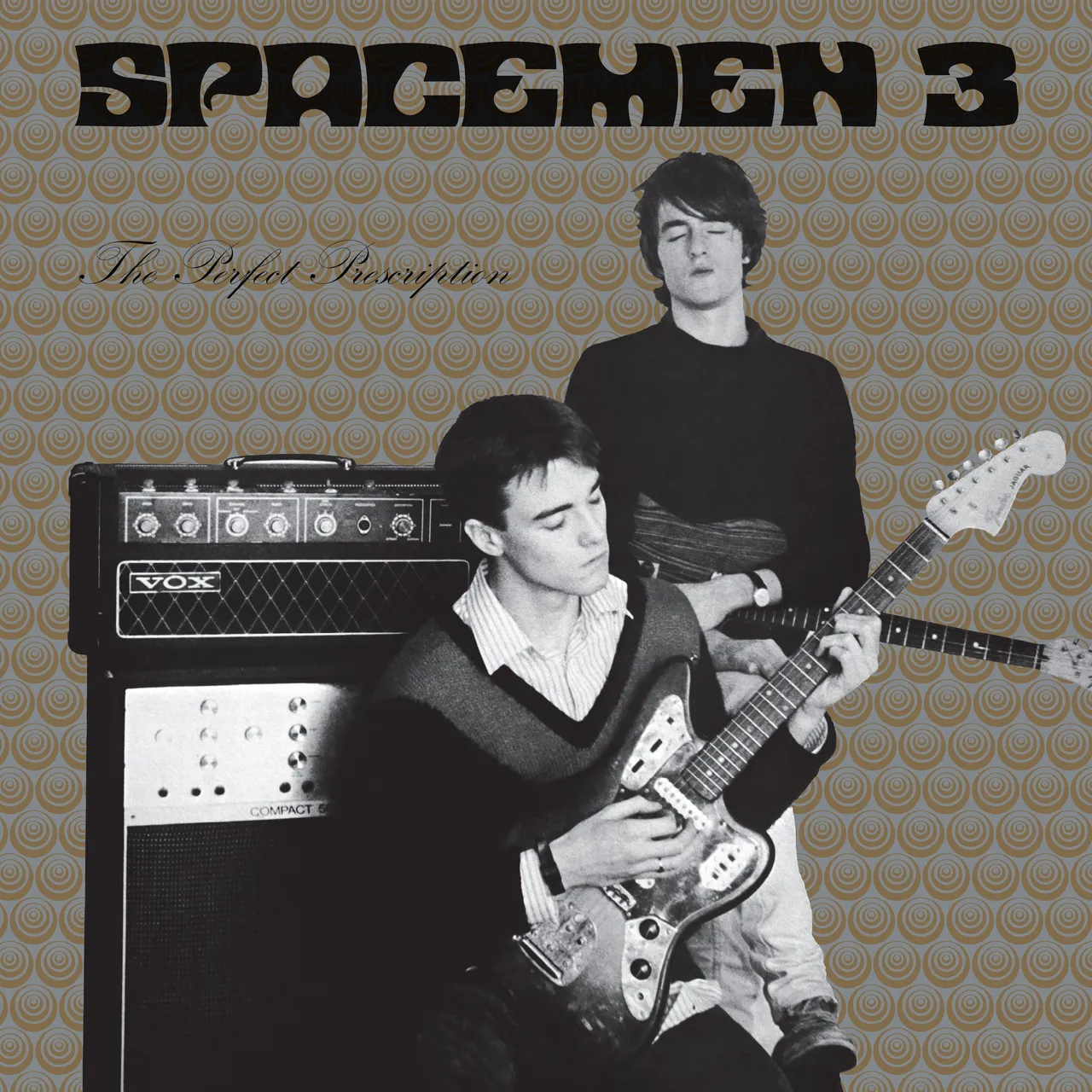
As Europe panted through rolling heatwaves this summer, I became drawn in by The Perfect Prescription anew. I’m older now, with far too many responsibilities to let a tab sizzle. Still, for days on end, I’d get an afternoon headrush that felt positively psychotropic, and rather than fix what was probably a simple case of dehydration, I’d throw on some beat-up running shoes and crank Spacemen 3 loud, an act of goofy liberation that allowed me to feel reckless while still showing up the next day with marbles intact. I’d slow whenever the rustle of leaves between two canopies caught my eye, a vision of green-on-blue which triggered the familiar warm shivers of a gentle decline from a killer trip. It’s been a while since I ventured to the other side. But to tell you the truth, I don’t think I ever really left.
No score yet, be the first to add.
The Perfect Prescription is Spacemen 3’s masterpiece, an imperfect record made by one of the last holistically perfect groups of the 20th century. Here was a band dutifully marching behind a unifying vision, and it’s no great shock what that vision entailed. They really, really, really loved doing drugs. Not since Lou Reed jammed 26 dollars in his hand has a group so believably articulated the crescendo and contours of a high, alongside the mundanity, side quests, and thousand-yard stares, too. Nor has anyone been as gifted in making it sound this good.
As any dabbler will tell you, you can foil the windows and amass all the beanbags in the world, but if the company is off, the hours ahead are likely to drag. You’ve gotta know how to riff gracefully. How to lean in without crowding anyone out. And where too much droning on risks crashing the mood. The crucial factor, truly, is people on the same wavelength. For a brief wrinkle in time, in life as in music, Jason “J Spaceman” Pierce and Pete “Sonic Boom” Kember found themselves immaculately in tune.
While the destination they arrived at wasn’t radical in and of itself, the approach they took categorically was. The Perfect Prescription remains one of the most essential guitar records of their or any era, a fumble toward ecstasy that chained up overlapping scenes of indie rock, drone, heavy psych, shoegaze, minimalism, Delta blues, and a kind of toilet-circuit trundle native to England’s middle and northern geographies. You could call it a gateway drug, if the term didn’t finger you as a narc. By redirecting attention into tone experiments at the expense of a conventional rhythm section, it sounds as alluringly odd today as it did in 1987. Tremolo is the tether and pulses are propulsion. Vocals strain at the center of the songs while lonesome organs burn around the margins like the argon glow of a street-sign montage. Charged with a curious kind of antigravity, all the elements are floating, as it were, in space.
In the 40 years since, every facet of Spacemen 3’s story has been turned over and generously embellished, resulting in an excess of grandeur and foresight projected onto the duo at the heart of it. At first blush, the album doesn’t feel that different. Sonorous riffs, DIY essence, third-eye probing behind thick shades—stop me if you’ve heard this one before. They forced audiences into durational listening sessions, while simultaneously employing a bassist too spangled to remember to turn his amp on. Contemporary reports present Pierce and Kember in a mixed light, given to draining a room of air rather than flooding it with posi energy; they might very well have been miserable hangs.
You can’t imagine them falling out of rotation now, though, even as every idiosyncrasy the Spacemen nailed in their relatively short run has been rendered ordinary in the fullness of time. The group’s advocacy for narcotics was both far-out—the idea that Class As might ever be administered clinically or therapeutically by the NHS was a fringe pursuit—and shockingly comprehensive. Their analgesics alone make “Feel Good Hit of the Summer” sound like a roll call for the Model UN. The duo gallantly knocked off countless brain cells in pursuit of how it really feels to exist outside society’s confines. The Perfect Perception’s doctrine is an eternally inviting one: You can’t know true freedom if you only ever stick to the middle lane.
Pierce and Kember were born in the same place on the same day, a lore-enhancing coincidence too stupid to make up. The cosmonauts plonked down on November 19th, 1965 in the Midlands market town of Rugby, a cultural backwater best known for the sport, the school, and wartime poet Rupert Brooke, in that order. After years in the wilderness, they crossed paths again at art school, Kember now equipped with a curious affinity for the frequency of washing machines. Come the end of 1982, shared references pooled, they were jamming in assorted family rooms, and on their way.
The tone is there on the band’s first album, 1986’s Sound of Confusion, just not quite the tunes. You can hear their collection loud and clear: 13th Floor Elevators, Muddy Waters, and, as gig posters advertised: “Stooges? Velvets? Stones?” But when 43 percent of your debut is covers, and those covers orbit psychedelic influences that are already honkingly obvious, you’re fenced in, rendering the self-absorption of tracks like “Losing Touch With My Mind” in cold light. It’s good! But, like, Black Rebel Motorcycle Club could make this.
Abraded by a shrugging reaction to Sound of Confusion, the Spacemen began to take their shit marginally more seriously. First, they sent their shoeless drummer Natty packing and installed Sterling “Rosco” Roswell to back up Pete “Bassman” Baines instead. Second, as people tend to do once they shift into their 20s, they lasered in on what they were really trying to say. And the answer that called back was gospel.
The influence of Black American music was absent from not just their Warwickshire peers at the time, but all of the dour indie milieu toiling under Thatcher’s grey skies. The scene’s touchpoints lay elsewhere: French literature, industrial sterility, cardigans; at best, a few nods to the Ronettes. By the 1980s, England was beginning its turn away from churchgoing as a cornerstone of society, so nothing as extroverted or nakedly clerical as gospel choirs would fit a downcast, monochromatic land anyhow.
Kember, who grew up in a Catholic household, and Pierce, the son of a proselytizer, were fascinated by spirituality. You can hear it all across their repertoire, in the 1930s gospel standard “Amen” reborn as “Hey Man” on their debut, The Perfect Prescription’s “Soul 1,” and Playing With Fire’s “Lord Can You Hear Me?” Well before blueprints were sketched for Spiritualized’s cathedrals of sound, the draw of Farfisa warbles and voices cracking with vulnerability pulled them in like a tractor beam—and just like their idols in the Velvet Underground, they ooze both quality and insuperable conviction, floating above the mire of the bums, burnouts, and blotter-curious in their wake.
That may have contributed to their decision to acridly lil-bro Loop, the ’80s space rock band they were routinely compared to, in the press. Until 1989’s Playing With Fire drew more attention to Spacemen 3’s repertoire, Loop looked set for the longer career. But what good are cranked amps and stacked pedalboards if you don’t have faith to back it up? Strip Baptist choirsong down to the studs and it might reveal itself as technically basic. But in the Spacemen’s eyes, that totality of expression was the bar, the brass ring, and it pushed them to greater heights than they might have expected themselves.
“The appeal of gospel for me was the whole fervor of it,” reflected Pierce in 2005. “That’s the kind of feeling we wanted to put into our music… that it’s going to produce some movement within you.” Chimed in Kember, “I’m sure that the Staple Singers put a lot of energy and effort into their singing. They don’t sound like they’re filing their nails or reading a comic at the same time. They sound like they’re totally into it.”
Just one snag. How do two middle-class lads in ratty threads, who might very well have both been played by Robert Pattinson, fast-track an appointment with Jesus? Well…
There’s a tug of war inherent within Spacemen 3. It comes down to how charitably you gaze upon their lifestyle. On the one hand, it’s fun to frame their vast drug intake as divine transport, two men on a mission to penetrate the outer reaches of sound and sentience. On the other, evidence suggests this pair of habitual time-wasters were commonly found on the floor, running laughter through a Yamaha SPX90 effects processor for kicks and strumming the same note for 40-odd minutes. Unsurprisingly, much of The Perfect Prescription was conceived horizontally. Under the exasperated eye of recording engineer Graham Walker, they commandeered Rugby’s VHF studio for six full months, save for the days when Kember was getting nicked in police stings. Without a studio meter running, they were able to loaf around for so long that the odds were in their favor that they’d attain nirvana sooner or later.
Take the album’s centerpiece: “Ecstasy Symphony” and a cover of the Red Krayola’s “Transparent Radiation,” tracks which originally came separate but here were gracefully combined. The 1967 original becomes unrecognizably loose, converted into the most zonked stream of consciousness you could find on record until “Drinking Out of Cups.” On the instrumental bed underneath. They’d taped down a lone A on the Vox organ, split eight ways with different effects added in each channel—tremolo, phaser, autopan, reverse—then recombined into a single tone, with each modulation continuing to bounce off each other like overstimulated electrons.
The decision to set that tone staggering through all 10 minutes of the extended cut might scan as raw inspiration, placing Spacemen 3 on a narrow band from La Monte Young and Terry Riley to some brilliant dro)))ne future. But really, they blundered sideways into it. The one-note repetition was cribbed from the Stooges’ Ron Asheton, Kember later admitted, a trick they also hammered out on Sound of Confusion’s “O.D. Catastrophe.”
“I can hardly play guitar,” Kember cheerfully copped to Forced Exposure in 1988, “and don’t understand a lot of chords.” They made immense hay of it all the same. Just as Kevin Shields would soon make the whammy bar his own, Kember’s tear-shaped Vox Starstream fortunately contained a massive array of built-in effects, which would later be replicated in Spaceman and Sonic Boom-aping pedals. Listen closely between the mentions of needles entering veins on “Things’ll Never Be the Same,” and you can pick out Kember’s unsteady hand guiding the wah-wah at the base of his guitar around like a dog on chain-link lead, lending the song a discombobulated grain.
Some time after you find yourself questioning where the drums have got to, you might notice the lack of anything as trad as verse-chorus-verse. Not so on “Walkin’ With Jesus,” an incredible thing for two 21-year-olds to come up with, and surely the Spacemen tune most likely to be etched on a golden record aboard any future Voyager. Many before and since have grappled with the price of salvation, but rarely has such a theologically vast decision felt this intimate. “Heaven” appears coyly in the official lyrics in lieu of another H-word, but come on: They’ve found theirs on Earth.
Genius, accident, estupenda, estúpido—it fundamentally doesn’t matter, because on The Perfect Prescription, one fuels the other. Limited facility made each move substantial, just as one key change in a sustained hum can hit like tectonic plates colliding. Over time, a familiar retelling has presented the record as a hot dose from start to end: kicking off with a mighty rush (“Take Me to the Other Side”), seeing stars (“Ode to Street Hassle”), getting cosy with dependency (“Feel So Good”), and then turning blue. But this is too elegant, too linear. What I hear on The Perfect Prescription is more ragged, more intuitive, and ultimately more compelling. You can arrange all the elements but you can’t sway a trip. At some point, you have to simply let go.
They power down with “Call the Doctor,” the greatest Spacemen 3 song of all. Heroin, LSD, coke, or otherwise, no drug opus is complete without the crash, so this one’s a motherfucker: Our narrator is seconds away from death. And when Kember sings about overdosing, you’d wager your life it’s real. The call-and-response vocals and sweet moments of riff affirmation across “Feel So Good” and “Come Down Easy” are gone. He’s calling out to someone to hide the spoons, but they’re gone too. At the denouement, Kember is completely alone, his flat, narcotized baritone dripping onto the faded guitar notes like melted mercury. Neither maudlin nor melodramatic, and without any glorification, the song is infected by the same chilling gloom which has glommed onto the best of Messrs Linkous, Berman, and Drake.
As much sway as “Call the Doctor” holds over me, it never fully sat right with its creator. Nor did much of The Perfect Prescription. Long after the band’s final show at Reading Festival in 1989, Spacemen 3 continued to chip away at the album’s source material. A few moves didn’t quite take: 2008’s DJ Tones EP was a sick idea, if there were more than a half-dozen DJs in the world bold enough to execute a mid-set drop of “Transparent Radiation”’s violin mix. In 2003, however, Kember made a splash with Forged Prescriptions, a re-release that favored fuller mixes and extra overdubs which the band had jettisoned owing to the difficulty of reproducing them.
The alternate versions certainly add extra bite, and a few outtakes could have made it to the main tracklist. Yet as an attempt to correct the record, it does too much. The extra baggage negates the weightlessness, revealing a more flawed and earthbound iteration of the band. “Call the Doctor” suffers worst, replacing flamed-out resignation with sheets of fuzz that telegraph a swift recovery. If anything, the song sounds too alive.
Because the void is the sell. That’s the crucial element which diverted Spacemen 3 from a creative cul-de-sac onto the road to ascension, and lifted The Perfect Prescription, as well as dazzlers like Playing With Fire’s “So Hot (Wash Away All of My Tears)” and later standouts higher in the space-gaze canon. Even as other artists of the period might have boxed Spacemen 3 out for technicality, volume, daring, and original thought, they genuinely went there, treating their bodies as test labs out of a piquant mix of curiosity and boredom. They dangled their feet over the edge, communed with the point of no return, and, having found no chemical solution for a spiritual problem, bled it out on record instead.
On stage, Spacemen 3 could go full napalm hearts and head-splitting feedback, which is why they typically pop up in relation to the Brian Jonestown Massacre, Flying Saucer Attack, Wooden Shjips, and Ride. But The Perfect Prescription’s brittle strangeness, burying guitar alongside trumpets, violin, and deep’n’dubby sound design, dislodged them from the conventional orbit of space rock and scattered fragments of their influence farther afield: Animal Collective, Buttechno, Scorn; Kendall Roy’s All Bangers, All the Time playlist.
Unsurprisingly for such a chemical experiment, the band unravelled less than 18 months after The Perfect Prescription: first conceptually, then as a working partnership. They hang no longer, and have barely been on speaking terms since the Berlin Wall fell. Their final LP, 1991’s underrated Recurring, is really a Spiritualized-Spectrum split in all but name; had they been around to promote it, it could have made serious waves in tandem with the Haçienda, Weatherall, and the rest. Yet by the time their reputation had carried beyond the M6, both men had moved on.
You could level that the group never quite extended their fingertips to the ceiling of their full potential. It’s inevitable that a few that merited amplification or deeper investigation inevitably petered out in a cloud of smoke. (They tracked “Come Down Easy” twice, and didn’t exactly equivocate about what they were chasing: In 1986, get stoned. In 1987, get stoned.) Nothing would lure them back to repair the fracture; not a 1998 tribute record, nor a £2 million reunion offer. “[It] was only our second album,” Pierce confided to Erik Morse for a 2004 biography of the band. “But we never went anywhere near it again.”
What might have been, we’ll never know. Kember’s dabbling in experimental electronics betrayed a quality he’d bank on across the next three decades, growing in confidence to become a studio radical called on by some of the 21st century’s quirkiest stars; here, however, he’s a hair too green. Throughout the ’90s, Pierce marshalled the full apparatus of salvation and became an acknowledged indie genius, lavished with enough label support to make his dreams of pharmaceutical packaging come true. Might he have ventured further with Kember by his side? I reckon so. But that’s drugs for you. You can get blown off course pretty easily.
In the middle of one of those summer heatwaves this year, Kember was in the promotional cycle for a record with his new partner of 15 years, Panda Bear. During the Q&A, a fan earnestly asked him how he felt today about being a conduit through which enormous volumes of weird music flow; to be constantly ahead of the curve, and so destined to watch vibrations ricochet through culture. At one point, “the UK’s Velvet Underground” slipped out.
A grin spread across the Rugbeian’s face. He neither took the bait directly nor demurred with faux modesty, but instead used the question as a spur to discuss the inherent randomness of influence: how what we regard today as a masterstroke of far-sighted clairvoyance really only attains coherence in the rearview mirror. He spun a tale about untrained, ragtag schoolboys in bargain-bin jumpers who weren’t straining for the stars in the way history records it. Instead, they hit all their lucky numbers on a creative accumulator. They were taking drugs and making music to feel good, and had the records been heard by no more than an audience of three, they would have been every bit as satisfied. It could have been anybody. Still, it turned out to be them.