 Written by
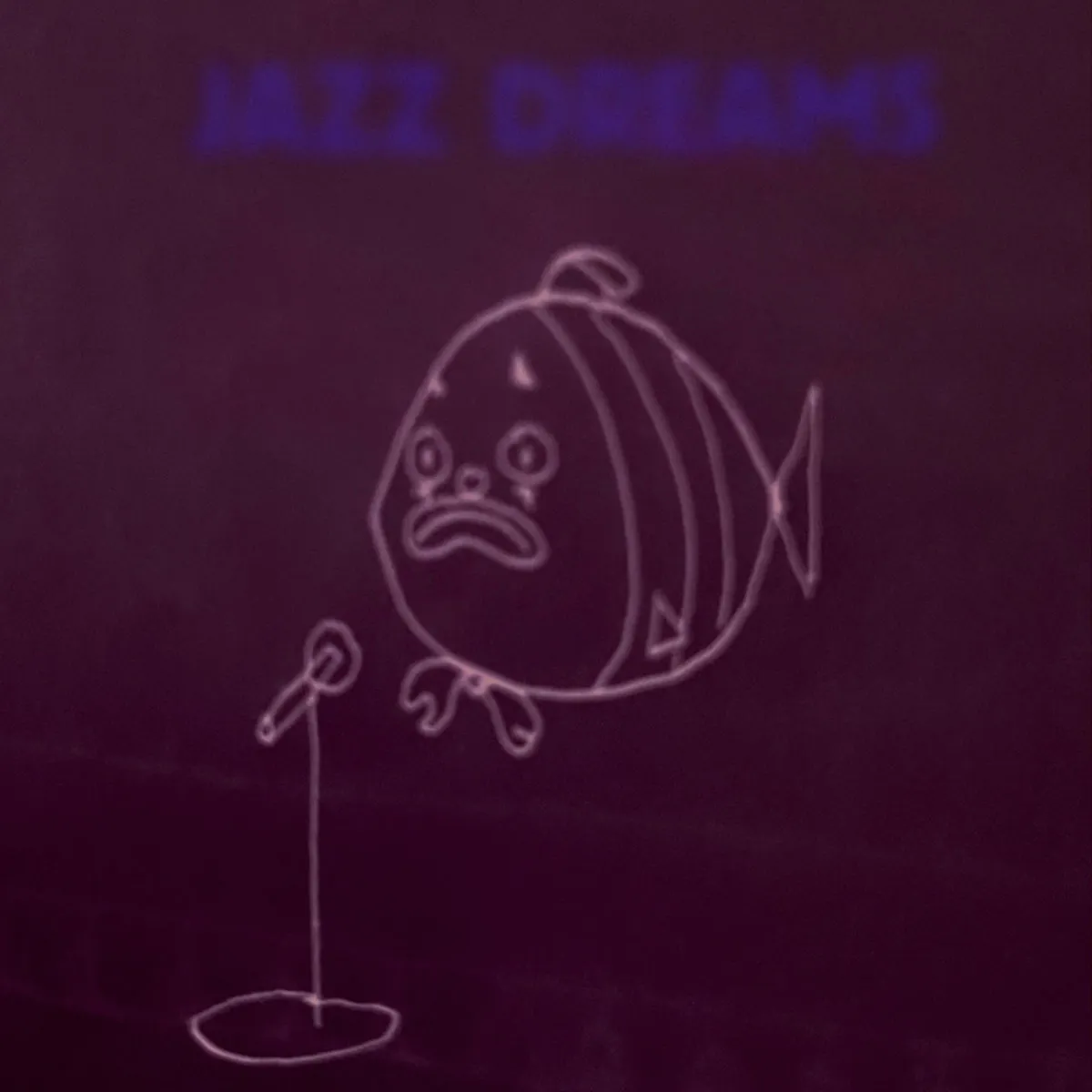
You know Fine Glindvad Jensen from somewhere. Perhaps you recognize the Danish polymath as the pitched-up voice echoing across Two Shell’s 2022 breakout “home”; maybe the hooks she wrote for that NewJeans EP got stuck in your head. Perhaps you’re familiar with her cohort at Copenhagen’s prestigious (and publicly funded) Rhythmic Music Conservatory, where she shared the halls with Smerz, Erika de Casier, ML Buch, and Astrid Sonne, among others. Her dusky alto may remind you of Hope Sandoval, or Lana, or the beautiful stranger who covered Nancy Sinatra at your local dive’s open mic—or did you imagine that? The great trick of her beguiling second solo album, Jazz dreams, is the veil of velvety uncertainty it casts over sounds I’d thought were carved into stone: jangle pop, lounge standards, jukebox folk-rock. It’s hard to believe these songs haven’t always been here humming in the background, so primordial are their musings and skillful their old-school execution.
“I think it can be useful to just approach situations without trying to master them. To just try to experience them with a little bit of wonder,” Jensen told Perfectly Imperfect last year. This might sound strange coming from a conservatory kid whose curriculum included both peer-reviewed composition sessions and lessons like dropping pebbles into water to hear how they sunk. But Jazz dreams exemplifies why the galaxy-brained approach is often the simplest, delivering classic songcraft with the guilelessness of an amateur. Its naturalist flow sneaks through the time and practice it took to nail down, like improv between seasoned session players.
No score yet, be the first to add.
Many of these 13 tracks have popped up as demos in Jensen’s live shows or NTS sets, cooking down to their essence in plain sight. All the elements here—a killer band, Bacharach-tight melodies, the studied ease of putting in way more than 10,000 hours—have been pressure-tested across the decades, giving Jensen a sturdy launchpad to pursue the ambiguity that drives her songwriting. She lays out the conceit on the blink-and-you-miss-it slice of trip-hop “Sometimes I rush,” which builds around the line: “Sometimes I rush but don’t arrive.” Why hurry through the journey when the finish line is never promised anyway?
Jazz dreams finds its pocket in these rich moments before the future starts to happen. “I could come up to your place,” she purrs on “I Could” before a chainsaw of an oscillating tele chord slices through the tension, flirting with the implications of what’s next better than a pan to curtains ever has. On the rockabilly strummer “Get in,” we catch her in Sheryl Crow mode just before she drives off into L.A. traffic, or maybe hops the plane home; that’s for her to know and us to wonder. The lighters-up love song “Everything in the shade,” which would’ve fit right in on Honeymoon, carries the thread from the other end of a romance, noting: “After all that we’ve been through, I’m looking forward to see you.”
Jensen has the vocal equivalent of a familiar face, which for another performer could become a disadvantage. She fashions it into a strength by flexing into unexplored territory that never reveals its stretch. The alternating 5/4 and 11/4 measures on “Million years” have shades of a Jack DeJohnette or Dave Holland joint, but slots in seamlessly after the twilit art rock of “Any minute.” Opener “The thing” is a grand piano trot punctuated with snaps and a staircase baritone guitar, where she portrays an enigmatic figure with more than a passing resemblance to Linda McCartney, posted at the corner of the scene and not “looking for anyone specific—just looking around.” The odd flute flourish and chime strike land like blips in her roving gaze: It matters less who or what she saw, then that she settled on it at all.
Transcend the realm of first thought, best thought, liberate yourself from the confines of don’t overthink it, and you might just achieve the happy tranquility of “Goodbye brain.” Spreading an ultra-buttery bassline over a jangle-pop groove, she sings the praises of lights on, no one home. “I had just one impression: good, babe,” she sighs, instantly earning the envy of anyone who has ever awoken in the middle of the night worried they forgot to turn off the oven or sounded weird in an email. “I’m so hollow, I’m full of dreams,” Jensen sings, so convincingly content you might wonder if the “glass half empty” adage got it all backwards. Jensen is a fan of the post-modernist Brazilian novelist Clarice Lispector, and it’s plain to see how a writer whose magnum opus Água Viva was originally titled Beyond Thought piqued her interest. (Lispector gets a more direct shoutout on the lullaby-like closing track “Much to say,” when Jensen reminds her ever-present “babe,” “Beyond thought, there are no words.”)
A moment here for the mix, which Jensen handled herself and which makes even Jazz dreams’ more abstruse moments sound intimate and unvarnished. Largely eschewing the double-tracking and layered harmonies that gave her 2024 debut, Rocky Top Ballads, a grungier patina, Jensen goes full lounge singer, turning any sound she touches into a lost standard. Credit is also due to her band: Guitarist and Escho labelmate Lola Hammerich, a member of the sludgy noise-rock outfit Baby in Vain, brings depth and sensuality to Jensen’s palette, and heavy hitter Zach Sekoff, who co-produced Tinashe’s “Melatonin,” trades off ripping bass with Hammerich and Villads Tyrrestrup Øster. These are craftspeople through and through. How breezy a record can sound when all the small stuff has been duly sweated.
Much ado has been made over the new wave of RMC graduates shaping what’s cool in alternative pop, perhaps exemplified by Spotify’s move to categorize them on a confounding “Cph+” playlist. (Last I checked, Vancouver’s Sophia Stel, the Texan Quiet Light, and New York’s Chanel Beads all feature.) But rather than any of her contemporaries, one specific anecdote from Jensen’s school years seems like the most apt context for the measured wandering on Jazz dreams. When she was still a student, one of her teachers encouraged her to “try saying yes to the maybe,” a mantra she liked so much she wrote it “in big letters” in her notebook. That spirit of creation—the one prerequisite of really making something new—pulses through every note. Fine knows her way around the muse well enough to follow, if not blindly, at least a little brainlessly. That empty space is where the divine gets in.