
 Written by
Finally, some new old songs from Amy Winehouse. Though they are scant, the previously unreleased offerings on a new multi-disc 20th anniversary edition of her second album, the modern classic Back to Black, are tantalizing. The British singer-songwriter released just two albums in her tragically short life, a remarkably limited run for someone whose fame was global and endures some 15 years after her death. At the time of writing, she has over 23 million monthly listeners on Spotify, a stone’s throw from Prince, whose catalog is several orders of magnitude larger.
In stark contrast to Winehouse’s slim discography, the sheer amount of content she left behind—seemingly daily paparazzi footage in various states of coherence, performances that ranged from the sublime to the disastrous, tabloid items sometimes involving her direct participation, strange YouTubes that intimately conveyed her life’s disrepair—after fewer than five years in the spotlight rivals that of celebrities who stuck around for decades. Rarely was someone of her talent level and fame so openly messy in front of cameras. A fuck-it attitude regarding the paparazzi only helped ensure the cultivation of her image as a tortured artist. It didn’t take long after her ascent for the creation of new music to feel like blood from a stone; the public displays, on the other hand, were like blood from a heart that bled out for years. There was a seemingly insatiable hunger for Winehouse during the last half of the aughts, and while her demise could not be explained so neatly by the pressure of public demand, it clearly made a bad situation worse until her death at 27, in 2011, from alcohol poisoning.
No score yet, be the first to add.
Winehouse was proud of her work, Black to Black in particular, but she seemed legitimately bewildered why anyone would care about who she was as a person. “I haven’t got much to say, and I’m a bit of a dickhead to be honest,” she told the Canadian channel MuchMusic. “I’m just a musician” was something of a mantra for Winehouse in interviews. But the music in which she took such pride was so personal that it served as an inadvertent invite to do just that: care about who she was. Winehouse made it easy to want more of her.
Back to Black was inspired by the initial phase of Winehouse’s relationship with Blake Fielder-Civil, a professional dabbler whom Winehouse met (where else?) in a pub. Their relationship ignited like a struck match. Within weeks, she had his name tattooed over her left breast. They both had partners when they got together, and Fielder returned to his in less than a year. Winehouse references this in Back to Black’s title track: “You go back to her and I go back to black.” The other thing that line references is Winehouse’s destitution in the wake of her relationship with Fielder. “I had literally hit…not rock bottom, I hate to use such a phrase, since I’m sure I will sink lower at some point,” she said in 2007 with depressing prescience.
Those close to Winehouse shook her from her stupor, which involved a lot of drinking and very little music-making. This included the failed rehabilitation attempt immortalized in the first Black to Black single, “Rehab.” Freshly not out of rehab, she got to making an album preoccupied with dissecting the Winehouse-Fielder affair at various points and in various moods, from the early days of sneaking around in the sunny “Just Friends” to the desperation in his absence in “Back to Black” to resolve in “Tears Dry on Their Own,” a song of self-reliance in which Winehouse performs a Joni Mitchell-like self-laceration: “It’s my responsibility/You don’t owe nothing to me/But to walk away I have no capacity.”
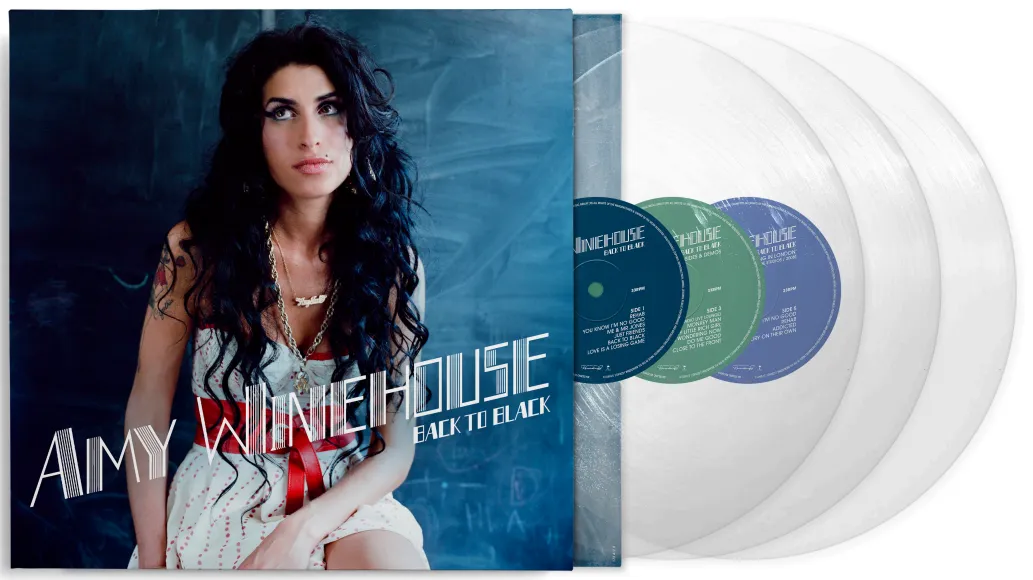
Winehouse’s key collaborators on Back to Black were Salaam Remi, who produced and co-wrote roughly half of her strong 2003 debut, Frank, and Mark Ronson, a DJ who was still new to producing when he connected with Winehouse in 2006. Early on, Ronson created a rough sketch of Back to Black’s title track and enough retro ’60s splendor shone through for the girl-group-obsessed Winehouse to decide she wanted her whole album to sound like it. Eventually she started using vintage microphones and recording to analog tape. Unifying the sound required returning to Remi to rework songs they had already laid down, including “Me & Mr Jones” (initially known as “Fuckery”) and “Tears Dry on Their Own,” which was much slower in its initial version. Both demo versions appear for the first time on the 20th anniversary edition, and help chart the album’s evolution from a neo-soulification of the boom-bap hip-hop Winehouse sung over on Frank to the retro flair of Back to Black’s final form. Unfortunately, listeners are left to put these pieces together themselves as the liner notes are little more than pithy (but affectionate) reminiscences from Ronson and Remi. Regardless, these original versions alongside Rhodes-heavy, ultra-smooth B-sides “Do Me Good” and “Close to the Front,” not only display how the album could have sounded, but also Winehouse’s stunning versatility.
Winehouse handily navigates this pastiche that marries the oldies (Motown, wall of sound, doo-wop, a smidge of surf rock) with a contemporary approach to the low end. Her influences couldn’t have been more blatant if she had tattooed them on. She sang with the clarity of Dinah Washington and the emotional nimbleness of Sarah Vaughan. She could make her voice sound like a horn, in the style of Billie Holiday, and deliver the kind of melisma that Lauryn Hill had patented, limber but controlled, the notes bending just enough to maintain the mood without letting you forget that she could go all out if necessary. It was all finished with a swagger that owed more to hip-hop than anything else.
Winehouse was sometimes criticized for appropriation, perhaps most famously and convincingly by Daphne A. Brooks, who referred to Winehouse in The Nation as “the retro-soul [Al] Jolson in a dress,” writing that she had created “a record about a white woman wanting to be a Black man—and an imaginary one at that, stitched together from hip-hop and bebop and juke-joint mythologies.” Winehouse piled on melisma like the hair on top of her head, and her runs could defy logic. But her extra-ness was an aesthetic choice and a consistent one. The iconic Winehouse look—the heavy liquid eyeliner, that beehive, the tattoos—was gloriously tacky. If her voice was, too, it could be interpreted as a challenge to hear beyond the adornments and into her soul. She reveled in artifice and yet was unmistakably authentic: both a “soul singer,” scare quotes and all, and a performer capable of imbuing her pop songs with aching reality. It was hardly a surprise when rappers embraced her as a friend or collaborator: Jay-Z, Nas, Ghostface Killah, Mos Def. Well versed in the art of reference, Winehouse would make clear that she lived what she sang on a dogmatic level.
As a Frank Sinatra disciple, it was only appropriate that both albums Winehouse released in her life were breakup albums—Sinatra invented the form with his tear-stained 1955 masterpiece, In the Wee Small Hours. The breakup album in its purest form is a work based on a real relationship that contains at least a cycle of songs related to that relationship’s dissolution. Not every song must concern the breakup or adjacent issues, but it should have an unmistakable presence on the album. Most of Back to Black’s songs either are about Fielder or seem to be, and the ones that aren’t couldn’t possibly be deleted. Take away “Me & Mr Jones,” a song about Winehouse’s love of hip-hop (Nas is the title’s Mr. Jones), and you remove one of the album’s signature couplets: “What kind of fuckery is this?/You made me miss the Slick Rick gig.” Subtract the last song, “Addicted,” about Winehouse’s roommate’s boyfriend smoking all her weed, and you throw off its beautiful symmetry with album opener “Rehab.”
The 20th anniversary set includes a stripped down, cooler-sounding demo of “Rehab,” the song that catapulted Winehouse to worldwide intrigue, but the original is as lovable as ever. The Dap-Kings, who played on many Back to Black tracks and became Winehouse’s touring band, fire on all cylinders here. “Rehab” features some three dozen instrumentalists, including a string section, as it breezes through the belly of the beast. It’s an infectious, uptempo number about a crisis, driven by handclaps and a honking baritone sax riff. It’s like the music is breaking the fourth wall and proclaiming, “What a gag!” Tonally, this sense of irony rhymes with that of the album’s repeated pairing of ’60s sounds with contemporary attitudes and slang, like when Winehouse sings that Fielder “kept his dick wet” in the title track. Back to Black often has the effect of someone telling a vivid, ethically dicey story about her thoroughly modern life while an oldies station plays in the background. It doesn’t provide warmed-over nostalgia, but a kind of postmodern tinkering where each constituent sensibility works to highlight the strengths of the others; it practically defined the no-skips album for the aughts.
Because breakup albums tend to be about real relationships, they represent the platonic ideal of diaristic songwriting. They collapse the boundary between writer and narrator in a way that stan culture glorifies. “If I haven’t done it, I just can’t put it into a song. It has to be autobiographical,” said Winehouse. Finding the life behind the song in her work requires little effort on the part of the listener. Through her music and public persona, Winehouse donned her experience in a way that made her soul and, yes, soulfulness undeniable. Her former manager Nick Shymansky said that Winehouse’s writing was probably “the only part of her that was truly confident.” Winehouse was all of 22 or 23 when she wrote “Love Is a Losing Game,” but she sounds deflated by decades of heartache in lines like, “Memories mar my mind/Love is a fate resigned.” A previously released demo of the song, featuring a solo Winehouse tentatively strumming it on the guitar as if she’s coming up with it on the spot, appears on the anniversary set. The desolation of this stripped-down iteration is infinitely more poignant than Ronson’s glammed-up final spin on it.
Back to Black is the epitome of pop nonfiction, and it bridges the specific and universal in a virtuosic way that few breakup albums in its wake, even the very good ones, have managed to do. It is also the rare breakup album about a couple that ended up getting back together. Back to Black was released October 27, 2006, and by the following March, Winehouse and Fielder were publicly an item again. It wasn’t until after their May 2007 marriage that they began using heroin and crack together, according to Fielder. The decline was obvious and further exacerbated with Fielder’s arrest in November 2007 and subsequent imprisonment. Winehouse spiraled, sometimes onstage.
Before all that, she played a gig in Amsterdam on February 8, 2007, presented in full on the third disc of the CD release. Winehouse was in good voice and spirit, backed by the band that typically played her European shows at the time, directed by bassist Dale Davis (i.e., not the Dap-Kings). It’s a fairly straightforward runthrough of Back to Black, with some Frank gems and a cover of the Zutons’ “Valerie,” a future Winehouse signature, thrown in. Though the band is loose and prone to vamping, particularly on the reggae-kissed “Just Friends,” these live renditions are faithful to the recordings. Winehouse would go on to bend and stretch within her songs as she performed them through the years—she had a finite list of material she could pull from, especially since most people were showing up to hear Back to Black. She eventually got sick of her songs, according to father Mitch Winehouse’s memoir. She would at times delete the most desperate of the Fielder-related songs from her setlist—“Wake Up Alone,” “Some Unholy War,” and “Back to Black”—because they were too hard to sing. “To sing it good, I’ve got to think about how it felt at the time,” she said. “By the end of it, I’m always half in tears… personal songs, innit?”
The Amsterdam show was previously released in part on a Dutch special edition of Back to Black and, besides “Addicted,” it has been available as a soundboard-quality bootleg online. It’s nice that this recording, some B-sides, and the new demos are now streamable and available in one place on physical media (though the vinyl edition is slightly truncated). But this 20th-anniversary package is rather sparse in its brand new offerings—just five previously unheard tracks, and a lot of old covers that have already been available, like Winehouse’s rocksteady version of Sam Cooke’s “Cupid.” Winehouse claimed she had “loads” of leftover material from the Black sessions, and, around the time of the release of the posthumous compilation Lioness: Hidden Treasures, Salaam Remi revealed “a lot of things she wrote and laid down that haven’t been released.” The demos she worked on for the planned Back to Black follow-up, however, were destroyed, per former Universal Music UK executive David Joseph, who told Billboard, “Taking a stem or a vocal is not something that would ever happen on my watch. It now can’t happen on anyone else’s.” That’s great, but it also reminds us that a void can never be filled. Maybe the Back to Black 20th anniversary edition is wise for not even trying.