 Written by
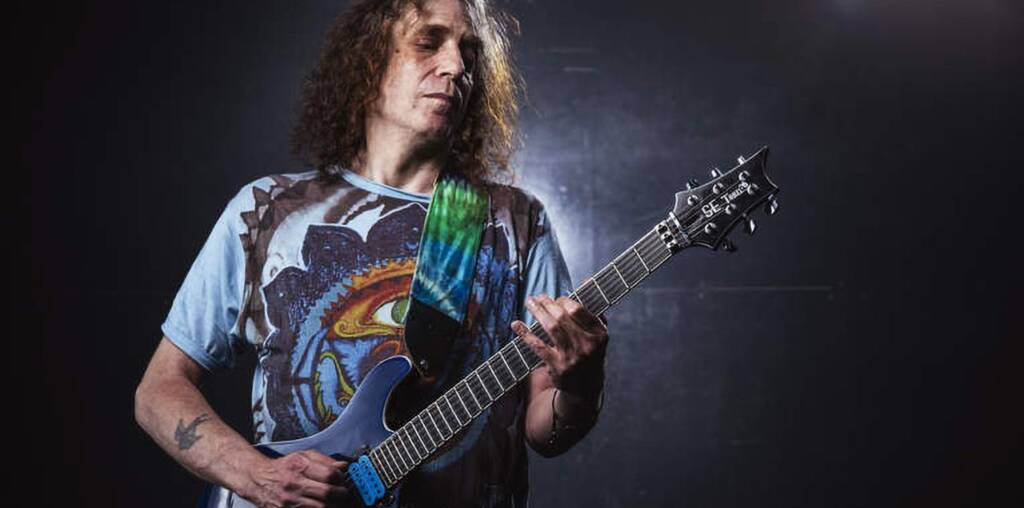
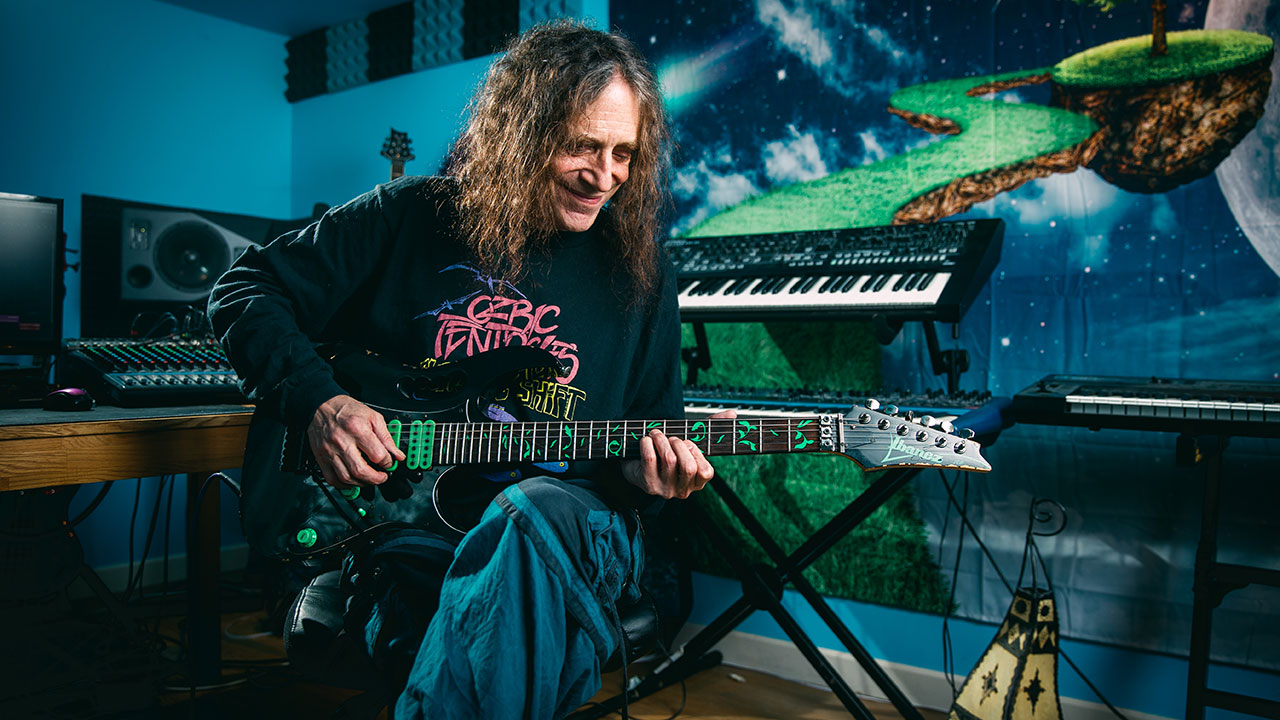
After 2019’s exploratory excursion into a solo career with Shimmer Into Nature, Ed Wynne resurrected Ozric Tentacles in 2021 with Space For The Earth, the band’s first new material in half a decade. He told Prog what had changed and what had stayed the same.
Can you remember the first Ozric Tentacles gig?
It was at Stonehenge Free Festival in 1983. I had just left school. I bumped into a load of people and they said, “We’re going to this festival. We’re gonna hire a generator. Bring your amp and guitar and we’ll see what happens.” So we went down there and set our camp up, made a little fire, got the generator on and chugging away. After half an hour I looked up and there were 100 people there. Half an hour later there were 500. I thought, “Blimey, we’ve got a gig going on here.” Someone came up to me and said, “What’s the name of the band?” And I just said, “Well, Ozric Tentacles is what it’s called today. I don’t know what it’s gonna be called tomorrow.”
Latest Videos From Louder
Were these freeform jams?
We didn’t really have any tunes at that point; we were very used to jamming. It’s kind of where the whole thing came from: freeform, just for the enjoyment of the moment. I remember Joie [Hinton] set up his keyboards and said, “What do you want me to do?” I just said, “Make some swishing noises.” So off he went – and it was brilliant. All those synthesised textures we were hearing in our minds were suddenly right there.
After that you started writing tracks and making cassettes. You became a little cottage industry, didn’t you?
Yeah. It was literally a question of getting enough tunes together and buying a pack of 20 cassettes and copying one by one, photocopying the covers and folding them up and putting them in a box. They were £2.50 each.
The first gig I went to with those, I crouched down at the end of the stage after the gig and said, “Anybody want a tape?” And they went within a few seconds. Every week became taken up with copying and making cassettes for the gig at the weekend.
To what extent are Ozric Tentacles a band rather than Ed Wynne and friends?
I’m kind of at the controls, I’m the filter it all goes through. It always has been a little bit like that. It was me sitting in my little home studio, a little bit like what I do every day anyway, but then there’s a floating body of people who came and went. We were all involved in it but it wasn’t like a solid line-up of a band. Whoever happened to be there at the time got on the track.
Some of those musicians have guested on Space For The Earth. How did that come about?
I’ve got their phone numbers so I just give them a ring! It was nice. I wish there could’ve been more involvement with those guys. John [Egan]’s on one track, Joie’s on one track. If I’d been able to have them here in my studio there would’ve been more of a general band feeling. In a way these old members have their track. The one with John Egan is lovely, actually. It turned out to be very different to what I expected. He gave it a certain Celtic flavour. John’s from Ireland so he definitely has that in his blood. He was almost apologetic. I gave him the track and he phoned me up and said, “It’s coming out a little celtic here. Is that okay?” And I went, “Of course it is. I live in Scotland, you’re from Ireland. Why not?” It’s nice to have that feeling. I’ve not had so much of that on Ozric albums before.
World music in general has always been integral to your sound. Is there any particular culture’s music you feel more drawn to?
I go through phases. When I was younger I used to love Indian music then I heard a bit too much of that; so now it’s there for when I need it. I like to add a little piece of this and that. We used to call it ‘ethnological forgery’ – pretending we were these people playing amazing ethnic music when in fact it’s just synthesisers or whatever.
I’d seen weird photos of Gong, so you always imagine they’re really weird people. Instantly it was absolutely fine. They have this lovely philosophy about them
Last year you made a solo album that was very well received. What made you want to do Ozrics again?
The solo album was something I’d been wanting to do for a long time. Not that it turned out that much different to Ozrics really but I enjoyed doing my own album with my own ideas. I don’t have to see what everybody thinks. It was good for that but then I just suddenly felt I wanted to get back and do another Ozrics album.
How did the new one come about?
The idea before the Covid lockdown was that we would get together and do a proper album with loads of us in the studio jumping about, enthusing mutually and all that but then this lockdown happened so therefore it came out as a slightly different thing. It was still good but I do miss being able to sit in the studio with somebody and say, “Is this a good idea or not? What do you think I should do here?” So I was kind of back to my own devices really.
The idea with an Ozric album was to get back into the band mentality a little bit; then suddenly with lockdown you’re not allowed to see anybody – you have to sit and do it on your own. It was almost like I was doing another solo album, but as much as I could I was getting involved with other people from earlier versions of the band.
Your first ever solo gigs were opening for Gong, who have been a huge influence on you – so how was it?
It was really nice. I was nervous, I hadn’t met any of that particular incarnation of Gong before. I’d seen various weird photos of them so you always imagine they’re really weird people. Instantly after I said hello it was absolutely fine. These are lovely people. Of course they are ’cos it’s Gong! They have this lovely philosophy about them. I felt very safe from the moment we started talking. Mutual respect and a really good feeling. Every morning we’d stumble into the venue and we’re all very happy to see each other, full of good energy. I’ve never experienced anything like it.
You’re remastering a lot of the back catalogue. Was it a weird feeling revisiting those albums?
Extraordinary. I expected to be thinking, “I’ll go anywhere that needs tarting up and I’ll EQ or top it or whatever,” but when I put it on and started listening it was like opening a photograph album. Each song was a moment in time, a week’s worth of time. I’d put them on and suddenly I could remember the situation of sitting in the studio, what was on the walls and what was going on at the time, who was around. It’s really like a little diary for me, these tunes. It’s extraordinary. I hear a little blip in the corner of the music and I remember, “Oh yeah, that was when someone came and switched the light on at the wrong moment.”
Song titles have always been a problem for me. That’s probably why they’re so weird
What has the feedback been like?
People seem to like them. I’m really happy about that. It’s my first foray into the remastering world and people really do seem to have noticed that I’ve done something because often I imagine people remastering doesn’t make that much difference. I’m happy people notice. I spend a couple or three days on each one to get it right.
As you revisited them did you find you had a personal favourite?
Looking through the entire catalogue I would say the ones that stand out for me are Sliding Gliding Worlds [1993] and I also really like Pungent Effulgent [1989] because that was our first excursion into the real world of finally people taking us seriously. Slightly. For me they all have their amazing stories. It’s more to do with the feeling of the time and what was going on rather than the actual music.
Is there anything you would change about those albums?
When I listen back to some of them I often find they’re way too quick, the tempo is too fast, especially Paper Monkeys [2011], which was good fun at the time but listening back to it it’s cruising along. We try to play it live and it’s really exhausting stuff. Sometimes in the studio I tend to speed things up to keep the excitement going for my own personal interest so I’ve got to remember other people are hearing
it for the first time.
Lost In The Sky from Paper Monkeys became a live favourite, didn’t it?
Live, it always freaked me out, because the bassline when it came in was so strong. I was really happy with the chords at the beginning of that one. That was written underground in a house in America that I lived in. I was in a basement with a huge fish pond in the corner of the room so the whole thing was this slightly damp atmosphere and slightly fishy-smelling studio so Lost In The Sky was me trying to escape that.
Where do the bizarre song titles come from?
Titles have always been a problem for me. That’s probably why they’re so weird. I use Cubase to write and if you come up with a new little ditty and want to save it the first thing it asks you for is a name so before the track’s written you have to come up with something. Often these become the title.
The last album, Technicians Of The Sacred was a double album. Space For The Earth is half its length. Was that a conscious reaction or just how it fell out into Cubase?
I said, ‘What would it take to make the cover out of hemp?’ He arranged for truckload of marijuana to be imported
The thing with double albums is it’s like making two album – it’s twice the work. Incredibly hard. I forgot that I felt that with Erpland [1990] and then three-quarters of the way through Technicians Of The Sacred I suddenly thought: “I’ve got this huge pile of music to do.” It’s a lot of work to make a double album consistently make sense. It was nice to make a little album again, explore a little deeper and not scrimp over the details. Again, a good aspect of the lockdown was that I had time to explore with nobody hassling me about anything else, so I was just completely in that world.
Jurassic Shift was nearly a UK Top 10 album in 1993, peaking at 11. What was that time like?
It felt great! It was a really good feeling. Very exciting. For instance I’d be with our bass player Zia [Geelani] at some party and these young kids put on Jurassic Shift. Zia said, “Look at these kids. They don’t know we’re here and they don’t know what this is but look they’re all jumping about to it and loving it.” It was really nice that it was that available.
Jurassic Shift caused a stir because of its hemp packaging. Who came up with that idea?
It was through a friend of mine called Pete Messenger. He told me he was making hemp-based products and I said, “We’ve got an album coming up. What would it take to make everything out of hemp?” He got back to us a couple of weeks later and said he’d found out how to import a load of hemp from Europe. He arranged this whole truckload of marijuana on behalf of Ozric Tentacles to be imported into the country. He found a mill that used to make hemp paper, but they didn’t have the same blade to cut the stuff up with.
So he ordered a new blade to be manufactured and installed into this old hemp factory, got the machines chugging away again and managed to make this lovely paper and brought a sample round. We had a look at printing on it and it was perfect and there you go. We had our hemp thing. Because of that the Hash Marihuana & Hemp Museum in Amsterdam have a copy of our CD on the wall [with a plaque stating], “Here’s the first CD made with hemp paper.” Great! We’re in a museum!
It could’ve gone either way at that point. I did a solo album to say, ‘Look, I can do this with or without a band‘
Did chart success present new opportunities to the band?
A lot of bands at that point would say, “Okay, we’ve got to this point with our own record label” [Dovetail Records at the time] and tried to jump onto a major label. For some reason we didn’t do that. I don’t know if that was a good or a bad thing. Maybe it’s a good thing because we kept our individuality and slight humility. Maybe if it’d gone ballistic we wouldn’t still be doing it now. Who knows? Things fall into my lap and I just have to take them on board. The way the world seems to swerve, I try not to resist too much. Keeps me slightly sane.
You played in front of thousands at that time at Reading and Glastonbury. How was that?
We played the NME stage one year [Glastonbury, 1993]. That was incredible. Ridiculously huge. A sea of people to the horizon. Glastonbury was crazy because I got there half an hour before the gig and I was at the wrong side of the backstage area so I had to worm my way to the front, rattle on the fence and shout, “Let me in! I’ve got a gig.” They’re like, “Yeah, yeah, mate. Sure.” Thankfully I saw somebody I knew and got onstage in time. It was looking dodgy for a second.
In 1994, Joie Hinton and drummer Merv Pepler left to concentrate on Eat Static. Was there ever a point when you thought the band can’t continue?
When Joie and Merv left it wasn’t possible for us to split up because we had an American tour two weeks after that. It wasn’t a question of whether that was the end of the band. It was like, “Oh my God, we’ve got to find a bloody keyboardist.” Luckily enough we found a perfect replacement so we got away with that. I’ve never thought to end Ozric Tentacles, except perhaps after Technicians Of The Sacred, where I really needed to get out.
It could’ve gone either way at that point so I did a solo album as a thing to say, “Look, I can do this with or without a band.” With the Covid situation again I was wondering what’s gonna come at the end of this. We’re all still wondering a bit about that but I think Ozric Tentacles has become my identity and it’s probably a little late to try and alter that too much at this point.
How have you managed to stay so prolific for nearly 40 years?
Pretty much all I do is make music or gig music. I’ve nothing else to do so I’m working on a conveyer belt of spacey tunes.