 Written by
In the early 2010s, if you spent any time in the greater Boston area, in the places where overeducated, underpaid millennial rock fans congregated, you were liable to hear a rallying cry: Krill forever! The cri de coeur was pulled from the band’s quasi-anthem, “Theme From Krill,” a track that exemplified its approach: existential, ramshackle songs filled with oblique takes on ethics and morality, all filtered through singer and bassist Jonah Furman’s insistent, nasal voice. Krill’s off-kilter references reached from Kierkegaard to Boston’s public transportation system; their songs posed high-minded philosophical questions (“What’s the proper orientation of my self to my non-self?”) and imagined what it’s like to feel, literally, like a piece of shit. Indie rock has long had a neurotic contingent, but I always admired the way Krill turned that anxious spiral toward larger moral quandaries. If you, too, were attuned to the weary breakdown of the world around you, if you also felt obsessed with questions of righteousness and justice, Krill’s tangled riffs were a worthy companion inside that maze of unsolvable problems. Their songs even offered a sense of humor about the hopelessness of it all.
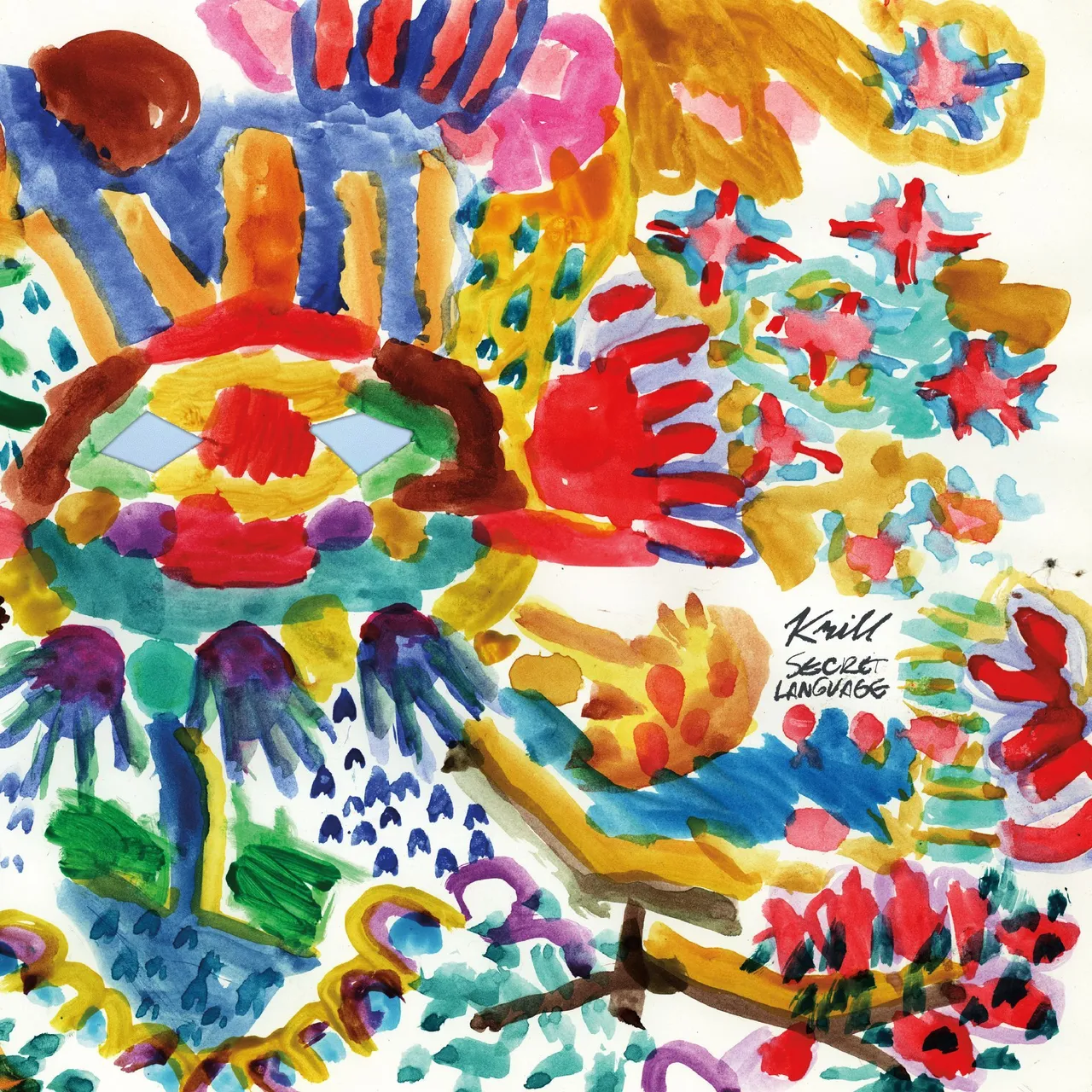
Krill released three albums and a handful of EPs, achieving cult status within the northeastern indie-rock scene. But eventually, opining about moral responsibility from within a band started to feel futile. In 2015, Krill broke up, and the members took jobs more directly aligned with their values: labor organizing; public housing; civil rights law. For his part, Furman says he had also simply run out of things to say: “I felt I had expressed myself,” he put it in a recent interview. “I hadn’t lived enough to say more.” Years passed; members moved from city to city; a series of nauseating presidential elections made the stakes of their new jobs seem (I can only assume) increasingly dire. And after some more living, Furman returned to songwriting; as it turns out, he had more to say. The result is Secret Language, Krill’s first new album in 11 years. Part reunion, part reevaluation, it considers questions both weighty and intimate with the wisdom of time and distance.
No score yet, be the first to add.
Secret Language doesn’t exactly sound like the band picking up where it left off. (For one thing, the band already picked things back up, sort of, reconfiguring their lineup, adding a guitarist, and releasing a self-titled album as Knot in 2020.) Furman’s sauntering basslines and Ian Becker’s drumming—which can tightly punctuate the vocal melodies or inject chaos into a song’s climax—are carried over from Krill 1.0. They’re joined by a new guitarist, Andrew Clinkman, who often prefers guitar parts that chug or sprawl over the band’s usual wiry, jittery riffs. Secret Language also features additions that would have felt out of place on previous Krill records: vocal harmonies, violin, and saxophone, performed by members of local bands in Chicago, Krill’s new home base. If the group’s earlier music captured the claustrophobia of young adult neuroses, this new sound feels more grounded and reflective.
That feeling threads through Secret Language’s lyrics, which contemplate the passage of time and the rewards of commitment. Furman doesn’t entirely abandon the self-loathing (“Hawaii”) and visceral metaphors (“Snails”) of Krill’s earlier work. But several songs consider what it means to re-engage with this band (“I have said what I have to say,” Furman murmurs on “Commemorative Plaque,” “I don’t know what any of it meant”). The closing track functions as a reprise of “Theme From Krill,” proffering a sort of justification for Secret Language: “A decade passed,” Furman sings on “Theme From Krill 2.” “Thought I had better things to do/Everything I hated about myself was Krill/But everything I liked about myself was Krill, too.”
Secret Language’s most moving moments come during odes to Furman’s family. On “Karst Fenster,” he uses the titular geological feature—a porthole into a sinkhole—as a metaphor for wishing he and his beloved could peer inside each other’s skulls, to completely comprehend the inner workings of each other’s minds, before he’s played out by a skittering sax solo. On the title track, he sings about reading Goodnight Moon backwards to his kids; then, once the kids are asleep, he describes being alone with his wife: “You are my radio/My guitar/The wanting sound in my throat,” he sings, swooning harmonies and violin beneath him, reveling in an unconflicted sweetness that’s new for the band.
The album’s shift in perspective feels crystallized on “Dominate,” a song about two television spectacles Furman watched growing up—the Chicago Bulls and America’s war in Iraq—that could indelibly shape a young mind’s understanding of power and might. By the song’s end, we’re considering the forces of history and empire over two winking interpolations—one of the theme song for NBA games on NBC, the other of the ’90s Bulls entrance music. “It takes a village to burn down a village/It takes your guts out and with them suffocates you,” Furman warns. “And in the lake of fire, justice awaits you.”
That last line kept rattling around in my head when I first heard it; the finality and assuredness of its dark optimism felt surprising in the realm of Krill. Secret Language isn’t an album about a world that is much better, or fairer, or more equitable than the one in which Krill disbanded. But they all “lived enough to say more” and wound up with a profoundly hopeful message: that retribution is coming for evildoers; and that, in the meantime, comfort and love are available to those who genuinely seek to build something better.