 Written by
Share this article
Join the conversation
In 2016 former Marillion vocalist Fish confirmed he was beginning to wind down his musical career. Even though it would take longer than he’d expected, his announcement was the ideal opportunity to look back on what he’d achieved over the previous four decades, including his earliest days, his first artistic ventures and Marillion’s faltering steps towards success.
When did music first become a major part of your life?
I remember singing along to Hey Jude when I was at primary school, but it was in high school that I really got into music – Emerson Lake & Palmer, Genesis and the Floyd. Progressive rock was my thing. And because I was the sensitive kid who spent most of his time in an attic room listening to records, I got into the words.
Could you play an instrument?
No. I was rubbish at music. At school I played the recorder and I couldn’t get a tune from it. When I was 11 I tried guitar. I thought you just picked it up and songs came out. When I realised it needed all this work, I was despondent, in tears. Then my dad bought me an accordion, for fuck’s sake! That’s when I decided I was never going to be a musician.
But you still fancied yourself as a singer?
I did after I saw Rod Stewart and The Faces on telly. Rod was obviously pissed and having a fantastic time. I thought: “That’s something I could do!” So that was my dream, singing along to the mirror in my bedroom.
When did you first get up on a stage and sing?
I was 21 when I did my first ever gig, at the Golden Lion in Galashiels, singing covers – Steely Dan, Aretha Franklin. That was in 1980. I met up with Diz Minnitt, a bass player. We tried to set up a band up in the Scottish borders.
And then in 1981, we saw an ad in a music paper from a band in Aylesbury that wanted a bassist/singer. The band was Silmarillion. We convinced them to take on a separate bassist and singer, and the rest just fell into place.

Were you apprehensive about moving south, away from home?
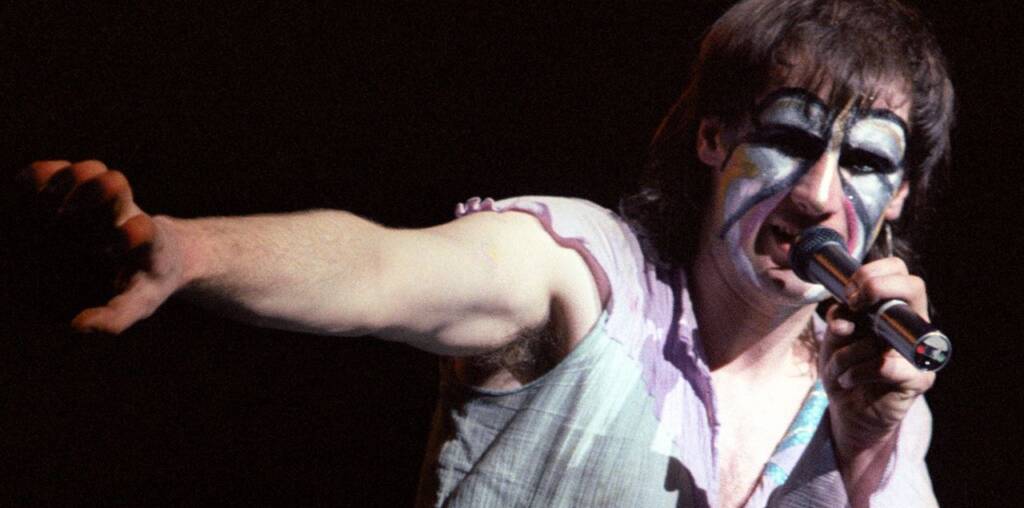
Oh no – it was an opportunity to reinvent myself. In a new place I could be whoever I wanted to be. I’d picked up the name Fish in 1979, and with that name, and the make-up I’d wear on stage, I was able to build up my confidence.
What did the band sound like before you joined?
I thought they were a lot like Camel. It was very clear to me that Steve Rothery was a brilliant guitarist. And they had no lyricist, so I said, “I have lyrics…” I already had the idea for Script For A Jester’s Tear. I was a big fan of The Who, and when Keith Moon died, I wrote a whole set of lyrics on that theme.
Tony Smith, the manager of Genesis, said if he’d known about Grendel he would have sued us!
At what point did you realise the band had something special?
I knew it from the first rehearsals. It was an incredible feeling, singing your own words with a bunch of guys who all had a similar taste in music. We were all brought up on those 70s progressive bands, but the Genesis influence was the most powerful – the one in the Venn diagram that brought us all together. We talked music all the time; there was a great energy between us.
Debut single Market Square Heroes was released in 1982, featuring the epic 17-minute Grendel as the B-side. Was that your attempt to out-prog Genesis?
Not consciously. We just thought: “Let’s write a big, long song, because that’s what progressive rock bands do.” But yes, it was very, very Genesis-oriented. Basically it was Supper’s Ready. The music came from a song that Silmarillion had, The Tower. The lyrics were inspired by John Gardner’s book Grendel. Steve and I put the song together and it just swung into that Supper’s Ready thing.
Many years later I spoke to Tony Smith, the manager of Genesis, and he said that if he’d known about Grendel back then, he would have sued us!
Did it hurt when critics branded Marillion a poor man’s Genesis?
It used to irritate me at the start. But now, yeah, I can hear it.
What do you hear now in Script For A Jester’s Tear?
I hear somebody singing in very bad keys! Sometimes I don’t even recognise the guy on that album. That high falsetto voice was very forced. But I was young – I didn’t understand anything about music and keys, and I was singing very high. When I think now of singing like that, six nights in a row… fuck that for a game of soldiers!
Bad singing aside, what else do you hear in that album?
I hear the youth, the naivety and the aspiration in it all. Across that album and the next one, Fugazi, you can hear us trying to find our own style. Don’t get me wrong, those are two wonderful albums. But I think Misplaced Childhood was the marker for us, not just because it was a hit, but also because we found ourselves.