 Written by
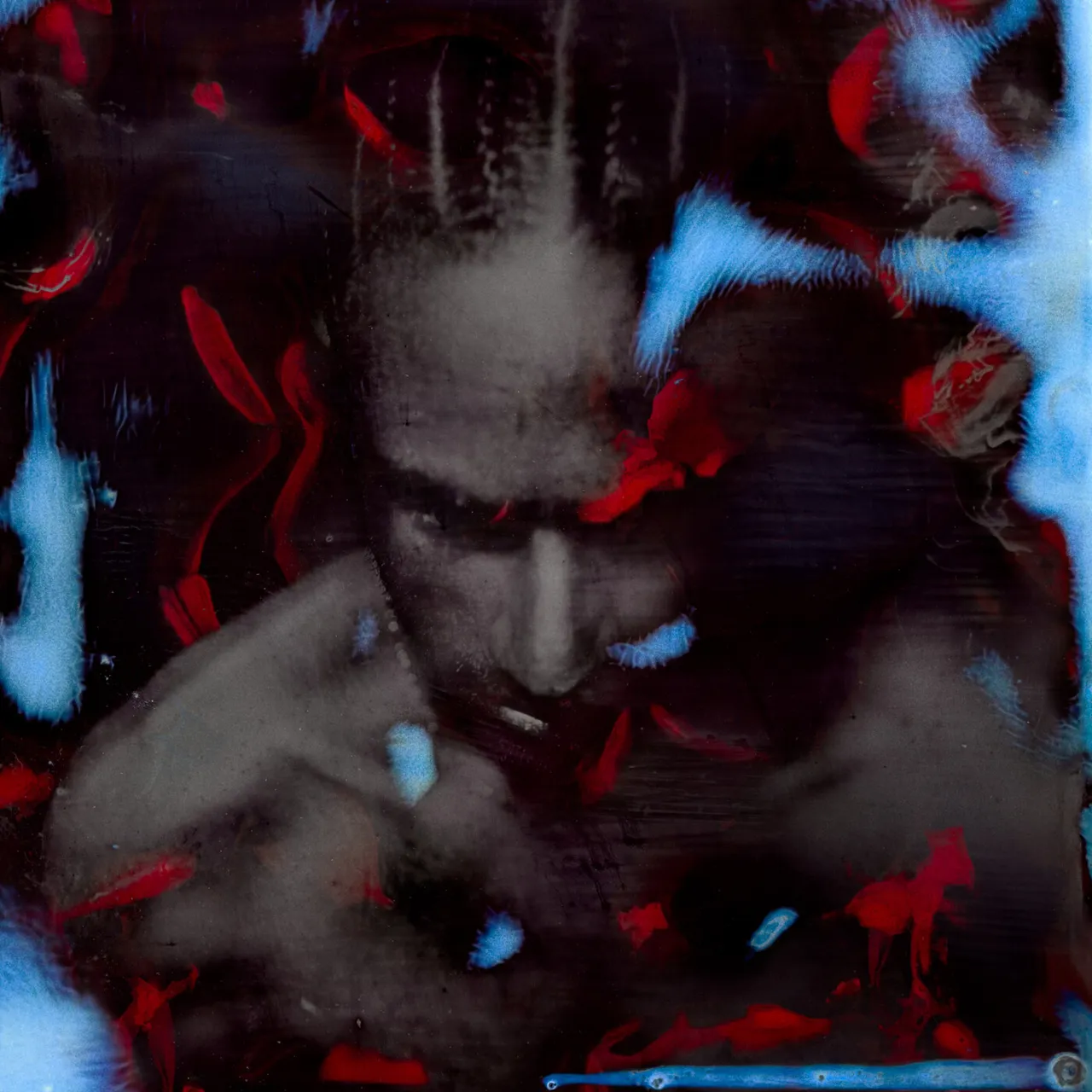
Shortly after moving to Baltimore three years ago, Ian Mugerwa, who records muted and experimental R&B under the name Dawuna, suffered a traumatic brain injury in a car accident. Effectively bedridden, he was unable to make music for a year. When he did sit down to write and record what would become African Family Laptop Musick, made in his earliest recovery phases and released this past summer, then-undiagnosed amnesia meant he was only able to commit fragments of it to memory.
Where that release was a refashioning of the creative groove, a semi-conscious catharsis, Love’s Arp, his fourth album, is a more intentional and considered record—one almost impossible in its ambition. It is a self-conscious attempt to place himself on a continuum of Black music, from spirituals through to R&B, and to present a roadmap of future-soul marked with what he calls “diasporic twists.” But for all of its nods to diasporic traditions and explicit references to wildly extroverted music from history, Dawuna’s output since that accident is often remarkably quiet, as though all that history is being filtered through a thick membrane of cerebrospinal fluid.
No score yet, be the first to add.
It’s only on the album’s fourth song, “Love Jaunt,” that the skin of an acoustic snare drum spits through the mix, and it’s another half-hour after that before it happens again. For all that the first single “Love’s Ekongo,” with its beautifully arpeggiated thumb harp, suggests space and light, “Love Wants a Family,” the following track, falls back inside. The percussion on “True” is so compressed that it sounds industrial. It’s music made at and for midnight, a rhythm still thrumming through the heart and resisting sleep. Dawuna’s voice croaks and crackles on “Love Wants a Family” and “Love Is…” as though he’s in a reverie.
He hasn’t always sounded so distant. On the deeply melancholy soul song “Govinda P” from 2024’s Naya, he sounded crystaline, voice cutting through the spartan arrangement. On the first side of Love’s Arp, the arrangement wins out over his lead vocals. His backing vocals—particularly the wordless and monastic lines that close out “Love Wants a Family”—remain prominent, Dawuna’s voice succumbing to itself. In these choices, it’s easy to hear the legacy of gospel music, the all-encompassing choirs, as many voices (even from one man) consume a soloist. But again, it seems to have been buried. If artists like Pastor T.L. Barrett were channeling the voice of God directly through human lungs, Dawuna is hearing the sound of their lungs through layers of tape fuzz and revoicing it in a dimly lit room.
The back half of the album maintains this humid atmosphere but spasms into life. “Love for Sly and Brian” is dedicated to Sly Stone and Brian Wilson—the Pet Sounds harmonies would have signposted the latter even without the song title—who died within days of each other in 2025 and clearly played on Dawuna’s mind as he made the record. But the unspoken ever-presence here is D’Angelo, who died shortly afterwards. “Be Careful II” and “Wet Sheets/Lip Gloss” (two snare drum tracks back-to-back) channel that irrepressible soul-funk, and Dawuna’s croak is intentionally sexually charged.
The slowed-to-a-stop slow-jam “Your Light” is the track worth returning to most often. Dawuna was not raised in the church—he’s described what seems like a joyless ambient Protestantism after he moved with his family from Uganda to the Maryland suburbs as a child. And here he takes far less from the gospel choirs than from Prince, who didn’t so much blend the sacred and profane as he did raise profanity to the level of sanctity. When Dawuna sings “Let’s just make love well into the night” over a joyous organ, there’s a little flicker of Prince on “Adore” (“In a word, you were sex”).
The track is the most pointed (but certainly not the only) reminder that this is an album about falling for another person—in this case, conveniently, a woman called Love. And there’s more to that than simple devotion. Dawuna shifts his voice artificially and naturally across the album, pitching it up digitally or slipping into falsetto—occasionally, as on “True,” in the same song. What he’s done here isn’t as confrontational as Prince’s gender-hopping alter-ego Camille, but his music asks the same sorts of questions about masculinity and its limitations, and he’s expressing the same desire for freedom. Heard as a work of devotion to Love and the history of Black music, Love’s Arp sounds deeply intimate and often transportive. Still, love, sex, God, death, and the long arc of history all yearn for a snare drum jolt.