 Written by
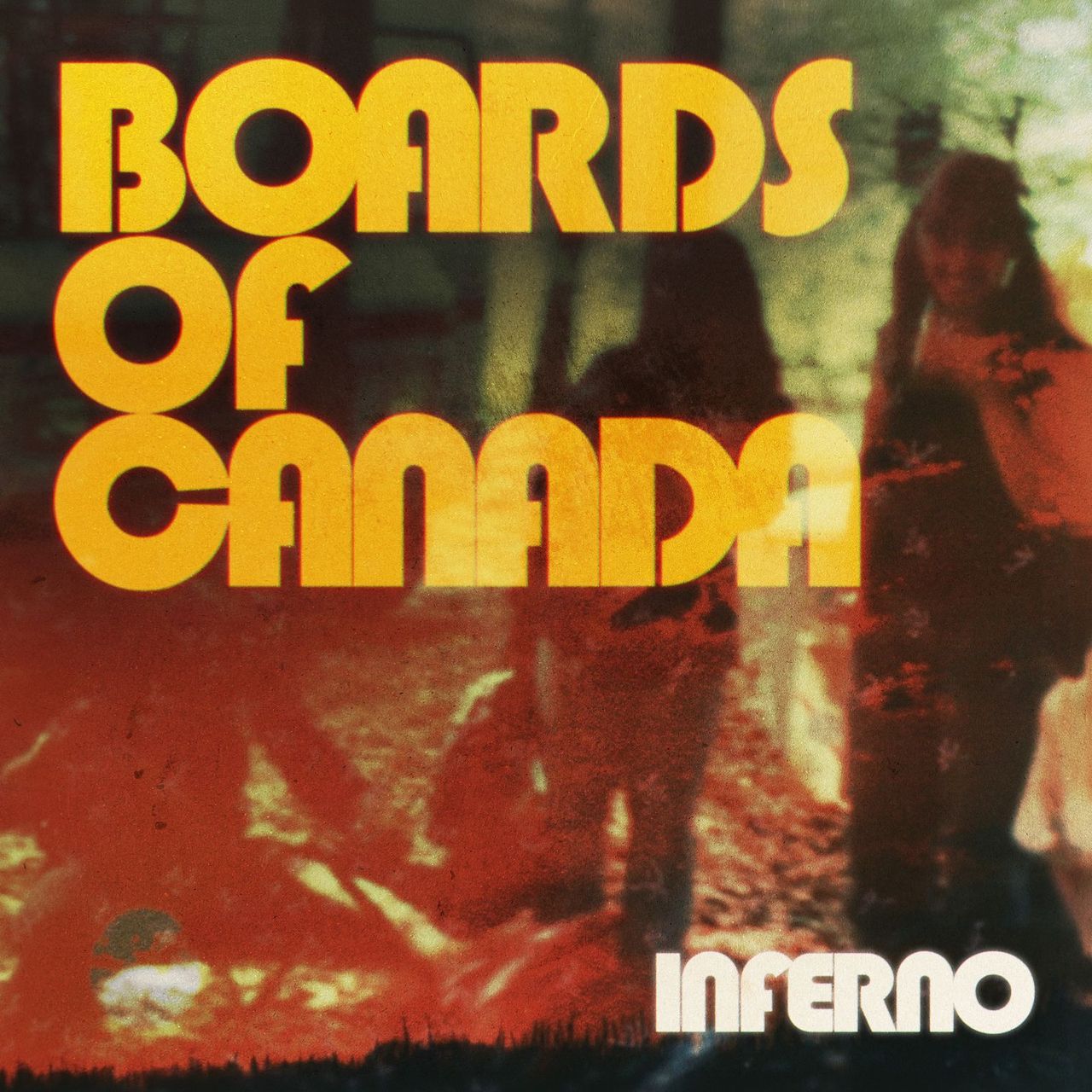
 A week before the release of Boards of Canada’s Inferno, attendees in a Barcelona arthouse cinema watched a flaming hexagon rotate slowly in the darkness while the album played back in its entirety—part of a series of listening sessions held that day in theaters, auditoriums, churches, and record stores around the world. The Barcelona moviehouse had been decorated for the occasion; the cryptic Scottish duo’s hexagonal logo was projected on the walls and spun on circular screens set into the ceiling. But even without further adornment, the venue’s sleek, modernist interior would have been a perfect fit for Boards of Canada’s retro-inspired fantasies, thanks in particular to one serendipitous detail: a hexagon motif woven right into the lobby carpeting.
In the days after taking part in the listening session, it seemed that everywhere I looked, I spied hexagons: in the graphic pattern of a passerby’s black-and-white shorts; in a tech company’s logo; in the New York Times’ Spelling Bee game; on the plastic grille covering the speakers in my car; in the geometric membranes of a wasp’s nest in the yard. Rewatching Wes Anderson’s Asteroid City, I was startled to realize that the alien’s spaceship is in the shape of—yeah, you got it.
No score yet, be the first to add.
That I should have noticed this lattice of coincidence may have less to do with any cosmic unconsciousness than with the persuasive seductions of Boards of Canada’s portentous world-building. Since at least 1998’s Music Has the Right to Children, brothers Marcus Eoin and Michael Sandison have notoriously laced their music with esoteric details that send devoted fans spiraling down rabbit holes, and perhaps no symbol holds a more privileged position in their lore than the hexagon. One of their most beloved songs is called “Turquoise Hexagon Sun”; the six-sided shape graces the cover of 2002’s Geogaddi and the center sticker of a related EP; Hexagon Sun is the name of the brothers’ recording studio and broader artistic collective. “The hexagon theme represents that whole idea of being able to see reality for what it is, the raw maths or patterns that make everything,” Eoin told NME in 2002. “We’ve always been interested in science and maths. Sometimes music or art or drugs can pull back the curtain for you and reveal the Wizard of Oz, so to speak, busy pushing the levers and pressing buttons. That’s what maths is, the wizard.”
Their wizardry has rarely felt more potent than it does on Inferno, the most welcoming and gratifying Boards of Canada album since Geogaddi. Structured as a long-form listening experience (a deluxe edition includes a single-track continuous mix of the full album), Inferno unfolds across a carefully paced sequence of peaks and valleys, alternating between punchy, rhythm-heavy chuggers and the gauzy, nostalgia-soaked interludes that are the brothers’ atmospheric stock in trade. And while no cereal-box decoder rings are necessary to appreciate the music, the album is laced with mysterious hints at a broader investigation of religious faith, human biology, and existential doubt, teasing the revelation of great secrets against a backdrop of some of the most spellbinding music of their career.
After a 13-year radio silence, of course, the first question on many minds will be, What’s changed? The answer remains, as usual: not much. The duo has not significantly altered its formula since Music Has the Right to Children, though that’s not to say its discography has delivered diminishing returns; one of Boards of Canada’s talents has always been the ability to eke out subtle variations from a relatively fixed pool of sounds and moods. Geogaddi doubled down on Music Has the Right to Children’s mix of lacerating hip-hop beats and woozy psychedelia; flush with acoustic guitars, 2005’s The Campfire Headphase carved out space for pastoral contemplation; things turned darker and muggier with 2013’s drone-heavy Tomorrow’s Harvest, their last album until now. Darkness once again shades Inferno, but the shift this time has more to do with heft and texture: The album’s palette is distinguished by its sharp lines, ultra-vivid detailing, generous dynamic range, and crisply tactile feel, especially in the rhythm tracks. If Tomorrow’s Harvest was influenced by soundtrack composers like Wendy Carlos and Mark Isham, Inferno suggests a 3D projection on the biggest screen in town, with richer colors and more dizzying spatialization than anything they’ve done before.
Inferno opens as Boards of Canada albums so often do, with a cluster of brassy, vaguely optimistic synths, a dead ringer for the sorts of abstract jingles once encountered alongside the introductory credits on VHS tapes; barely a minute later, things leap into action with “Prophecy at 1420 MHz,” whose chiseled rock beat, evolving synthscapes, and plangent guitar lead feel like the platonic ideal of a Boards of Canada song, blown up to gargantuan proportions. The title is a reference to the frequency at which hydrogen resonates, believed to be a likely signal path for interstellar communication; as the track gathers steam, a robotic voice delivers a gravelly treatise on consciousness and being: “Nothingness comes to a greater awareness of itself/The divine intellect/I am the truth, extinction… I am God, the ultimate resonance.” It’s a high-stakes bid to claim ownership of the oldest story in the book: the meaning of life.
That story appears in fragments across the album; sleuths will have a field day scouring the record for its copious Easter eggs. Over pistoning Steve Reich pianos, “Age of Capricorn” begins with a computerized voice spelling out coded references to the Antichrist (and Osama bin Laden) before a Christian prayer is intoned against a swelling choral backdrop. In “Father and Son,” the dialogue from what sounds like Ned Flanders’ favorite evangelical radio broadcast is cut up and rhythmically synced to an almost deliriously funky, quintessentially Boards-in-B-boy-mode groove. Another choppy voiceover is the centerpiece of the Geogaddi-esque crunch of “The Word Becomes Flesh,” this time a chipper educational spiel about human embryos, the kind of thing you might encounter in a middle-school sex ed class. At first, these highly specific voiceovers, with their Books-like rhythmic tics, feel jarring, but after enough repetitions, it would be hard to imagine the music without them; they function as portals you can’t quite unlock, or puzzle pieces you keep spinning in your mind.
Things get darker: “Naraka,” which pairs gleaming pads with what sounds like a sample of South Asian devotional music, is titled after the Sanskrit name for Hell. “All Reason Departs” begins with ominous fragments of a text by Aleister Crowley (“There is a magical operation of maximum importance: the initiation of a new Aeon… This bloody sacrifice is the critical point of the World Ceremony of the… crowned and conquering child, as Lord of the Aeon”) before unfolding into a low-slung downtempo cut boasting one of the duo’s juiciest toplines since “1969.” And god knows—or maybe make that devil knows—what’s happening on “The Process,” in which a garbled voice speaks of bishops and atrocities against a backdrop of droning synths, radio interference, and the din of what might be a distant riot.
The occult themes and enigmatic samples would be irrelevant if the experience of listening to Inferno weren’t so scintillating. But the elevated subject matter seems to have animated Eoin and Sandison, too; everywhere you listen, strange and thrilling things are afoot, stirring up pockets of turbulence in even the most placid passages. I keep coming back to the weird guttural undertow of “Father and Son,” where it sounds like a demon is growling in response to the chirpy Christian platitudes. In an ambient sketch given the very OPN-like title “Memory Death,” there are buzzing flies and an inhaling sound that makes me think of the old Skype log-in chime, as though some death-bringing force were leaching into our dimension through the WiFi. Throughout the album, the guitars have an unusually gothic cast, almost as though the brothers had spent much of the past 13 years steeped in the Cure’s Pornography.
More than any other detail, what stands out is the way the songs’ mazelike sequences draw you in and hold you rapt. If the duo had a weakness in its early years, it was in its tendency to get stuck cycling through endlessly repeating four-chord progressions, milking them for everything they were worth. That’s no longer an issue; even when the beats are resolutely 4/4, unusual phrase lengths—five bars, seven bars—wrongfoot expectations. Loops never retrigger quite where you expect them to; harmonies refuse to resolve neatly. Again and again, I’ve found myself counting beats and bars, trying to ascertain the tracks’ architectures, wondering if there were some meaning encoded into the patterning. I don’t really think so; a healthy skepticism is warranted in the face of the obsession that fuels discussion on Boards of Canada fan forums, which treats the duo’s music as though it were a cipher to be solved—a puzzlebox like Lost, rather than an exceptionally skillful manipulation of mood and emotion. But in the same way that the listening session had me suddenly seeing hexagons everywhere, the intricacy of Inferno’s clockworks makes me want to believe.