
 Written by
The child, if William Wordsworth is to be believed, is the father of the man. It was the poet’s enigmatic 1807 line that Van Dyke Parks first set caterpillaring into the mind of Brian Wilson, for it to emerge again—as an ethos not just of the Beach Boys, but of a generation in the throes of cultural revolution—from within the skunkworks of SMiLE. The steady trickle of those recordings into the groundwater of influence has guaranteed the album its afterlife, both as a great lost future of American music and as a central pillar in the group’s legacy. While Pet Sounds remains its unshakeable capstone, tributes after Wilson’s death last year reflected the effects of a long-gestating shift, away from the band’s earliest bubblegum hits and toward the messy, mellow years that were neglected once upon a time.
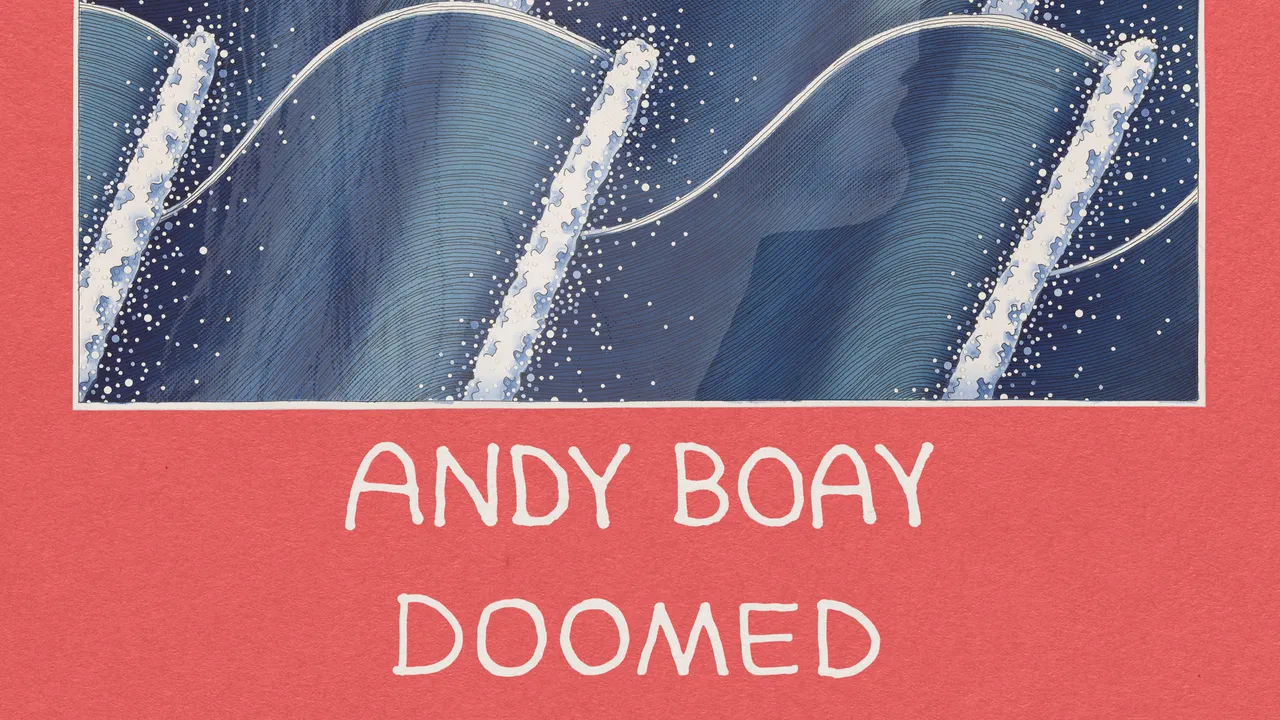
The latest album from Andy Boay, the solo project from Tonstartssbandht guitarist and vocalist Andy White, is best understood as a downstream event in this shift, though it’s free to be enjoyed on its own terms. Pulling on a long rope of influences that begins with the Wilsons and runs through British prog, bedroom pop, and chillwave, Doomed is a serene and satisfying collection which, like its forebears, makes a personal matter of universal consciousness. Buoyed by White’s stained-glass ear for melody and dappled by meticulous layers of sound, the album charts a line of flight into a rich, cinematic dimension, unburdened but never losing touch with its own idiosyncratic tradition.
No score yet, be the first to add.
Opener “Child” nests the uncanny in the familiar, a pallor of dread creeping over Mark Mothersbaugh’s Rugrats theme. White’s lyrics are bittersweet pinpricks, his keening vocals already in mourning of childhood’s end—of responsibility, of bathing yourself, in so many words, knowledge of death. “Nothing washes off this feeling,” he dialogues with himself in high and low registers. “Doomed from the very beginning.” Spare, pogo-stick rhythms crescendo on a gentle but assured motorik, then drop away all at once into the skeletal space-pop of “Riddle.” Sequenced at the center of a three-track medley, its death-dream logic deliberately evokes the SMiLE era’s dark, confusing edge.
Even among the most distinguished tracks in this knowingly suite-like album, White doesn’t resist his tinkerer’s instinct for microstructures. The medley’s closer “Runnin’ Off” previews each of the song’s interlocking melodies like gears of a watch on display, before it jumps spring-loaded to life. It’s the closest Doomed drifts toward surf-rock homage, and it’s a blast, riding a rushing lyrical stream of consciousness and swinging from hook to psychedelic hook. It’s also where, for sheer, sunny pop songcraft, White draws even with his closest established contemporary, Panda Bear.
On hiatus from Tonstartssbandht, White has transformed his solo project from a release valve for feral tape loops into an avenue for a more fully-fledged persona. His singing as Andy Boay is more distinct, his lyrics more diaristic and even self-referential. The densely woven slacker guitar groove “Fear” deals unguardedly with the anxiety that comes when love burns too intensely. “Listen to the words I use,” White addresses his subject, “I don’t want to be with you, I want to be you.” This personal touch extends to production. While Tonstartssbandht’s most recent album, 2021’s Petunia, exulted in studio perfection, Andy Boay’s sound is more handmade; Doomed was recorded on a Tascam 688 cassette deck, a piece of prosumer tech that gives his elaborate compositions a late-20th century digital sheen. The lapping, static churn of “Strangers in a Town” deploys an older, more utopian idea of digitality as a retro-futurist texture, suggesting Yes’ Jon Anderson helming Spacemen 3 toward an event horizon.
To become easily enveloped, even cast adrift, in these textures is partially the point. Were we ever meant to find our bearings in Another Green World or Future Days? Reality, for Doomed, hangs on the harmony of the spheres, a crystalline architecture with the power to dazzle—and, at times, to lull. The tightness of White’s control over his arrangements can occasionally foreclose the sense of chaotic freedom inherent to his more collaborative efforts. It’s an issue that Panda Bear has periodically dealt with and, through collaborations with Rusty Santos and Sonic Boom, managed to overcome. Then again, an exquisitely guided guitar solo on the lost FM pop of “Around the Eyes” makes a compelling counter-argument for the album’s totalizing approach. The audience with whom White is communicating knows there’s pleasure in lingering awhile, and the path he walks is no less wild for being well-traveled.