 Written by
 There’s the snatch of a moment tacked on at the close of Diablo, the rolling and tumbling second track on Deep Purple’s new studio album Splat!, that’s as good a summation as any of the general air surrounding the record. As the song ends, the studio tape is left rolling and we hear Ian Gillan laugh out loud and then shout: “I love that!”
In a split second, it’s the sound of a band quite simply revelling in the act of playing together. In the case of this one track, it’s along with guesting second guitarist Keith Urban, the country superstar and new owner of Purple’s favoured studio of late, The Sound on Nashville’s storied Music Row.
“Absolutely, we’re having a great time,” Gillan affirms, just as enthusiastically. “I couldn’t help but laugh, it was so joyful.”
Latest Videos From Louder
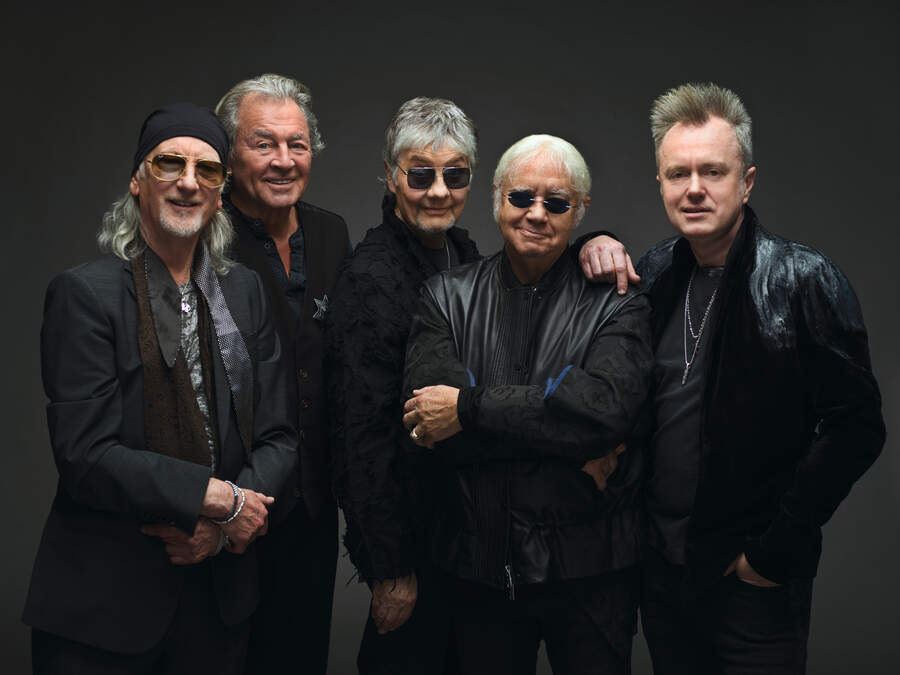
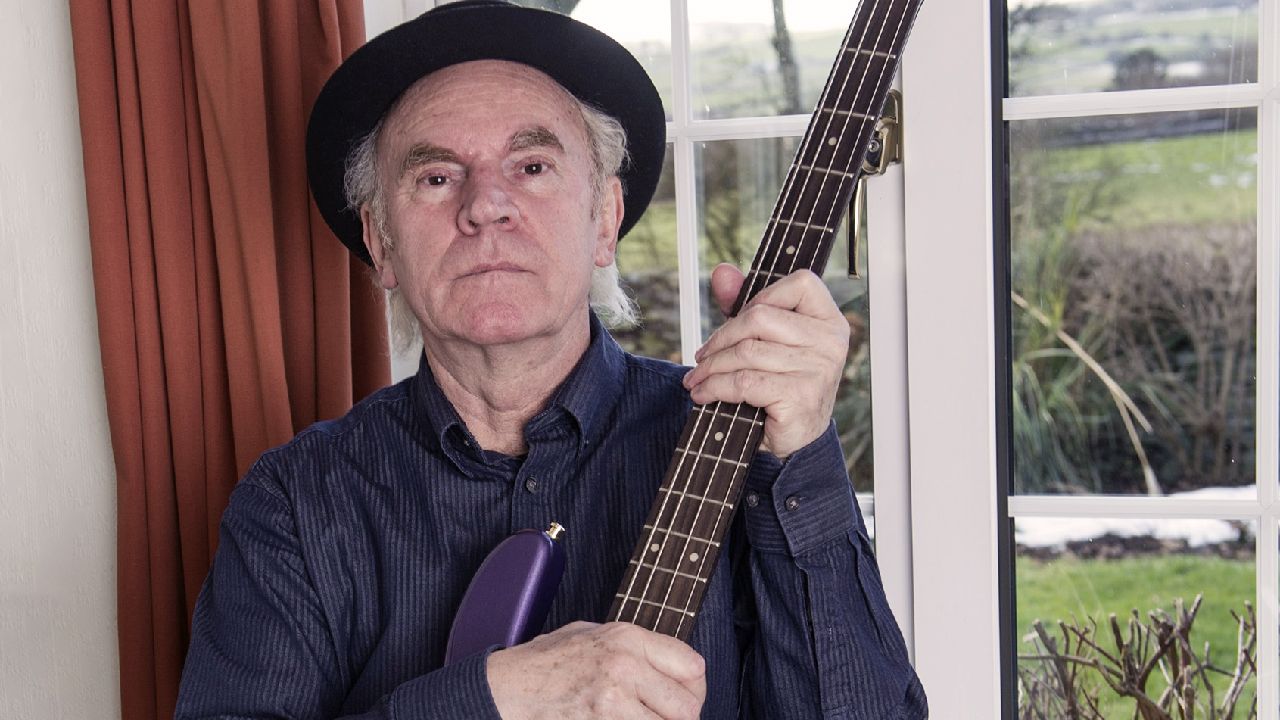
Splat! arrives relatively hot on the heels of its predecessor, =1, which was the first Deep Purple record with their new guitarist, Irishman Simon McBride, who stepped into the breach left by Steve Morse’s departure. McBride, Purple’s fourth full-time lead player, following on from Morse, Tommy Bolin, and Ritchie Blackmore – the ever-present elephant in the band’s room – is a sprightly 47 to Gillan and Roger Glover’s 80, and Don Airey and Ian Paice’s 77. McBride judges =1 to be a getting-to-know-you exercise, Splat! a more comfortable arrangement.
Altogether, they intended to make a heavier record this time around, McBride says. More riff-based, says keyboard player Airey. Something packing a punch, and as evidenced by its leaping-off-track Arrogant Boy, a band favourite, and a helter-skeltering opening gambit in the grand, right-up-in-your-face tradition of Speed King and Highway Star.
“We established the ethos of the band in the very early days,” says Gillan. “We’d all been around the block a little bit and we decided we’d do everything we could to avoid being fashionable. In other words, anything contrived.”
“We’ve always tried to be leaders,” Glover adds. “And mostly, I think we’ve succeeded. We’ve not followed trends, but for a bit in the eighties with recording techniques and when samples came into power. “The first time I listened to this album all the way through, I thought how it didn’t sound like anyone else. Especially lyrically. I can’t imagine anyone writing anything like it.”

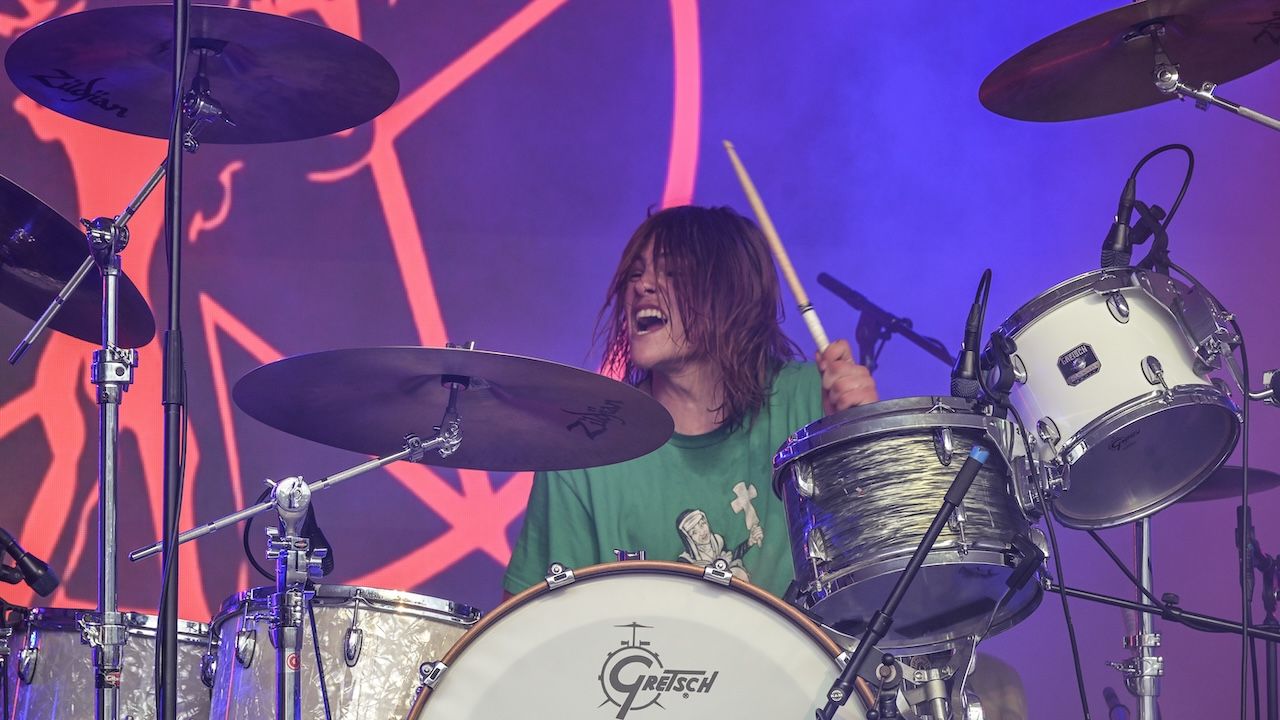
Incontrovertibly, Splat! sounds precisely like Deep Purple. In a gloriously defiant sense. The shuffle of Paice’s drums and Glover’s metronomic bass bumping them along. Airey’s Hammond organ squelching just like the beloved Jon Lord’s once did. Gillan’s voice, settled now into a lower register but still instantly recognisable. This much could indeed be the inner workings of no other band.
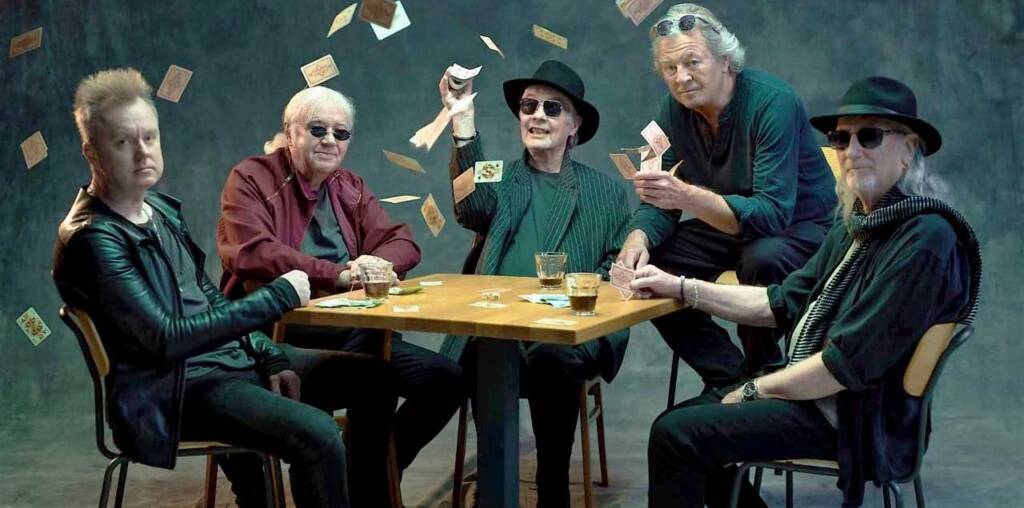
As with each of their most recent albums, this one went down live in the room, the five of them set up together out on the studio floor, and under he steer of veteran producer Bob Ezrin. The taboo of rock bands rumbling on into their dotage vanished with the Stones, of course. The fact of a group of men with a combined age of 361 still making music not only this powerful, but also so vibrant and, well, alive is quite another matter. As a whole, Splat! is pretty, agelessly splendid. Some feat.
Witness The Lunatic, a Hammond-heavy rocker. Or the dinosaur stomp of Scriblin’ Gib’nish. Or the portentous Third Call rising to a hulking pitch. Indeed, almost every one of its 13 tracks. Listening to the whole is like being spirited back in time to a 1970s heyday; a flared jeans and faded denim jacket with the whiff of patchouli oil kind of experience.
“To thine own self be true,” Airey says, drolly. “It’s a good trick if you can pull it off, and there’s a lovely vibe about the band now. Or as much as there ever can be with Deep Purple.
“A lot goes unsaid, but you can always feel there’s a standard to be kept to. We know what the job is, and we get on with it. So many bands these days, everything’s rushed. We try to sit on it. Follow Paicey, that’s the secret.”
“I never have seen a difference between a beautiful melody and someone who’s screaming their nuts off, so long as the feeling is right,” Gillan reasons. “You can incorporate all of those things if you want to make life more interesting. And as you get older, the elastic also goes in your inhibitions. They drop around your ankles and off you go.”

Today, Purple have just flown in from playing five whistlestop shows abroad – three in Japan, one each in South Korea and Kazakhstan. Scattered now back to their own corners: Gillan to a London hotel room, ahead of returning to the place he has in Portugal, Glover, Paice, Airey and McBride at their homes in, respectively, Switzerland, Buckinghamshire, Cambridgeshire and Belfast.
By Gillan’s description, as personalities they are five polar extremes, yet ever so alike in their apparent sheer good blokey-ness. Glover reports to being jetlagged, and smokes roll-ups. Paice is a few minutes late to our appointed interview, saying he threw a birthday party for his wife Jacky the night previous that was “rather large and went on a little longer than planned”.
Airey remains sore from the five-nil drubbing his football team Sunderland were handed by Paice’s Nottingham Forest the week before, “although Paicey was very kind to me, I must say”. McBride spent his morning at the local hospital getting the all-clear on the wrist he’d broken for a fifth time, “which is just ridiculous”.
The first words out of Gillan’s mouth when we meet are “How you diddling?” He has, he shares, a pressing domestic issue on his mind. A trouble occasioned by his Portuguese housekeeper, “wonderful Thelma”, having rearranged the optics in his bar at home while he was away.
“I left it ordered so I’d know exactly where everything was,” he says. “Thelma has re-done it by size. So all of the bottles that were easily reachable and identifiable will be muddled with ones the same size but not the same content. That,” he concludes, “is challenge enough for anyone.”
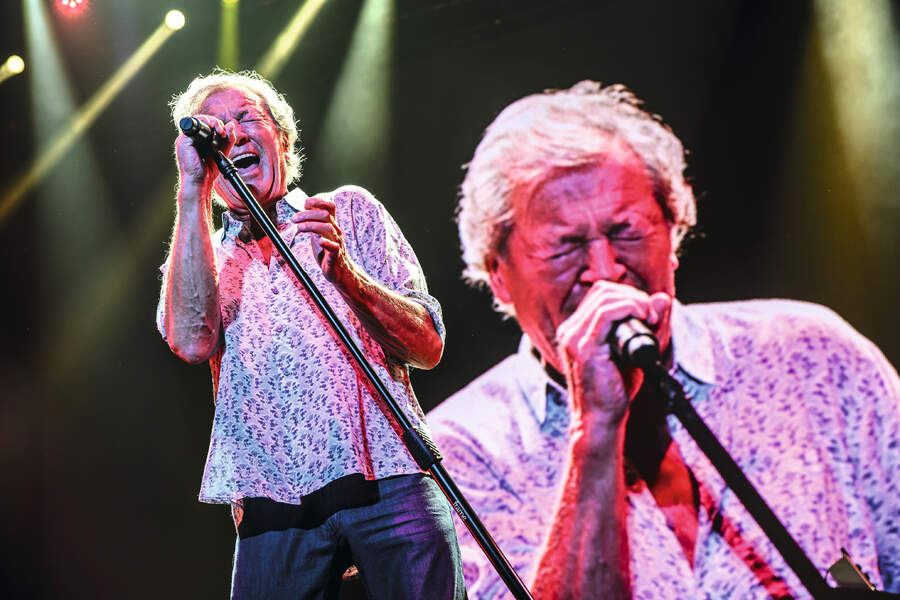
Glover says Gillan is a typical Leo, “a lion, a stubborn kind of fellow and which is his strength as well”. Clearly a deep thinker, Gillan is a good and engaging talker. Someone always prone to bounding off topic and into, as Paice puts it, “his Gillan-isms”. Which is to say you can have asked him about his first memory of hearing music, and he’ll veer away to tell you how he once saw aliens, or at least how he thought he did.
“I was a kid in Hounslow,” he says. “They’re always represented as humanoids in the comic books and movies, aren’t they? Arms, legs, and eyes. I don’t think they’re like that at all. They exist in a metaphysical form.”
Purple’s resident eccentric apart, Paice pen-portraits his bandmates as follows: Glover is “still the hippie he was fifty years ago”; McBride “I’m always laughing at, can’t help it. But when I’m with him I end sounding Irish too”; Airey is “gloriously dryhumoured. “We all of us,” Paice stresses, “get on very, very well. Ian, as he’s getting on, can be a little insular, but not that it’s a bad thing. We’re at that stage in our lives where we know when to leave each other alone.”
Nothing better illustrates the pronounced four-to-one age gap between them than the facts of the schoolboy McBride being inspired to play the guitar after seeing Gary Moore play Belfast’s Kings Hall, and Gillan listing his own formative influences as Elvis, Roy Orbison, Buddy Holly and a local West London hero Cliff Bennett who, with his band the Rabble Rousers was signed to Beatles manager Brian Epstein’s stable.
Generally, the older contingent is most likely to fall into conversation about football. Gillan, a lifelong QPR supporter, puts once scoring a goal in a charity match as his proudest moment. Glover is their most recent convert to the game. “Pretending to be an Arsenal fan,” quips Airey. “He’s most unknowledgeable about it. It’s very gratifying.”
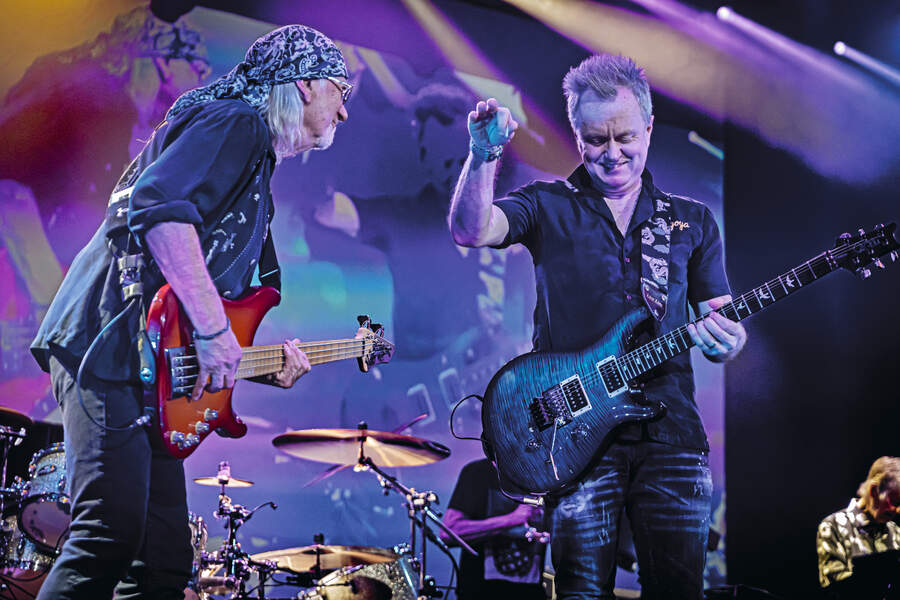
There are hard-and-fast rules governing their other social interactions. Certain topics forbidden from their conversation – the kind of things an old-school pub landlord would enforce lest they lead to blows: no politics, no religion.
Aside from football, the band members’ common ground, says Gillan, is humour. Picking out a defining example, he recalls one particularly raucous evening of dining and regaling at Hollywood hangout The Bistro, where they were joined by the British composer and arranger Paul Buckmaster (David Bowie, Elton John, the Grateful Dead, Taylor Swift…).
It happened to be Republican Day, and Buckmaster, a renowned bon viveur, and on that evening fortified by liberal amounts of alcohol, began to expand on the history of Republicanism in America.
On he discoursed, for a full, uninterrupted five minutes, his voice getting ever louder, banging a fist on the table for emphasis, and until he reached fever pitch. At which point he informed the assembled men of Purple: “Of course, it all started with the Punic Wars. You do know about the Punic Wars?”
“And Don,” Gillan says, delightedly, said: ‘We talk of little else on the tour bus.’ Priceless.”
Here’s the thing with Purple. They have such a rich, shared history. Seven decades of camaraderie, 120 million records sold, and with the odd rupture and seismic upheaval along the way for Gillan, Glover and Paice. It’s coming up to a quarter of a century in Purple for Airey, who goes back much longer, to Rainbow, with Glover. Enough so that, often as not, all that’s required is to ask them each a question and then sit back and let them tell their stories.
What’s the first thing that springs to your mind about playing music?
Ian Paice: “Any musician, or any artist in any form, goes back to when they started. The glory of finding you can actually do something without it being a strain. Doing what you were put on this planet to do. Whatever happens after that, whether it becomes part of your life, the way you support yourself, or whether it’s just something you do for fun, that little niche is an amazing thing to have found.”
Don Airey: “Meeting Gary Moore. I’d seen him play a couple of times, so I was very conscious of how good he was. We sat down and jammed for three hours, and at the end they offered me the job with his band. A baptism of fire.”
Roger Glover: “The excitement of being on stage. Records were always a necessary evil, if you like. Where the band always existed was live, because it was spontaneous and impetuous.”
Ian Gillan: “My family. My grandad singing opera. He was a bass baritone, used to shake the walls. Together with Monty Lloyds, who was a sea captain who lived next door, they would do arias on a Sunday morning. My uncle Ivor who was a jazz pianist. My grandmother was a ballet tutor, so we had a lot of Tchaikovsky in the house. I was a boy soprano in the church choir. I just loved the harmonies of the choir with that wonderful reverberation.
“My first band. Playing drums with knitting needles on a biscuit tin. Five guys with five strings between five guitars. The joy of rehearsing and moving on from one band to another. Getting better. Learning more harmonies with Episode Six, and meeting Roger Glover. Probably the nearest thing to a brother I’ve ever had. Joining Purple. Standing in the Speakeasy, looking at Rog and going: ‘Whoa, this is it, mate! This is what we’ve been searching for.’”
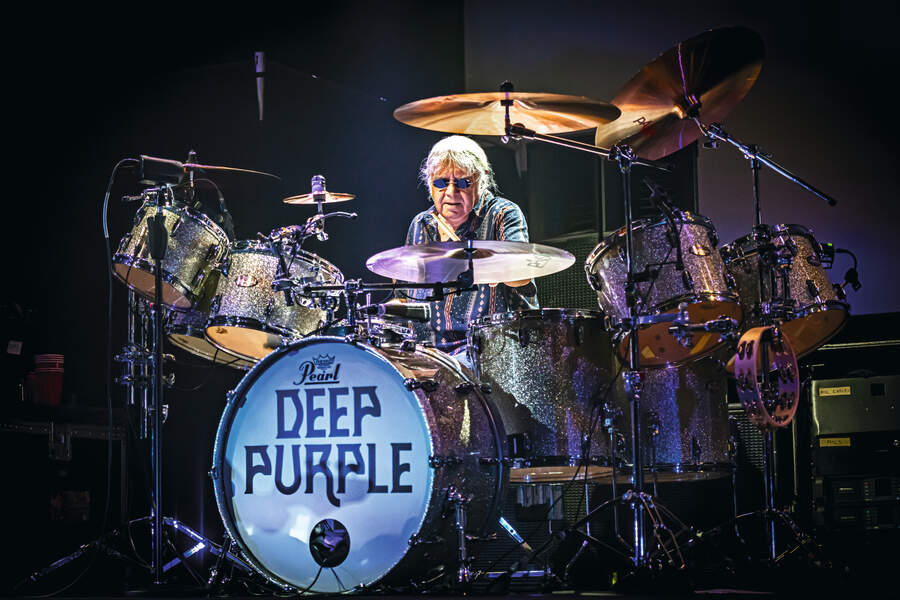
Which one piece of advice would you offer the teenaged you?
RG: “Don’t take it too seriously. Don’t try too hard. With time, you get to the point where you don’t care what people think of you. And that’s freeing.”
DA: “Take yourself a bit more seriously. Practise more. I had a piano teacher when I was at the Manchester Royal College of Music, the most wonderful man, and he used to say to me: ‘There are only three things: practise, practise, practise. No girlfriends, no TV, no cinema.’ It’s a great lesson if you want to be any good.”
IG: “Don’t ignore the experience of your parents. You will, at some stage, as an adolescent, go through what I call this psychological vandalism where you kill everything in sight in order to make space for your useless talent. Until you’ve developed an idea of where you’re going, or how to do it, don’t shove them to one side. You don’t have to do it the same way, but they’re only trying to help.”
IP: “Don’t do what I did: don’t sign your first two contracts. The first one was awful, and the second not great. It took a while to realise that you weren’t all on the same side. Get your own lawyer. You’ll have a lot less sadness in your later life, I can tell you.”
Last summer, as is now the established order with Purple, Gillan took away with him the pieces of music they’d worked up as a band over three writing sessions, to turn them into songs with his words. On this occasion that took him a couple of weeks of solitude and of thinking up narrative stories, and then, painstakingly, editing them down to the barer bones of lyrics.
“An amazing feat,” Paice marvels. “I really don’t know he does it. Incredibly difficult to do, but he manages it every time.”
“It is very limiting, writing lyrics,” Gillan agrees. “Having to cut into the whole thing. But if you’ve got a beast of a story… Dylan was great at that. Boots Of Spanish Leather. That’s the whole of the song. You don’t need any more.”
Thanks to Gillan’s affinity for language and tale-telling, there is to Splat! a lovely sense of the absurd. The songs are populated by a cast of colourful characters, woven through like threads. The Only Horse In Town, for example, recounts the odyssey of a homeless junkie on a kind of pilgrim’s progress. His roaming leads him to a ramshackle film set gone to rack and ruin on the high plains of New Mexico and where he discovers an old horse, abandoned to a fallen-down stable by a travelling troupe of gypsies.
“A knock-kneed, clapped-out beast,” as Gillan describes it. “A bit like me. And these two derelict living beings find sanctuary together. A beautiful thing.”
Then there’s The Rider, a sly, funny swipe at rock star peccadillos (‘I can’t exist, I can’t do anything… I’ll let you know when I’m ready to sing…’), and Guilt Trippin’ which, says Gillan, imagines “God and Darwin having a pint”. And Jessica’s Bra, leaping out for obvious reason. The title, Gillan informs, is an accident of his mistyping the word ‘bar’.
“My eyes aren’t so very good these days, and getting worse,” he explains matter-of-factly. “Musically, it sounded to me like an Irish jig. I grew up in pubs, smoking cigarettes and drinking beer and whisky, and it made me think of people dancing and getting merry, and wilder and wilder.
“The characters in the pubs in the old days were phenomenal. There were tons of tales of bawdy camaraderie that just went right to the limit. Talk about free speech now, free speech was rampant in those days. Those memories are very vivid to me. So it’s a pub story. Every character in it is real, every story happened. Of course I’ve embellished them, but only slightly.”
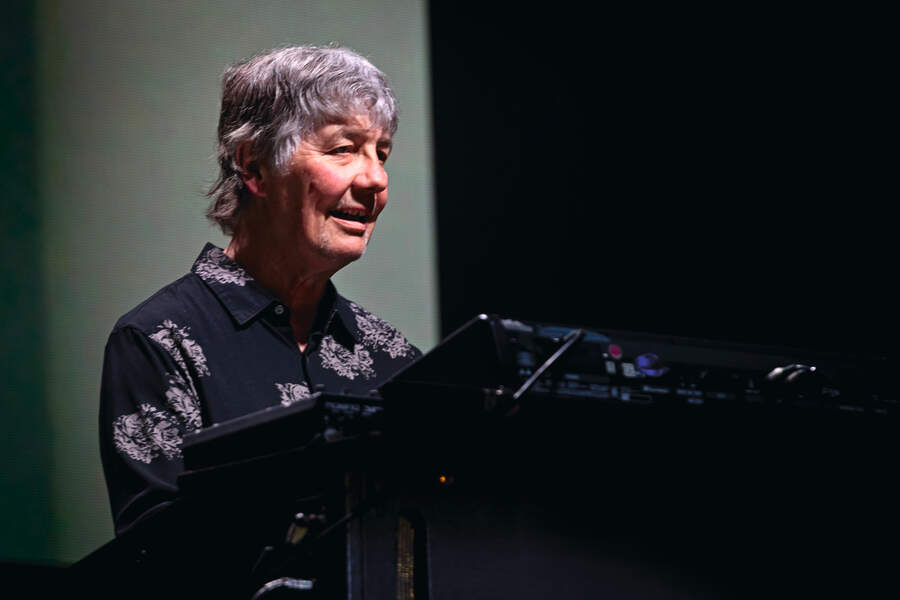
As a rule, Gillan prefers to have a loose, umbrella concept to write around. Something, as he puts it, totemic to link the songs to. With Splat!, a word he’d scribbled in a notebook years ago as a potential album title, he found himself thinking on the old joke about the bug flying into a car’s windscreen and the last thing going through its mind being its arse. From there he ranged, “as he does so very frequently, out of left field,” according to Paice. “God bless him.”
“For years I’ve been thinking about lots of scientific and humanity things,” Gillan qualifies. “The population of the world has tripled in my lifetime. That seems pretty terminal to me.
“One day, I just thought to myself, suppose we don’t die out. Suppose we go onto another phase, like butterflies. A metaphysical phase, where we’re joined with every other aspect of humanity that ever existed. That gave me the hope to be able to write about terminal things.”
He likes the word ‘metaphysical’, as you will have noticed. The question as to what, exactly, this metaphysical state he foresees is going to be like is one that also animates him greatly.
“Well, that’s something, isn’t it?” he responds with gusto. “I thought of me hitting the car’s windscreen, and through my skull flew King Arthur and the Roman Empire, and every other aspect of humanity that had existed. All in the form of chess pieces. And then they pixilated, gravitated towards each other, and faffed off towards the next form of human energy, but without arms and legs and bodies.
“The whole point of it is we’d become disembodied and part of a collective. All of the experience of a quarter of a million years of humanity lumped together as a smouldering energy force.” A smile, a pause, then a rejoinder to himself. “My vivid imagination, basically. I’ve no idea what the hell’s going to happen.”
When have you been the most fulfilled in Purple?
RG: “When everyone’s on fire. When you come off after a show and you know that everyone’s played to their utmost. A great feeling. If I’ve made a terrible mistake in one of the songs, which, you know, it happens, it kind of ruins the evening for me. I go to sleep wishing I hadn’t done that.”
IP: “I could pick a specific show. The old Queens Hall in Leeds, 1970, or 1971. The best onstage drum sound I’ve ever enjoyed.”
DA: “There was a period when we didn’t have a record deal. Around 2005 to 2010, and during which we were doing a hundred and fifty gigs a year. We were playing in places no bands had ever played. Vladivostok in Russia, down on the Black Sea. A strange time, but a very happy one.”
IG: “The greatest moments for me are when I’m not singing. Whenever I step back between the drums and the keyboards, and I’m right in the middle of it. It’s like when I was religious and doing my confirmation class. I used to go to church, sing in the choir, and I’d fly home, my feet didn’t touch the ground, I was uplifted so much. It’s like that every night with Purple. The magic of what these guys do. It’s just so identifiable. It speaks. It’s musical, powerful, and it’s a kind of fuck-off, too.”
And the most frustrated?
IG: “When things become artificial. Not always in anyone’s control, things just happen. You’ve seen Spinal Tap, same as everyone else.”
RG: “Sometimes, someone else will come up with an idea I don’t like very much. I’ll try to suggest something else, or change it, but can’t. It’s set in stone and there’s nothing you can do about it. With Ritchie, you couldn’t fight him. You couldn’t tell him he was wrong. He wasn’t like that.”
IP: “That time when we felt the band was falling to bits again. There was no joy, no happiness on stage. I don’t blame any one person for it, but I think we know who we’re talking about. Horrible times.”
DA: “When I first joined the band, everybody was a bit set in their ways. It was before Purple had become kind of iconic, as it is now. They were thinking they should get rid of all the old material and just play new stuff. We tried it for a bit but soon saw the error of our ways. Happens in all bands. You come out of the tunnel and into the light.”
Away from Purple, they are parents, grandparents. Five grandchildren in Airey’s case, each of whom he’s taught to play Smoke On The Water on piano, and seven in Paice’s, “the delight of my life”. Paice has a house in Spain. Both he and Gillan have boats. Paice takes his out fishing, Gillan goes “pottering around on the lagoon. I’ve always loved the water. I take my mates out with me. We go swimming, have a drink. Sit under the stars and get out the guitars. Play harmonica and sing a bit of Little Walter.”
Roger Glover’s preferred pastimes were once skiing and scuba diving. But both of those have now been given up for fear of injury. Instead he paints, although he bemoans the lack of time to do much of it. He admits to a struggle with turning 80 last year.
“That was a dreaded moment,” he says. “Being seventy-something, you’re still able to hang on to that, to cling to it. Time, though, has a way of ruling. It always wins in the end.”
Time, or what’s left of it, is these days an ever-present consideration with Purple. Specifically, of how long they can, should and will go on. Nine years ago there was the Long Goodbye tour, an intended “farewell” as Airey cops to it, but which proved to be nothing of the sort. In the notes accompanying Splat!, Gillan speculates on not just the ending of humanity but also, albeit “possibly, of Deep Purple as we know it”.
This being the most contrary of bands, no one is toeing to a single party line on what this actually means in reality. Paice suggests a not-so-distant future free from major touring, but with the odd weekend engagement perhaps sandwiched in between bursts of recording. McBride’s perspective is one of Purple proceeding “moment to moment. It’ll last until it stops. Everybody needs a purpose in life, I think, so keep going, keep moving”.
“Obviously, the thought of an ending keeps coming to mind because people are always asking the damn question,” Gillan huffs gently. “With respect. You get to the point where you think: ‘No, screw that.’ Well into my sixties I used to run upstairs two at a time. Now I run downstairs ten at a time. It’s much more exciting.”
What is known is that Purple are touring Splat! through to the end of this year, 83 shows in 27 countries. Beyond that there are dates pencilled in the diary already for 2027. As a performing band, they continue to press ahead and evolve. For those most recent shows, When A Blind Man Cries – recorded for Machine Head as far back as December 1971, and ousted from that album by Blackmore – was introduced into the set.
“It’s such a beautiful song,” says Airey. “And the way Gillan sings it, the master at work.
“I’ve got two big suitcases for touring,” he continues. “One filled with junk, the other with clothes. My wife says it’s the finest sight she sees, those two big cases out in the hall, ready to be picked up, and meaning I’m out of her hair for a few weeks.”

Whenever it happens, how will Purple go out, do you think?
RG: “I don’t want a final show. Where would we do it? How would we advertise it? Too much stress. We should just go on until we can’t. As Ry Cooder said, bop ’til you drop.”
IP: “Ian would be the one that calls time. He has the most fragile of instruments, and the fact it works as well as it does now is remarkable. Even still, we all have to be aware of how that vessel could shatter in an instant. At the moment, it’s okay and he’s having fun.
“The flesh will give up, though. It’s inevitable. There’ll be a day it happens to me and I’m not able to do all of the things I want to do. But for as long as you can have a bit of fun doing it, bugger anybody else.”
IG: “I realised some years ago that there’s an end to everything. I’ve thought on what is it that would stop me singing. What would stop me from being able to perform. If I felt for one minute that it was becoming embarrassing… I remember the stories of Sinatra and that sort of thing. When it gets to the point of being senile and forgetting where you are, or whether you just start getting sloppy with the performance and the energy, I think I’d recognise that.
“I’m not as strong as I was, but I’m still strong enough to get through a show without getting puffed out. So that’s alright, so far so good. But the end draws nigh, as they say. Until then it’s like family. People die, people get divorced, people get sick. You move on. Human chemistry is beyond all understanding as someone said in a big book.”

Existentially, what has all this, your whole musical journey, meant to you?
IP: “Good question. I’ve been doing this since I was seventeen years old. I was nineteen when I got into Deep Purple, early 1968. There’s never been a period in my life, other than when Jacky and I started a family, when I wasn’t on the road or making records. For me to try and take an adult view of what it’d be like without it, I can’t. Because it’s never not been there.”
RG: “I never knew what I wanted to do. I wasn’t a great student. I ended up in art college because it was the only place I could go. Music was the fun thing. I started my first band when I was fifteen. It just became a habit. I loved it. The fact it’s given me a lifetime of doing what I love is rare. I don’t think I ever had a proper job. It gave me a purpose in life. A means through which I could express myself. That’s the greatest thing I can think of.”
DA: “I feel lucky. It’s not what I intended to do. I dreamed of becoming a classical pianist, but of course I wasn’t good enough. Who is? As John Lennon said, life is what happens to you when you’re making plans to do something else. There’s been ups and downs, I must say. But, you know, I think God looks down sometimes and goes: ‘We’re giving Don a bit of a hard time, we’ll put something nice his way.’ That’s what happened with Purple.”
IG: “It’s not everything. Because if you allowed it to be everything, I think it would destroy you. It’s very simple. You learn all of the obligations you have. You learn to be bold enough to treat things with respect, but at the same time to put your own slant on them. That’s part of growing up, I think. But yeah, wearing your own clothes is the most important thing.”
Finally, for now, can you complete this sentence: Deep Purple is…
Simon McBride: “A rock band. It’s what we do, a simple thing.”
DA: “The sum of all of its parts.”
IP: “A law unto itself.”
RG: “Wow. The first thing that comes to mind is ‘a force’. A force for good. A force for employment. A force for joy. A force to be reckoned with.”
IG: “Can I leave one word out of the question? The word ‘is’. Okay, then just change it to this: Deep Purple means it.”
Splat! is out on July 3 via earMUSIC