
 Written by
In the late ’70s and early ’80s, Lebanon endured an intense civil war. Sectarian tensions and the disrupting force of the Cold War plunged the Middle Eastern nation into decades of armed conflict, with a chilling effect on daily life. Music scenes were insular; tapes were copied by hand and passed between friends and family. Nearly every musician in Beirut knew one another. Against the backdrop of seemingly endless violence, artists banded together and dabbled in soul, disco, and jazz as a salve to their suffering. Beirut City Pop, the latest compilation by archival label Habibi Funk, tells the story of the artists who dared to imagine a life beyond war.
Stephanie Stephanou didn’t have one in mind when she started sneaking into nightclubs while underage, a freedom she only enjoyed because her parents fled the country and left her behind. Her singing caught the attention of Abboud Saadi, the bassist for Lebanon’s most famous singer, Fairuz, who invited her to a recording session with Bypass Studio owner Ziad Rahbani. She became good friends with Rahbani—a musician himself and Fairuz’s son—and would lend her voice whenever he needed a backup singer. “You Turn Me On” is one of her rare attempts at singing lead, giving her best impression of Stevie Nicks over a sensuous funk groove. “We listened to foreign music when we were growing up,” Stephanou explains of her Western influences in the liner notes. “There weren’t really any decent, cool Lebanese or even Arabic bands that we were aware of.” Lebanese tape culture was a one-way mirror, reflecting the cultural imports pouring in while nothing produced at home was allowed to leave.
No score yet, be the first to add.
Abboud Saadi, by contrast, took full-time musicianship very seriously. He also made his most formative connection at a music club, linking up with Ziad Rahbani in 1979 and establishing an alliance they’d maintain for decades. Saadi stayed on call as Rahbani’s in-house bassist, and Rahbani would return the favor by recording Saadi’s personal projects. Two groups on Beirut City Pop, Force and Games, are fronted by Saadi, and each shows different sides of his obsessions. On “I Don’t Wanna Be Alone,” Saadi leads Force into a soaring synth-rock anthem that wears his Deep Purple fandom on his sleeve. As he spent more time with Rahbani and worked with a revolving door of session players, Saadi’s compositions grew in complexity. “Someday,” by the short-lived studio project Games, is a slice of smooth jazz fusion that pays homage to the duo’s mutual love of Steely Dan. It’s got the works: tenor and alto sax, a twinkling Fender Rhodes, and a chorus of backing vocalists including Stephanie Stephanou.
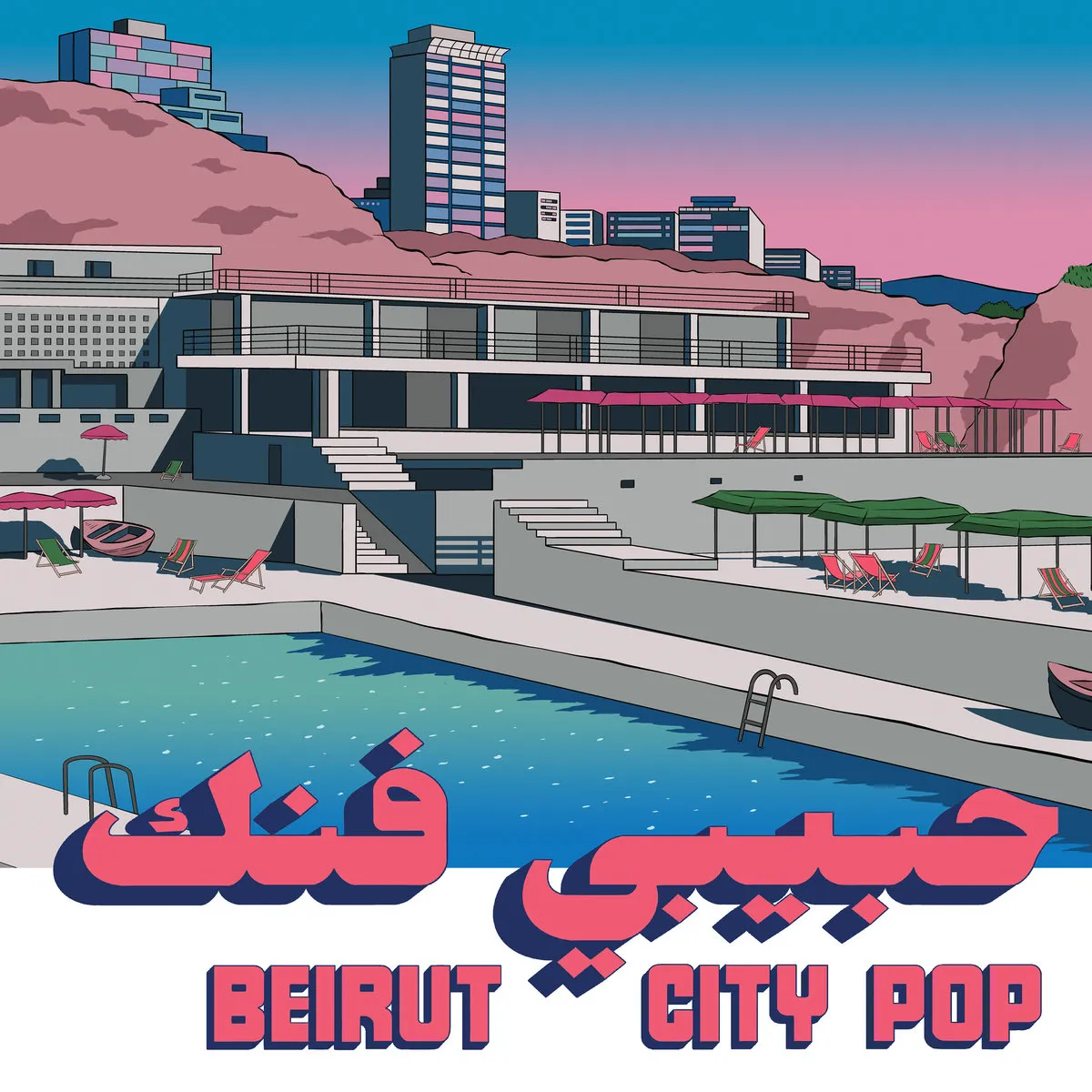
Beirut City Pop is a carefully constructed retelling of a precise moment in time, with comprehensive interviews and valuable context in its liner notes, but there’s a peculiar wrinkle to its framing. Elements superficially similar to what’s commonly understood as Japanese “city pop” can be identified—like the swinging, reggae-inspired groove of Games’ “There Is a Chance” or the Latin-infused rhythms of Andromeda’s “Bossa Blue”—though they’re distant relatives and not direct siblings. Beirut’s private-press scene has little in common with the studio culture of ’80s Tokyo, where an abundance of resources and technology filtered the same foreign influences into something more perfect and polished. Even the cover art, which references Hiroshi Nagai’s iconic depictions of idyllic metropolitan life that defined the visual language of city pop, bears no resemblance to war-torn Lebanon.
The most sobering reality check on Beirut City Pop brings the conflict into stark relief. Walid Itayim plays a free and funky guitar solo over Sami Shabshab’s slick bassline, but the lyrics pierce straight through the upbeat tune. “Car bombs,” Itayim sings, “they go off every day.” He laments that his city burns while the world pays no attention, breaking with the innocuous escapism heard on most of Beirut’s private-press tapes. But there’s a hopeful note buried under the harrowing descriptions. “Still I love the city,” he protests; “there’s magic in the air.” His rare dose of realism makes clear the contradiction in Beirut City Pop: It’s a convenient shorthand to describe a sound, but not a lifestyle.