
 Written by
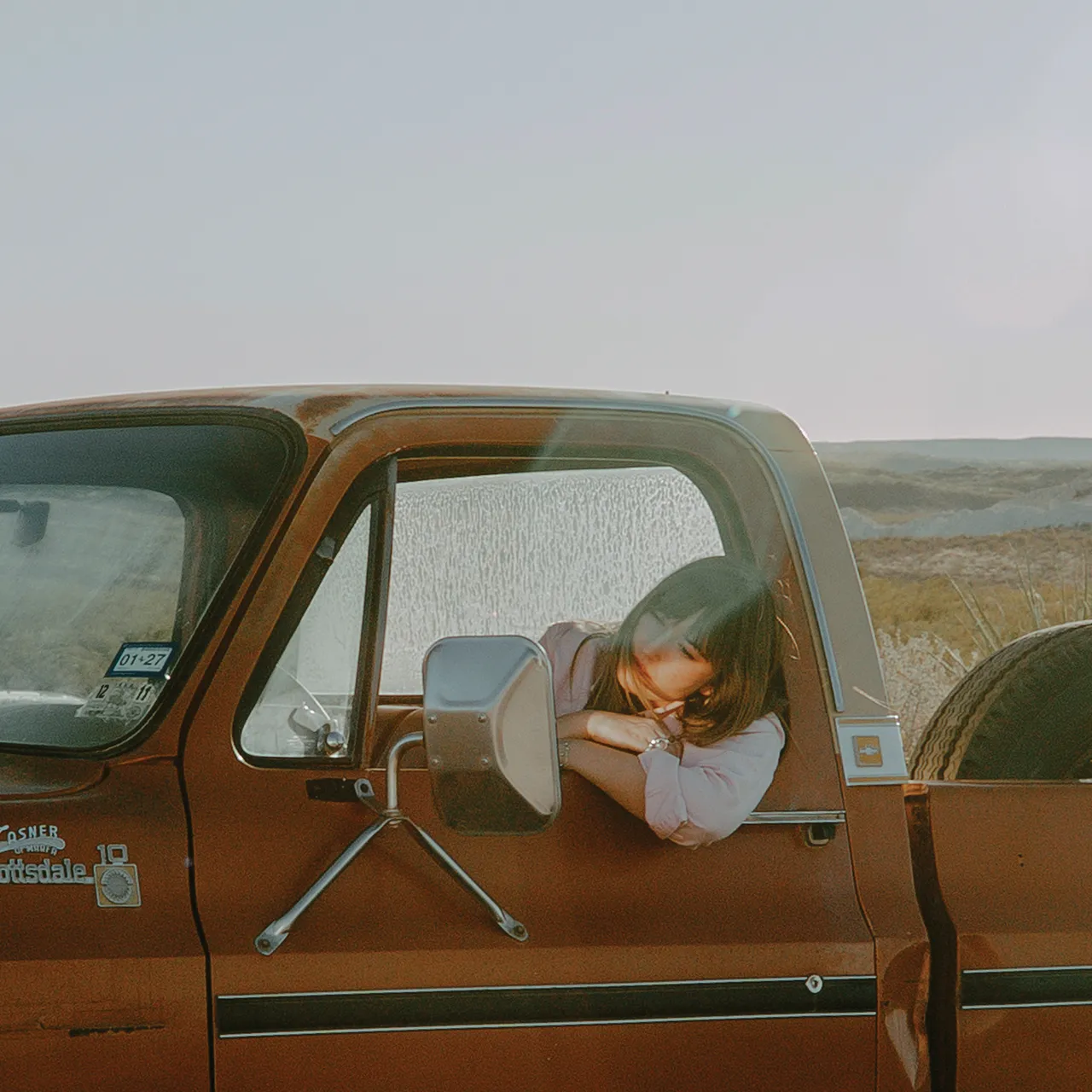
Not many country singers reference Alice Coltrane, but Jess Williamson is not most country singers. That much is evident from the opening moments of A Mile South of Heaven, her sixth solo album, when the natural Texas accent she’s slowly let creep into her singing voice over the years twangs over a weeping pedal steel guitar. Three years ago, when Williamson took a slightly Arthur Russell-ish turn on the magnificent breakup record Time Ain’t Accidental, it sounded as though she’d balanced the social and aesthetic contradictions of a life split between Los Angeles and Marfa. On A Mile South of Heaven, nearly all of the indie-rock patina that’s colored her work since her 2014 debut, Native State, has been buffed like a pair of Justins into a high shine.
As a songwriter, Williamson is still concerned with the mystical distance between city and country—that line about Alice Coltrane comes in “Country Mile,” a song about frustrating people’s expectations on the way to becoming yourself. As a singer, she inhabits these songs with a new depth of presence. Mostly, she’s working through her emotional and geographical listlessness; she’s never sounded more at home with herself. When she sings the phrase, “God damn, that’s a dark day in Dallas,” you can hear the decades of associations she’s built up with the city—it’s Dallas as signifier of ambition, as the location of heartache, a site of possibility, a place worth longing for, and a place not worth returning to. There are so many of these moments in A Mile South of Heaven, in which a slight turn of phrase or shift in intonation communicates an entire history. Like Emmylou Harris on Pieces of the Sky, Williamson sounds like she’s fully arrived, making music only she could make, informed by lessons only she could have learned.
No score yet, be the first to add.
A Mile South of Heaven was produced by Shooter Jennings, son of Waylon and Jessi Colter, and probably the only person who’s both produced a Best Country Album Grammy winner and made a solo record dedicated to Italo-disco icon Giorgio Moroder. Lately, Shooter has been fleshing out a batch of his dad’s rediscovered demos for a series of posthumous releases that sound—in voice and music—like they could’ve come out at Waylon’s mid-’70s peak. He brings the same touch to A Mile South of Heaven, cushioning Williamson’s supple vocals with the kind of warm, beery music that Texans have been making since Willie Nelson moved back to Austin from Nashville in 1972.
Jennings and Williamson know how to play off of one another and the expectations of this kind of music. Barn-dance fiddles echo through “Hum of the City,” set back in the distance in a way that mirrors how Williamson’s narrator drifts through the room, longing for the nocturnal thump of Los Angeles while encircled by dosey-doers. “Dance me around that beer-stained floor/Gave me all of your love/Now I’m begging for more,” she sings. Maybe she’s singing about a romantic partner, but it feels like her subject is rural Texas itself: acknowledging the pleasure of a packed dancehall while still knowing it’s not quite enough for you. Like all great country songs, it’s comfortable with its contradictions. When Williamson shifts perspective and places herself in L.A., longing for the comfort of home, the song becomes more urbane and languorous, closer to Lana Del Rey’s smoggy sadness than the western lament she’s been singing; each place shows up in the other.
Williamson seems profoundly at peace with herself here, even when she’s ruminating on her regrets. Her accent functions in this music the way Loretta Lynn’s did in hers—not just as a charming signifier of country authenticity, but as a distinctive tonal element in her delivery. The quirks in her phrasing—in “The Gem and Mineral Show,” “town” becomes something like “tie-yun”—allow her to bend her melodies in unexpected ways. Singers who do this well, like Lynn or June Carter or George Jones, can make their voice peal like the bittersweet tang of a pedal steel guitar, which Williamson does when she sings, “I was desperate, just dancing on the bar” in “High Heels and Blue Jeans.” Did you know the word “seven” can sound unbearably sad?
This subtle and powerful music-making is matched by the strongest songwriting of Williamson’s career. Like any good country songwriter, she knows how to write a masterful one-liner, and she knows how to use context to reinvigorate a cliché. When Williamson sings about a woman who “was born having visions” and is “mean when she’s drunk” in “Country Mile,” you know that she’s going to flip the POV for the final chorus. But before she does that, she spends the song telling us how people diminish themselves for others—“The cord between lovers gets pulled so tight/Just step to the middle and you won’t have to fight,” she sings in the second verse. So when she does affect that shift, when it becomes “I was born having visions/And I’m mean when I’m drunk,” she’s not just turning a well-worn storytelling trick, she’s stepping into herself, faults and all; no longer just telling the story, she’s using the form of the song to enact it.
In the gorgeous “The Gem and Mineral Show,” while she dissociates at the Chateau Marmont “with the Queen of Americana,” she wanders back to Texas in her mind, to a rainy night in Terlingua. After an evening of “dancing with tequila and ten thousand words for God,” she’s “howling at the cabin with the calcite and the cactus/A mile past the ghost town, acting like nothing’s wrong.” That final phrase breaks the soft rhyme scheme that’s built up over the course of the song like a startled realization, and suddenly we’ve snapped back into the present. Her context, we realize, doesn’t really matter. Whether she’s surrounded by the spirits of dead rock stars and sipping champagne by Hollywood’s most famous pool or pounding tequila in a Texas-famous ghost town, she’s still not letting herself believe in the trouble inside of her. That’s the kind of friction that keeps A Mile South of Heaven warm and alive, when Williamson is tangling with the spectral forms that trail her no matter where she goes.
For as long as country music has existed, it’s romanticized the figure of the outsider whose constitution leaves them no choice but to keep on keepin’ on. Hank Williams’ “Ramblin’ Man,” Roger Miller’s “King of the Road,” Merle Haggard’s “Ramblin’ Fever,” even Lynyrd Skynyrd’s “Free Bird”—in their own way they’re all songs about the beauty of packing up, heading on down the highway, and leaving responsibilities behind. “Cowboys ain’t easy to love, and they’re harder to hold,” Waylon Jennings once sang, and while he and Willie were technically warning against such lawless futures in “Mamas, Don’t Let Your Babies Grow Up to Be Cowboys,” it’s pretty obvious that they weren’t too upset about how their lives worked out.
Like these songs, A Mile South of Heaven is an album of wanderings—between cities and memories and states of mind. But Williamson’s rambling woman isn’t trying to outpace her demons or set out for another booze-soaked trip around the continental United States. As she sings in “Goodbye to All That,” flipping Joan Didion’s famous New York send-off (and a generation of it-girl Insta posts about moving to L.A.) into a farewell to Los Angeles, she’s not just thinking about giving up beach days and wearing shorts on Christmas. “Goodbye to the miles from my family,” she sings. “Living like a satellite alone in the sky/Touch down for the night, so lonesome I could cry.” It’s a reversal of another Hank song, maybe the best country song ever written. Hank Williams sits under the purple sky contemplating his pain; Jess Williamson moves toward it.
Editor’s Note: Due to a technical error, this review was originally published with a 0.0 and no text. It has since been updated.