 Written by
 All but the most blindly optimistic Deep Purple fans had given up hope of the band ever reuniting with former guitarist Ritchie Blackmore. But it looks like that’s exactly what is going to happen after Blackmore took to Instagram to drop the bombshell that he was planning on joining Deep Purple onstage at the hard rock veterans’ gig in Wantagh, New York tonight (August 12),
“I sent my A.I. pigeon to [Purple singer] Ian Gillan in Portugal, where he lives at the moment,” Blackmore said. “And I said, How would you feel about if I got up just for an encore? Just one of the songs. I don’t want to intrude. And I said, No pressure – just kind of [for] old times’ sake.’ I’m 81 now. So he seemed to love the idea, put it to the band, got a thumbs up, and it looks like we might be doing that.
If Blackmore makes good on his promise, it will be the first time he’s played with Purple in more than 30 years. The two parties have been bitterly estranged since the guitarist quit following a gig in Helsinki in November 1993, during the tour in support of that year’s aptly titled The Battle Rages On… album. The subsequent decades have done little to thaw icy relations between Blackmore and the rest of Purple, making a potential reunion one of the most unexpected about-turns in recent decades.
Latest Videos From Louder
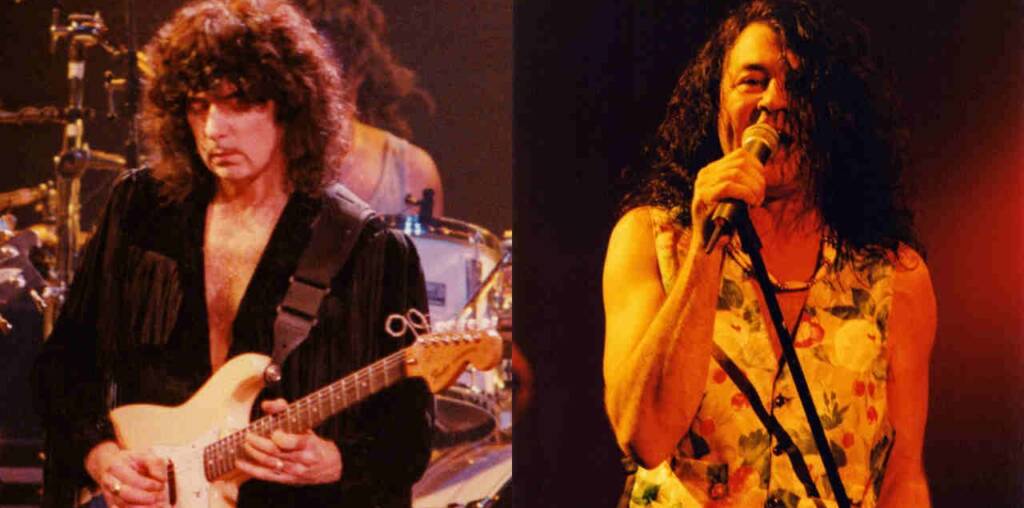
Blackmore’s history with the band he co-founded in 1968 has been turbulent, to put it mildly. He quit Purple for the first time in 1975, expressing his disappointment in the funkier direction the group had gone in with the previous year’s Stormbringer album. Following a successful reunion of the fabled Mk II line-up in 1984, old tensions between the guitarist and Gillan resurfaced, prompting the latter to leave in 1989.
After a stint with ex-Rainbow frontman Joe Lynn Turner that saw the band’s fortunes decline, Purple’s label suggested that Gillan – who had relaunched his solo career to little public interest – rejoin his former bandmates. Neither Blackmore nor Gillan were happy with the suggestion, but both agreed to attempt to patch up their differences.
“Ritchie is not someone you make up with in a conventional sense,” Gillan later said. “We’re both stubborn bastards. He’s a genius. I’ll always respect his talent, just don’t ask me to go on holiday with him.”
“You’ve got to know Ian to figure out what his personality is,” Blackmore said in 1997. “It takes a while because he’s an astute man, very clever. He’s got this strange psyche; a strange obnoxious side to him which is a side I don’t like.”
They managed to park their dislike of each other long enough to record The Battle Rages On…, which was finally released in July 1993 following a painful 10-month gestation period. The critics were sniffy – it’s subsequently been dubbed ‘The Cattle Grazes On’ – and the public weren’t interested.
Neither man was happy with the situation, viewing the recording of the album (eventually titled, with deliberate irony, The Battle Rages On…) as a necessary evil. It was apparent that both of them would rather be anywhere than spend time in the other’s company. Stateside sales of just 50,000 meant an entire 20-date North American tour was pulled. Purple finally hit the road in September 1993, kicking things off in Italy. Soon afterwards, Blackmore decided that enough was enough.
“I’d sent them a letter, within two weeks of getting on the tour, saying that I was leaving,” he said in 1997, adding that his decision was prompted by the failure to promote the first single from the album, Anya. “That’s what started the ball rolling for me to be pissed off with the whole thing.”
Purple kept the forthcoming split secret from the public, but behind the scenes Blackmore fumed. At the Birmingham NEC on November 9, things soured. To the guitarist’s annoyance, the gig was being filmed. He took umbrage at the fact there was a cameraman between him and the audience, and refused to join the band as they began opener Highway Star, leaving them to play it as a four-piece. After being told the cameraman had gone, Blackmore was persuaded out in time to play his solo – only to spot the offending lensman on the other side of the stage.
“I ran around to the guy with the camera, picked up a glass of water and threw it in the lens so then I knew he had to back off,” Blackmore recalled. “And, sure enough, he did, but I was so angry because the whole thing was such a fiasco.” The gig was recorded for posterity on the live concert film and album, Come Hell Or High Water, released 11 months later.
The guitarist’s commitment to the band had clearly waned by the time he played what would be his final show as a member of Deep Purple, on November 17, 1993, at Helsinki’s 8,000-capacity Jäähalli. Gillan later admitted that a bitter row followed in the dressing room, adding only that what happened there was “deeply personal”. “The problem was that Ritchie thought that what the band had was down to him – but it wasn’t,” he did offer. “He was only a fifth of it.”
The band recruited US hotshot Joe Satriani, who was enlisted to fill in on a six-date Japanese tour at the end of 1993. Satriani was only a temporary fill-in – the guitarist’s spot would be taken full time by former Dixie Dregs man Steve Morse and, subsequently, Northern Irish hotshot Simon McBride.
And Blackmore? He relaunched Rainbow before turned his attentions to the medieval music he loved. Deep Purple, it seemed, were buried deep in his past, never to be revisited – until now.
“It’ll be good to see the old guys again,” he said of his mooted appearance with his former band. “I just thought it might be an idea to let a few people know, cos I think a lot of people would like to see that. So hopefully my guitar stays in tune, and I can play whatever song is going to be played.”