 Written by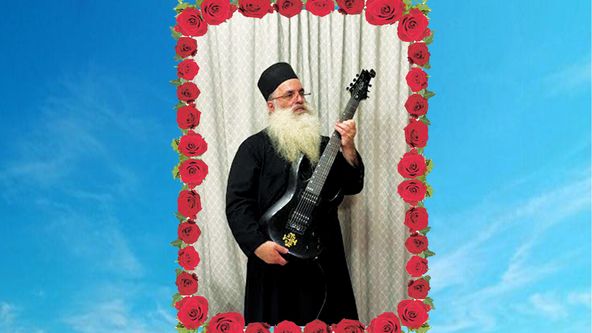
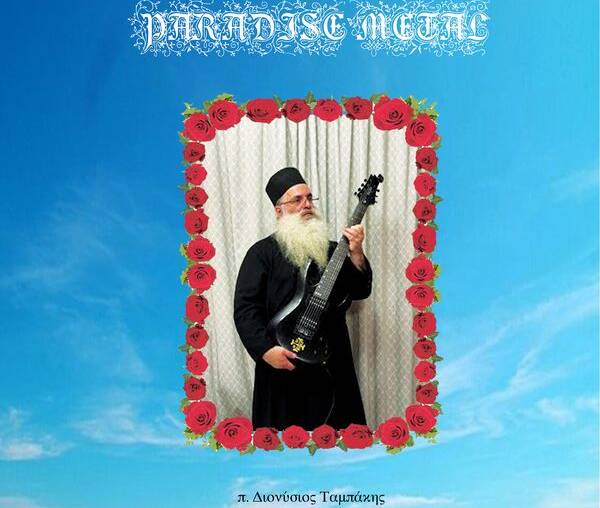
The cassette’s cover is a dream for the crate-digging exoticist. A bearded man in glasses stands at the center of the frame, wearing the black eksorasson and kamilavka of the Greek Orthodox church. He angles a matching obsidian seven-string guitar skyward, the Greek Orthodox cross painted in gold just beneath the bridge. The letters around it abbreviate a mighty message, “Jesus Christ Conquers.” Only his beard breaks the blackness, the white cascading down his vestments. He looks like a hesher but also, of course, a priest, a binary complicated by the rectangle of 36 red roses that surround him, all set against a backdrop of cloud-dappled sky. The title, typed in black across the bottom, summarizes this tension between heaven and hell, earth and ascension: Paradise Metal. It is a record that, if you see, you sample, plucking it from dollar-bin obscurity for at least a chuckle, maybe an epiphany.
Paradise Metal—the debut of Father Dionysios Tabakis, a 53-year-old priest in Nafplio, a small Greek city off the Argolic Gulf—is actually a series of epiphanies, an ostensible curiosity that functions as an object lesson about expectations. It is a joyous, solemn, playful, and painful record, its 12 tracks shifting between spare doom metal and heavy industrial Christmas carols, between meditative bliss and experiments in religious dubstep. Recorded at home by a married dad, it feels like the work of someone searching for a new way of navigating the world, not entirely removed from the church but at least parallel to it. These idiosyncratic pieces aren’t prayers, per se, but they certainly seem informed by the idea of prayer: personal dispatches into some unknown ether, with the hope that transmitting the message helps.
No score yet, be the first to add.
At this point, it’s fair to ask the question, “Would you be so enamored with this record if it weren’t by a 53-year-old Greek priest?” Probably not. But that answer has less to do with his identity or image than the structure that identity lends Paradise Metal. These 33 minutes move like a church service or any sort of sacred ritual, with a dynamic format that gives the album gravity, tension, and release. It is little wonder that the only track not titled in Greek is the opener, “Relaxation Music with Tanbur.” Tabakis lightly strums and plucks over a glowing drone and chattering birds, offering an ecumenical introduction, a smiling welcome.
And then Tabakis gets down to business with five emotionally tangled pieces for electric guitar. On two of these tracks, Tabakis is playing a perdesiz, or fretless, guitar, allowing him to render microtones, or notes that don’t fit into our expectation of scale. Both of them suggest the guitarist Loren Connors leading the early roars of Earth, his intuitive way of navigating the instrument’s neck bolstered by a formidable wall of hum at his back. Even with frets, Tabakis’ choices as a guitarist raised in Byzantine music seem to wobble from what you assume a riff will do, as if he’s playing to a memory of how rock’n’roll sounds. Toward the end of a track dedicated to the Virgin Mary, he slides into and then holds a single note for a second longer than you’d expect; it is a subtle moment that shocks, briefly upending notions about the way a guitar should move.
Paradise Metal’s first half is the most instantly relatable and, as such, has gotten the most attention as this record has gone viral in a sold-out-on-Bandcamp-and-Boomkat kind of way; as with Tuareg guitar, it sounds like a close cousin of familiar blues. But the back half is an absolute playground. Tabakis breaks the heaviness with two pieces labeled “techno”—the first a chant over lurid synths and spectral drum machines, the second a six-minute Christmas carol about God’s infinity that he sings above a heavy house beat and droning guitar. He then flirts with the wub of dubstep and a piece for warped and multi-tracked vocals that’s as disorienting as any harsh-noise missive from the RRRecords archives.
Tabakis ends his service with a collaborative exhalation by handing vocal duties over to the bell-toned Evgenia Symela Armeni. She intones a sad psalm over his drifting guitar. For the finale, she belts the words over a slowly shifting hum. It is a passionate benediction that ends with a series of blasts from the Greek bagpipes, as if the church doors have been flung open, the light and the worries of the rest of the world suddenly flooding this sacred space.
Apologies for projecting, but, if you’re reading this sentence on this website, there is a very high probability that you, like me, are not an expert in Byzantine music or Greek Orthodox liturgy and mores. Paradise Metal, then, prompts the kind of question that I believe Western listeners should always consider when extolling something so far beyond their wheelhouse, whether that’s the aforementioned Tuareg guitar or mbalax rhythms or Korean gayageum or Bolshevik folk songs: Am I fetishizing this because it’s something exotic to me, or do I like this because it makes me feel something?
That’s something I’ve pondered a lot since Paradise Metal and Tabakis’ beard started appearing in my social media feed several weeks ago, and I can unequivocally say now it’s the latter. I grew up in the church but disavowed it decades ago; still, the thing I’ve carried with me is a grim persistence, a belief that very bad things are opportunities to hold onto some hope. As an adult, I’ve found that same ethic in endurance athletics, the bright spots within Mark Rothko’s grayest canvases, the ecstasy inside harsh noise and endless drone. I sense it, too, in Paradise Metal, a record that suggests looking at the sky, seeing heavy clouds, and staring so long you believe you start to see the sun on the other side, anyway.