 Written by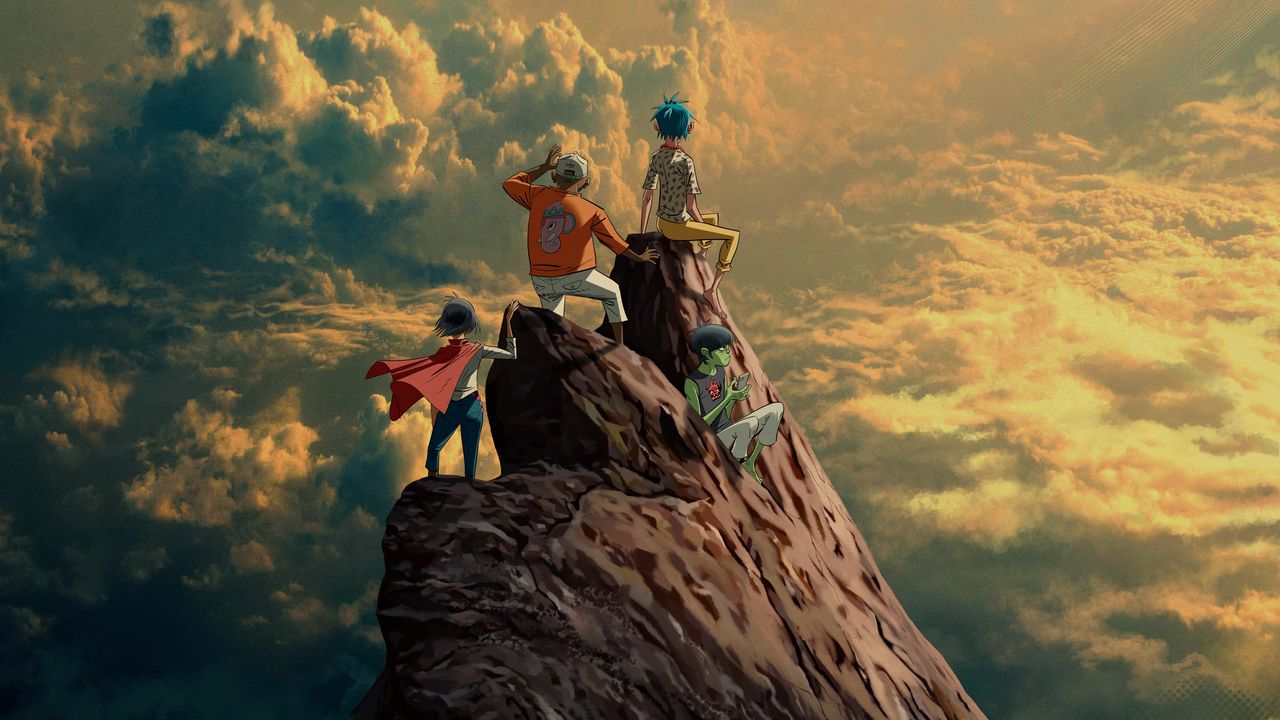
The idea had been for Damon Albarn and Gorillaz co-creator Jamie Hewlett to renew their creative vows by embarking on some “classic Indian odysseys.” Between their two trips to the country, however, the assignment changed shape. In the space of 10 days, both men’s fathers died, and the second visit took on an air of somber pilgrimage. Albarn swam in the Ganges, scattered his father’s ashes into its mythology. Somewhere along the way, he settled on a concept for The Mountain, the follow-up to 2023’s pallid Cracker Island. As well as recruiting a suite of classical Indian orchestra, he would raid his archives for unreleased recordings by deceased Gorillaz collaborators, enacting a convocation of souls.
Grand concepts in place, the pair of art-school Peter Pans proceeded as you might expect. Hewlett drew a cartoon in which a turbaned Russel charms a cobra with a flute (“a bit dated, this one,” Rolling Stone India noted) and Albarn started giving quotes like, “My early years were full of sitar music and incense.” In Albarn’s eager telling, India was not only a creative wellspring but a haven from the “celebrity virus that we all got from America,” a glimpse of a world where artists “could all work together in a wonderful, socialist way.” He was at pains to point out that he had not “suddenly discovered spirituality” in the Eat Pray Love tradition, Rolling Stone India reported, eyebrow still half raised. To Albarn, The Mountain was a humble meditation on grief, samsara-style, tinged with his artist father’s fascination with Indian music and culture.
No score yet, be the first to add.
This willful overreach is more or less business as usual for Albarn and his old housemate Hewlett, who, by conceiving this cartoon combo of multiracial punks in 1998, advanced a vision of pop hybridity that anticipated our age of cultural superabundance. Outstepping their lot as two white Brits was always part of the calculation. (“It was a risk: Damon singing reggae,” Albarn told Q in 2001. “But [cartoon avatar] 2-D singing reggae is fine.”) However simple his artistic code, few Britpop-era megastars have done more than Albarn to forswear allegiance to fusty rock purism—perhaps not even Thom Yorke, who may have written Kid A but did not go so far as naming his child after Missy Elliott.
Nor did Yorke decide, the day after 9/11, to cajole the stranded Detroit rap posse D12 into a West London studio to reckon with the news in real time. Albarn did, and at the heart of The Mountain is an unearthed recording from that 2001 session: a freestyle by the late rapper Proof, riffing on the grisly reality of murder five years before his own. The resulting song, “The Manifesto,” fashions a preset beat on an old portable organ into a hell-raising, seven-minute bhangra anthem with heavy artillery from Argentine rapper Trueno, bisected by a half-time interlude for Proof’s mortal reflections. The thrill of music like this has less to do with its compositional merits than its hatfuls of Albarnian audacity. Only he would devise this morbid musical séance and see the idea through; only he would have had D12 in the room to begin with. “The Manifesto” is a fine pop song but a shining testament to a quarter-century of Gorillaz hubris—Proof’s aural time capsule rising from the earth, Albarn poised to break it open on a canvas stretched just as wide as it will go.
Much of the rest of The Mountain fits into the enduring Gorillaz tradition of the apocalyptic party album, narrated by voices from either side of the veil. “Delirium” casts the Fall’s Mark E. Smith as a diabolical ringmaster beckoning us into the underworld with visions of “shrunken china heads” and “peg-legged slave traders”; “The Moon Cave” invites Black Thought and disco great Asha Puthli into communion with Gorillaz’s late collaborators Dave Jolicoeur (aka De La Soul’s Trugoy the Dove) and Bobby Womack; and “Damascus” presents an incendiary call-and-response between an ecstatic Yasiin Bey and the Syrian dabke supremo Omar Souleyman. Tony Allen and Dennis Hopper cameo from beyond the grave, complementing a reliably ludicrous array of living guests that includes Idles, the Clash’s Paul Simonon, and, together at last on “Orange County,” Illinois singer-poet Kara Jackson, Argentine superproducer Bizarrap, and the sitarist Anoushka Shankar.
Where “Damascus,” “The Manifesto,” and Sparks-assisted pinger “The Happy Dictator” play to their unlikely collaborators’ strengths, the bombast of songs like “The Plastic Guru” and “The Shadowy Light” teeters into folly. On the latter, Bollywood royalty Asha Bhosle, 92, sings in Hindi of setting sail to the other side, but Albarn smothers her beneath heraldic bursts of Disneyfied psych-pop. Musicians including Shankar and flautist Ajay Prasanna pop up across the record—the latter playing ragas in “The Manifesto”—but the material often reduces them to ornamental session musicians. You sense that Albarn’s electropop confections and Auto-Tuned laments, grounded in devoutly Western harmonies, might as easily have borrowed decor from whatever other musical tradition Gorillaz had chosen to covet this time.
That may just be the nature of this globalist-pop colossus: forever adaptable to its makers’ whims, stopping at nothing to snag the perfect collaborator—even if, it turns out, that collaborator is already dead. As much as Albarn comes off like an overstretched Wizard of Oz who can’t stop bowing from behind the curtain, he takes an infectious pride in linking one world to the next. The Albarn of The Mountain performs grief as epic possibility: a plea to embrace the world, even when it feels like the only one in it is you.