
 Written by
 The music of David Moore’s Bing & Ruth has typically resembled cloud systems, ocean waves, swarming shoals of fish. In the spirit of compositions like Terry Riley’s In C and Steve Reich’s Music for 18 Musicians, each of his pieces stirs diminutive patterns into unfathomably vast forces. But over the long sweep of his career, Moore gives the impression of an artist steadily clearing away cobwebs, determined to get at the essence of something. There were 11 players on 2010’s City Lake, his post-classical ensemble’s breakout album, and then seven on 2014’s Tomorrow Was the Golden Age; by 2020’s somber Species, he had stripped his materials down to Farfisa organ, clarinet, and double bass. Moore recently dropped the Bing & Ruth alias for a duo album with Steve Gunn, unadorned piano and acoustic guitar twining like lithe green vines.
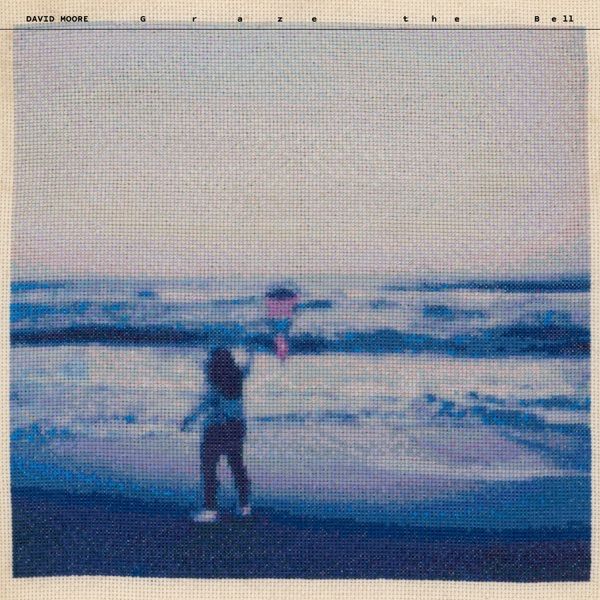
On Graze the Bell, Moore’s debut album under his own name, he further narrows his focus to just solo piano, picking up the thread from a pair of Species interpretations he released in 2022. Using his own name while working with Gunn “provided a freedom that I got really addicted to, and then I just wanted to keep going,” he recently said. That might sound counterintuitive; you might assume that using a pseudonym, escaping one’s given identity, was a surer path to creative freedom. But Moore found something there, and you can hear as much on Graze the Bell. Each of the album’s nine pieces, simple as they are, sounds like a conversation with himself, a search for a truth known but not yet articulated.
No score yet, be the first to add.
Opener “Then a Valley” immediately distinguishes Graze a Bell from Bing & Ruth’s recordings. There, his piano was repetitive, the sturdy backbone around which everything else coalesced. Here, his approach to structure is more open-ended. He begins with a pair of high notes, waits a beat, and answers with a low held tone; his left and right hands feel out the contours of the piece, refusing to settle on a tonal center, delaying the moment when the song will become fixed in a given key. Finally, he lands on a pair of his descending chords as his central refrain, and from there the song takes off, whirlwinds spinning in the right hand while his left hand seeks the ground. He’s not shy about using the sustain pedal, and the longer it goes, the more it smears, prettiness and precision alike sucked under the waves.
Most of the album strikes a similar balance between stillness and turmoil, slow-moving melodies carving their way through the colorful murk. The title track resembles bells gently clanging in the wind; “Offering,” even less delicate than the opener, swirls its chords into thick, wavy brushtrokes that distort a little around the edges. “All This Has to Give” focuses most of its energies below middle C, with roiled arpeggios so bassy that the harmonies are almost imperceptible; to make them out requires subtly retuning your ears, like readjusting your eyes to a darkened room.
For all the record’s fullness, Moore is also capable of great simplicity. The low clouds that open “We Will Be There” part to reveal a melody so fluid and intuitive, you’re shocked you’ve never heard it elsewhere. The Satie-esque “Being Flowers” is wistfully ruminative, the high-end melody resembling a mind in reflection, working out an idea in real time. Sometimes, as on “No Deeper,” his melodies take the form of a question, and then a slight reframing of the question. Despite the emotional baggage an album of solo piano might suggest, Moore’s music is never schmaltzy and never dogmatic. He’s asking, not telling. The halting two-note figures of “No Deeper” sounds to me like the weighing of doubts, a succession of tentative thoughts: And if…? Unless…? Perhaps…?
Many solo piano albums strive for naturalism, but not Graze the Bell. The record’s larger-than-life physicality stems from the way that Moore and his engineers Ben Kane and Owen Mulholland treated his instrument in post-processing, using Melodyne software to isolate the low end and mix it separately from the high end. I couldn’t tell you how that works, but I know how it feels: as though you were lying on top of his Steinway concert grand, the bass rattling your ribcage as the mids and highs threaten to overwhelm your ears. For all his affinities with ambient and even new-age music, Moore clearly has no interest in niceties. Graze the Bell has a bold, staring-into-the-sun quality; it feels like a shout from the mountaintop: Yes, goddammit, I am alive.