 Written by
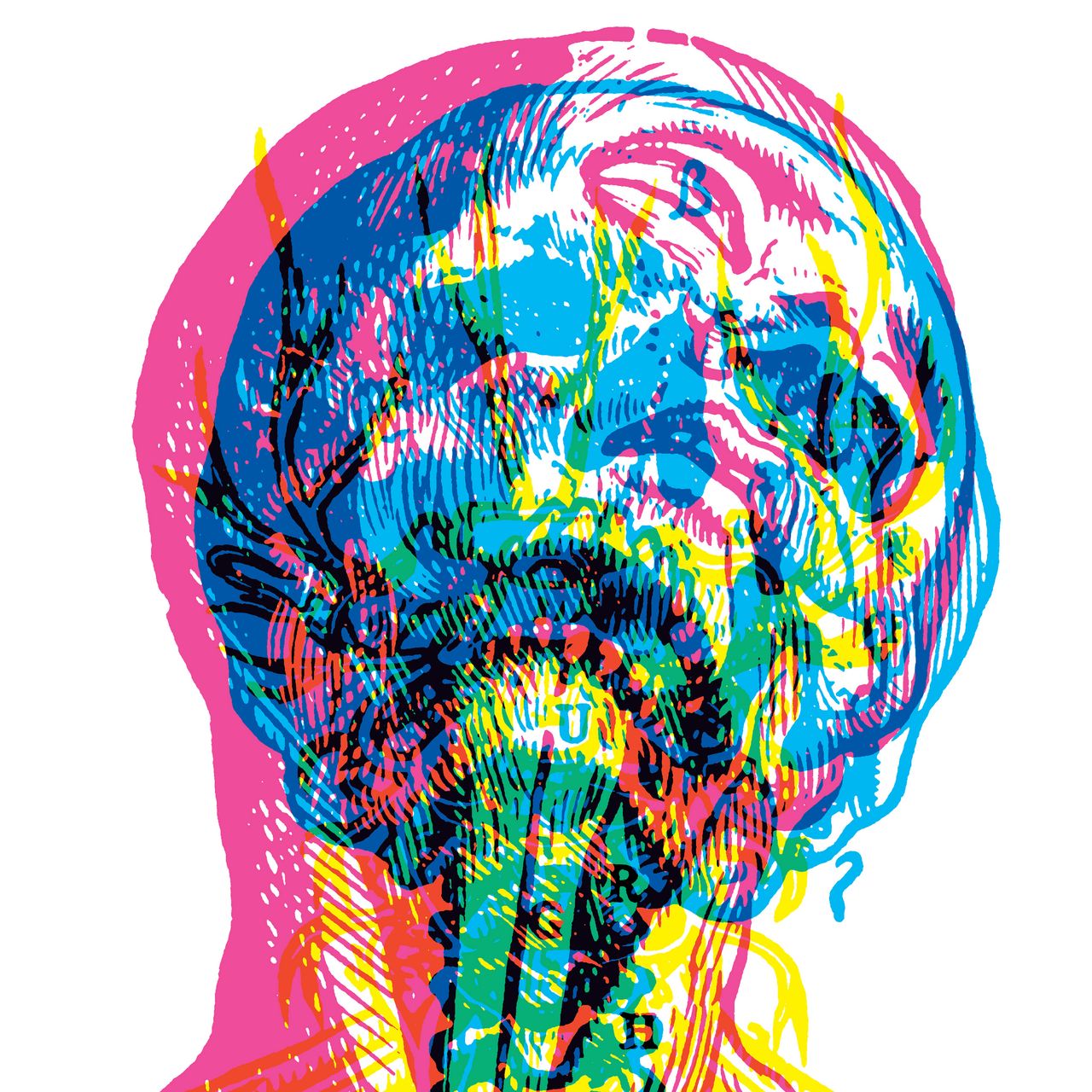
 While working on their second album, two members of Mandy, Indiana—the Mancunian quartet fronted by a French valkyrie named Valentine Caulfield—were faced with their own corporeality. Drummer Alex Macdougall underwent surgery for a hernia and, after doctors found a lump, had half of his thyroid removed. Caulfield lost most of her vision in one eye. The 10-hour days that comprised the recording sessions could have broken them. Instead, the band’s distinctive sound—an alloy of industrial, post-punk, and ’80s neo-noir soundtracks—emerged titanium-plated and electrified. URGH is both headier and more visceral than anything Mandy, Indiana have made before. This isn’t body music or brain music; it’s spine music, homed in on the bony junction where mind meets matter.
Listening to Mandy, Indiana’s 2023 debut, i’ve seen a way, felt like wandering the darkrooms at Berghain—if Berghain blasted vintage French pirate radio broadcasts. You were in the cool kids’ club but couldn’t shake the sense of being held at a remove, as if there were another velvet rope you weren’t allowed to cross. URGH puts you right in the sex sling, and there’s Caulfield towering overhead, cracking a riding crop. As she recites Revelation 6 (the one about the Four Horsemen of the Apocalypse) on opener “Sevastopol,” her voice glitches and frays like Jigsaw coming through the TV screen. The abiding mood is powerlessness: At any second, a trapdoor might open beneath your feet, sending you down a tube slide into a hornet’s nest of violins or a ball pit full of scrap metal.
No score yet, be the first to add.
Caulfield’s lyrics—most of which she delivers in her native language—have always been concerned with power, specifically how interpersonal violation mimics the patterns of structural violence. In press materials, she described URGH’s lead single “Magazine” as “the only way I will ever get to say to my rapist: You hurt me, so I’m going to hurt you.” After a blistering salvo that can best be likened to Trinidadian soca produced by Edward Scissorhands, “Magazine” plunges into a techno netherworld akin to the one Coil charted on “The Snow.” “This time, despite what you believe, you won’t escape me,” Caulfield purrs, as a one-syllable sample of her voice gets chopped and splattered across the stereo field. To borrow a framing from the radical feminist scholar Andrea Dworkin, when the autonomous zone of one’s body has been forcibly colonized, fantasies of retribution—to never let him do that to anyone else, ever again—are often the sole recourse. Caulfield sharpens them into knives.
In Mandy, Indiana’s hands, repeated sounds and phrases become improvised weapons. “Souris souris souris souris/C’est plus joli une fille qui sourit” (“Smile, smile, smile, smile/A girl who smiles is prettier”) went the skin-crawling nursery rhyme hook of i’ve seen a way’s “Drag [Crashed].” On URGH, Caulfield flips the French playground chant “Am stram gram” into a call to the dancefloor (“Cursive”), and recreates a sample of the “Light as a feather/Stiff as a board” scene from the 1996 teen-witch cult classic The Craft (“Life Hex”). As her voice gets gobbled up by the gnashing teeth of Macdougall’s kit, the listener is, in turn, subjected to the ravages of growing up as a girl under patriarchy. But these kinds of schoolyard games are also early building blocks of female solidarity, the groundwork upon which networks of collective care—from “Are we dating the same guy?” Facebook groups to French women’s activism behind Gisèle Pelicot—are built.
“Do you want to be remembered as someone who clapped as the bombs rained down?” Caulfield demands on “Dodecahedron.” “Stand up and march.” She namechecks Gaza directly on “ist halt so,” which sounds like “Bulls on Parade” being fed through a paper shredder. Mandy, Indiana’s livewire, high-wire act—they’re somehow even more galvanizing onstage—gets juiced here by production from guitarist Scott Fair and Gilla Band’s Daniel Fox, who throw on the floodlights, catching the contours and reflections of every instrument. The rotor-blade synth that descends halfway through “try saying” seems to chop the song into ribbons. On“Sicko,” which isn’t that far afield from the most virulent El-P beats, Caulfield hands the mic to another postmodern prophet, billy woods, who rails against Big Pharma.
For the closer, “I’ll Ask Her,” Caulfield dons a British accent and sneaks behind enemy lines: “And anyway, you stand by your boys, ’cause they’re your boys and that’s just how it is, and they’re all fucking crazy, man.” A synthesizer blares like an air raid siren, one of those Pavlovian triggers that means get out, get out, get out. Insidiously catchy, incomprehensibly groovy, URGH is a razor blade hiding in a rainbow jawbreaker. Then, in its final moments, Caulfield just says the thing: Your friend’s a fucking rapist!!!
Where do you go from there? Out into the streets seems like a start. An “urgh” can be a vulgar grunt, a furious growl, a cry of physical exertion. It also sounds a lot like “urge.” On a record that transforms this band’s music into an abstracted, serrated version of its previous self, it seems pointed to close with its most startling lyric, delivered in the second person as an accusation. Here the hard work begins.