 Written by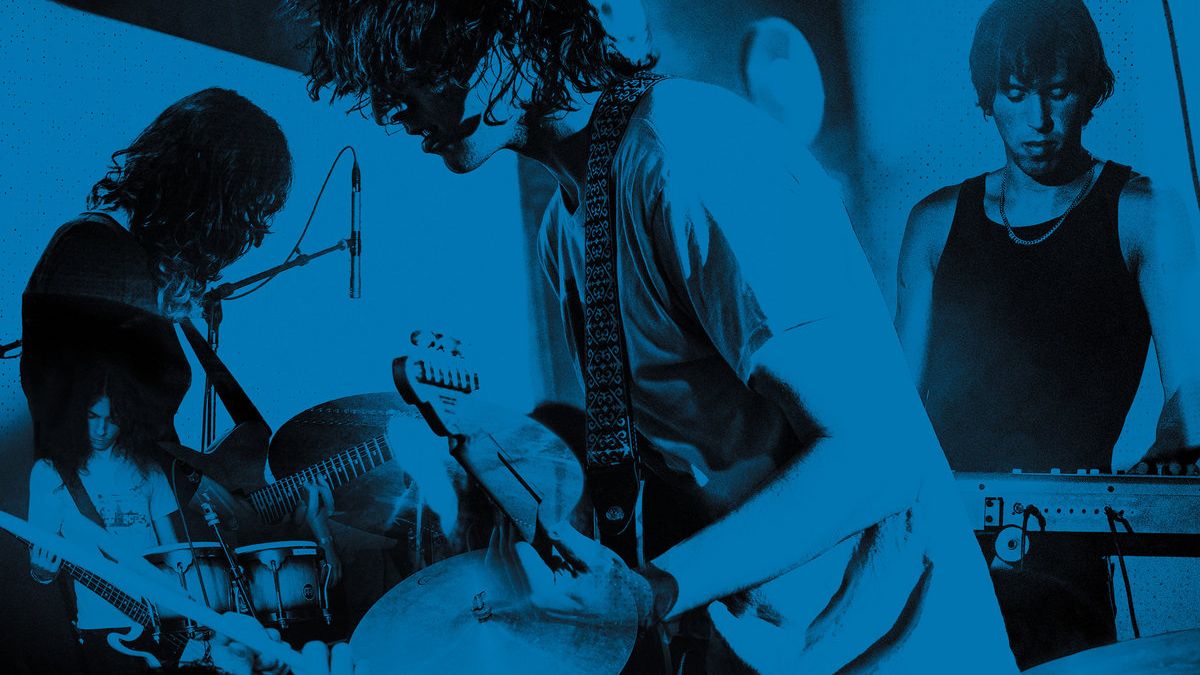
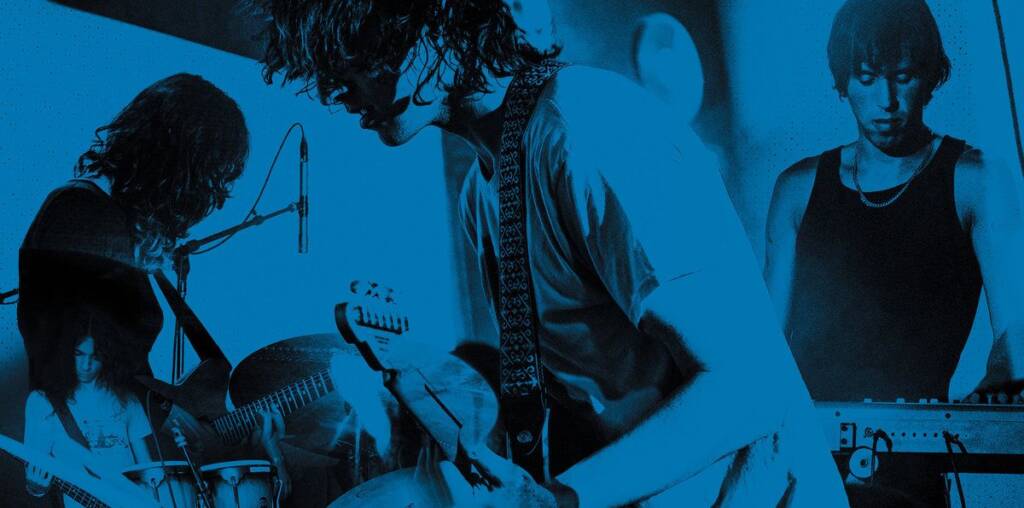
A Geese song manages to be both tight and sprawling the same way a lecturing physicist might reference astrology—a quantum conundrum that reaches towards the outer limits of the expected. Between their melodies, inevitable as a heart attack, the four New York musicians carve out room for the unexpected to unfurl. Geese’s live set at Third Man’s Blue Room in Nashville is a well-timed snapshot of their ascent to stardom, standing on the precipice between an underground artist’s hustle and the realized dream of widespread fame.
Opener “Islands of Men” shimmers with rapturous possibility. A steady drum beat punctuates the crowd’s anticipation before Emily Green’s guitar throbs to life, and then frontman Cameron Winter’s vocals warble in the foreground, a tentative entrance that quickly builds into an infernal madrigal. As the opening tease explodes into driving chords—“Will you stop running away from what is real?” Winter pseudo-articulates—a keyboard riff dances underneath the chaos, and we are somewhere inside Yeats’ “widening gyre,” the music growing more and more expansive while the center somehow holds.
No score yet, be the first to add.
There is an urgency to Geese’s performance, perhaps because the Third Man set captures the band finding its sea legs with a new spate of material. At this show, they debuted tracks they’d recently recorded for their album Getting Killed; that record would come out three months later, catapulting them to the top of year-end lists and earning them a reputation as potential saviors of rock ’n’ roll. Onstage in Nashville, songs like “Islands of Men” and “Taxes,” have a certain ranginess, rambling just beyond the point of propriety towards a CBGB’s sensibility that evokes Television or, if you squint, the spirographic noodling of a Dead & Company set.
Nowhere is this more evident than on the raging “Taxes.” “I should burn in hell,” Winter croons like an unmedicated Muppet at the opening, more meditative than resigned. Green’s guitar whirls nimbly underneath the words, while an effect like a muted choir loops in the background. It’s easy to invoke the songwriting greats here—Bob Dylan’s wry social commentary, or The Band by way of Scorsese, waxing poetic on the working man’s plight with a whiff of the existential—but more than anything, it’s the sort of cri de coeur that might lift the asses from a church pew, or hoist the picket signs skyward. The simple chorus is an adrenalized rallying cry: “If you want me to pay my taxes/You better come over with a crucifix/You’re gonna have to nail me down.”
It’s not all a fever dream. “Au Pays du Cocaine,” one of Getting Killed’s viral standouts, might be the weakest moment on this recording. What plucks at the heartstrings with its Herb Alpert studio melancholy sounds a little fried here, the song’s plaintive, tentative charm buried under thrashing improvisation. Similarly, the transition into “Half Real” rocks so hard it trammels its more delicate, wistful source material—a cacophonous entry into existentialism, like barreling full speed into the therapist’s office.
“If you want to sing anything to eternity, say it now,” Winter tells the crowd before “Trinidad,” the closing track, an on-brand admixture of confusion and profundity. The song shines like a pair of brass knuckles. “There’s a bomb in my car,” he shrieks in the chorus; picturing him here, onstage before a sold-out crowd, one wonders if this is an emergency or a First Amendment edge case. The lyrics recall an Ari Aster nightmare: son’s “in bed,” daughters “are dead,” “wife’s in the shed,” “husband’s burning lead.” In the midst of the carnage, Max Bassin pounds the snare like it might crack open to reveal the universe’s great mysteries. The noise is fervent. There inside the din, we have arrived at the thesis of Geese: head-scratching anthems that circle against the ineffable like ghostly revenants, ready to howl, stymied by the human condition.