 Written by
 When my parents gifted me a toy microscope in middle school, I put everything I could under the lens. I didn’t really care to learn the parts of a cell or the phases of phagocytosis like my parents hoped, but I was thrilled to uncover images that had been hiding in plain sight. Suddenly, onions were purple brick walls, cotton T-shirts were cobwebs, my own skin was full of extraterrestrial craters and rivers. It was exhilarating to learn that everything I had seen until that point could be viewed another way.
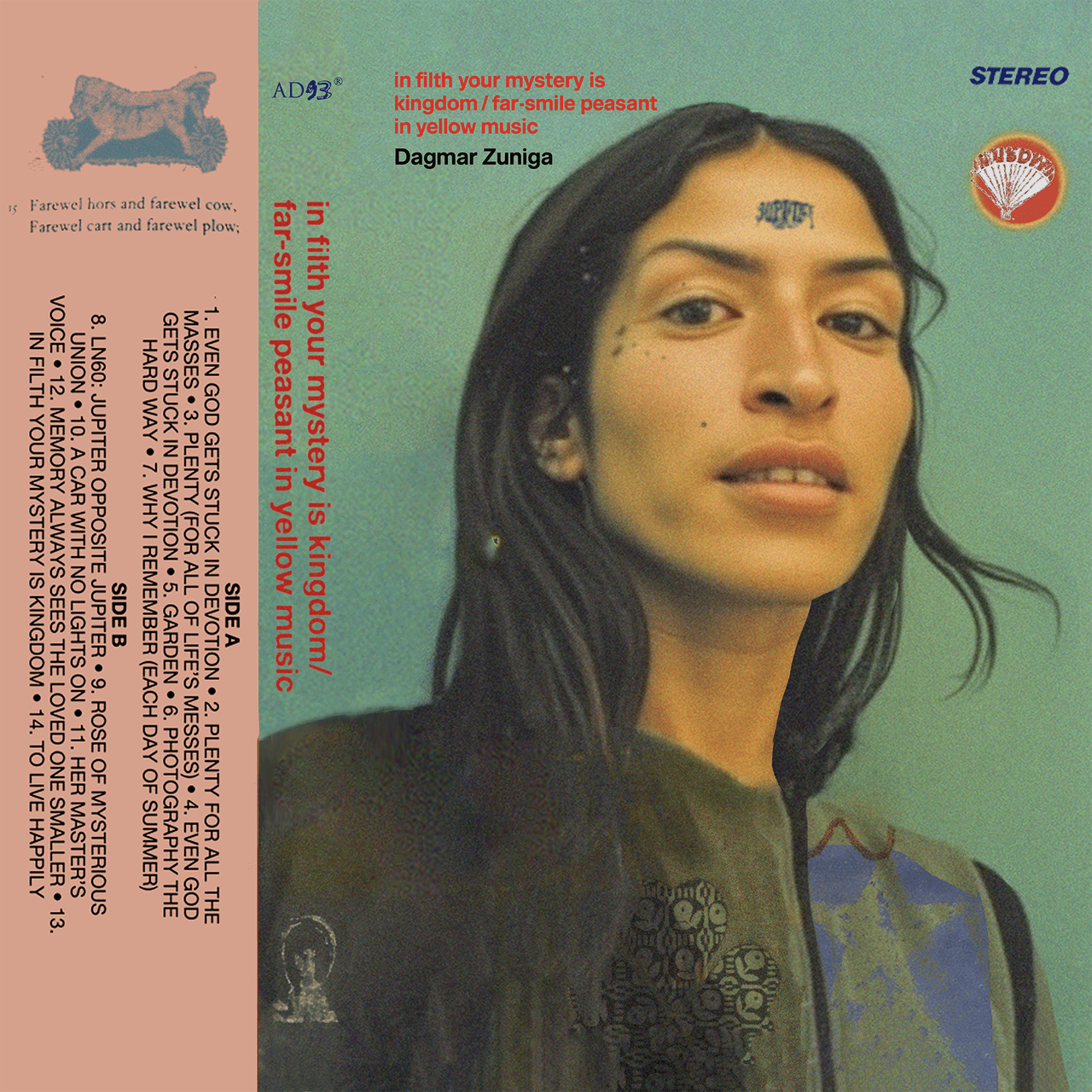
That’s the magic you feel hearing Dagmar Zuniga’s debut album, in filth your mystery is kingdom / far smile peasant in yellow music. It’s like Zuniga has placed half an hour under her own microscope to reveal the various slices of life coexisting within a single moment: the Roches arm in arm singing dissonant harmonies together in their living room; hand cymbals like those used at a Hindu prayer service; the life and death of a star; somewhere you went as a child, somewhere you might go in a dream. These songs encourage you to perceive time differently as you listen, less as a series of discrete events arranged linearly and more as a constellation of memories and premonitions, dreams and regrets.
No score yet, be the first to add.
Zuniga uploaded these songs to Bandcamp and YouTube last year, and they quickly gained a number of fans, including Mount Eerie, who took her on tour last summer. She recorded everything on a TASCAM 424, drawn to the four-track cassette recorder because, in her own words, “If something is not material, it does not exist.” The songs are nested in tape hiss and arranged with vocal harmonies she layers like falling snowflakes and drones that fill up the crevices of your lungs. It has the tactile intimacy of 1970s folk musicians like Vashti Bunyan and Karen Dalton, music that feels tied to the natural world it dreams of. Her work sits at many crossroads: between the analog tools she used to make it and the digital world where it gained recognition, the past and future, this world and another.
Zuniga pulls from a sonic palette that feels familiar one moment and alien the next. On “Even God Gets Stuck in Devotion,” she layers and offsets her gauzy falsetto with fingerpicked guitar and a flute melody as lonesome as a balloon floating away into the sky. It sounds both grounded and meandering, rooted in the love she describes and the solitude she anticipates. In “LN60:Jupiter opposite Jupiter,” a rhythm that could propel a pop song fades into swelling organ melodies that evoke a church wedding procession before dissipating into angular drone notes. Across the record, Zuniga moves between images of fleeting contentment to future heartache, from the sounds of devotional spaces to strange, detuned modulations. It feels like she’s holding all of time and space in her hands, considering which bits to exalt and which to discard.
As much as this music ties itself to the beauty of the physical world, it’s also enveloped by a thick fog. “A Car With No Lights On” paints an eerie half-image of a devilish man who haunts the periphery of Zuniga’s vision. Zuniga’s voice flickers as she describes his handle-less knife, his eyes like a car with no headlights. On “Rose of Mysterious Union,” an arpeggiated drone feels off kilter and menacing, like a home video played in reverse, or the moment you realize you’re dreaming and none of the people you’re speaking to are real. The effect is surreal and glitchy, reminiscent of the synth-driven, electronic shoegaze of early L’Rain recordings.
These songs aren’t explicitly contemporary—even the way the album’s packaged seems like it’s a lost private pressing you stumble upon in a record store. But this out-of-time music comes to us when the natural world is deteriorating and the ever-present internet is a tool of mass surveillance and a lens to witness multiple global atrocities at once. In her endeavor to exalt such a bleak world, Zuniga seems to be battling herself. She acknowledges that “memory always sees the loved one smaller” and then also shares “why I remember,” citing “white ripe strawberry bruise/beats in the heart” as her reason. She lays bare her pain but ends the record with a wordless composition of stormy static and crystalline piano notes titled “To Live Happily.” Zuniga allows these disparate perspectives to coexist without overexplaining. A star can be shining now and gone tomorrow, a memory beautiful and still insufficient. Her comfort with dissonance creates a sense of expansiveness and richness to songs that often only feature a handful of instruments at a time.