 Written by
 “I started shooting up heroin when I was 13,” Art Alexakis remembered when I first spoke with him in 1996. “Most kids were shooting up at 15 or 16, but I was hanging out with older kids, so I didn’t want to be left out of all the fun.”
‘Fun’ is not a word that crops up much when Everclear’s frontman looks back on his early life. There’s a lyric on his band’s ninth album, Black Is The New Black, that will stop your heart.
“I was raped when I was eight years old on a sunny afternoon,” Alexakis sings on You. “See me, playing with the older boys in a house where my mama told me not to go. They started hurting me, laughing as they held me down. They broke me as I screamed inside.”
“Obviously they had been beaten and raped themselves,” he reflected in 2023, speaking on the Lipps Service podcast. “Hurt people hurt people. I never told my mom about that because my mom kept a .38 under a mattress and she would have killed them.”
Raised by his “hillbilly” mother on the Mar Vista Gardens housing project in Culver City, California after his Greek father walked out on the family, Alexakis’ early years were filled with trauma, pain, violence and death. Before his 13th birthday he lost older brother George, aged just 21, to a heroin overdose, and his girlfriend to suicide. Friends were killed in gang shootings. Following a failed suicide attempt of his own, when he jumped off Santa Monica pier with his pockets weighted down by stones and sand, Alexakis decided to become a gun-carrying drug dealer. Before he was old enough to legally drink, his clientele had expanded to include millionaire English rock stars and Hollywood actors.
Article continues below
“Everyone dealt drugs to pay for their own drugs,” he recalled of his social group at the time. “When you become an addict you do whatever it takes to get your fix, and I was no different.”
On June 14, 1984 Alexakis shot up three-quarters of a gram of cocaine at a friend’s house in Orange County and collapsed writhing on the floor: but for the immediate attention of a medic who lived next door, he would not have seen the sun rise. Although he did not realise it at the time, it was exactly ten years to the day that his brother died.
“I went around to my mom’s house the next day,” he told me in 1996, “and she said, ‘Where were you yesterday, we were going to visit George’s grave?’ What could I say, Well, I had the paramedics putting electric shocks on my heart to being me back to life?”
The overdose was a turning point in the 22-year-old’s life. On New Year’s Eve, 1984, he gave up drugs for good, and began to pursue dreams of being a musician. After moving to San Francisco, he joined a cow-punk band named the Easy Hoes, and later started a solo project called Colorfinger, which in time became a band.
“I was always able to express myself better with a guitar in my hands,” he told me in 2015. “Songwriting was always a kind of therapy, a way of getting shit out. I wore all the darkness on my sleeves. It wasn’t until I started to like myself a little better that I was able to move on from that.”
I told my girlfriend, I have to do one more band or I’m going to kill myself
No sooner had Colorfinger began to attract a cult following in the Bay Area however, than fate intervened to derail plans once again. Alexakis’ girlfriend Jenny became pregnant, and the young couple relocated to her hometown of Portland, Oregon to await their baby’s arrival. Cast adrift from old friends, the singer was restless, bored and fearful of falling into old bad habits in a city infamous for the ready availability of heroin.
“I told my girlfriend, I have to do one more band or I’m going to kill myself,” he recalled.
In 1992, he formed Everclear with bassist Craig Montoya, and drummer Scott Cuthbert. A year later, Tim Kerr Records released the trio’s brilliant debut album World Of Noise, recorded for just $400. Rave reviews for the record soon had major labels sniffing around, with Everclear being touted as ‘the new Nirvana‘.
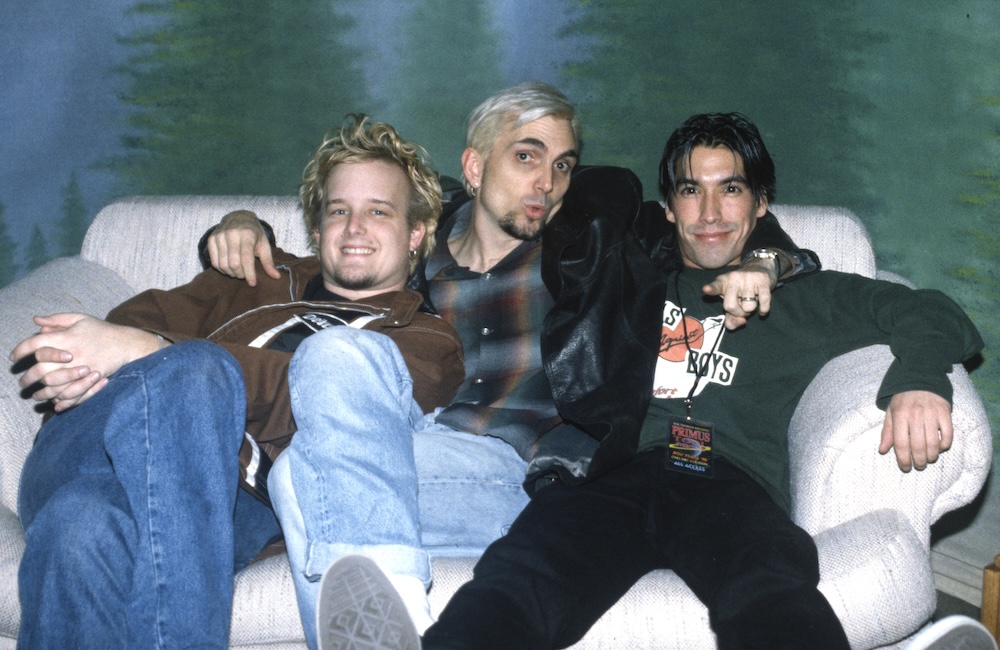
“I understood the Nirvana comparison, of course I did,” Alexakis said. “Blonde-haired singer, three-piece, screaming, from the North-West… I understood it. But it seemed that a lot of writers used that comparison as a way to attack us, like we were deliberately trying to copy Nirvana, which was nonsense. People always try to put you in a box, but all you have to do is smile, keep going and politely say, Fuck them.”
Drawing deeply upon stories from Alexakis’ troubled past in raw, open-hearted power-pop anthems such as Heroin Girl and Santa Monica, the trio’s Capitol Records debut Sparkle and Fade struck a chord with the US record-buying public, and passed the million sales mark by the end of 1995.
“I alway knew I had it in me,” the singer told me in 1996.
20 years and five multi-million-selling albums on, however, Alexakis admitted to me that he was never entirely comfortable with his band’s multi-platinum success.
“It felt good to have be appreciated,” he said, “but I kinda never trusted the acclaim, and unfortunately because of that I didn’t really enjoy the experience. I grew up poor, and I was used to people wanting and expecting me to fail, so when that album connected it felt strange. I knew how to fail, but I didn’t know how to win.”