
 Written by
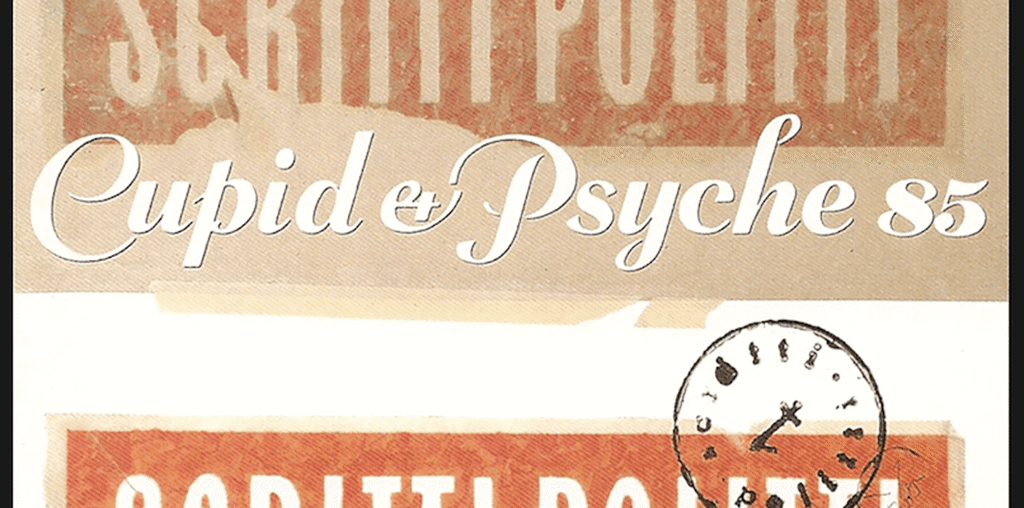
You could say that the songs on Scritti Politti’s Cupid & Psyche ’85 are informed by Robert Rauschenberg. You could say they interrogate the very creative act that yielded them. You could say that they rebel against the notion of private language in abstract art, taking the position that meaning can only be constructed in terms that have been agreed upon implicitly or explicitly by artist and audience alike. You could say that Cupid & Psyche ’85 was an effort to consolidate an audience large enough to recoup the $500,000 advance that funded it, an audience that included both the teenyboppers who would buy the singles and older connoisseurs who would shell out for the LP. You could say that Green Gartside’s indomitable tendency toward self-critical reflexiveness places him in danger of being a contrived performer, but—and this is important—you could also say that the whole notion of the primacy of gut-level emotion in music is a bankrupt one in a lot of ways. You could say that Gartside deals in rhythm, in grooves—that’s what matters. You could say that he draws from pop’s assertion of rhythm, its interruption of language, the way that it presents and dissolves identity. You could say Cupid and Psyche ’85 is Pleasurable: that’s Pleasurable with a big “P,” which can admit all similar degrees of discomfort and unease and challenge. You could say that it aims to address the whole complicated question of what pop is; its relationship to language, sex, power, and politics. You could say, finally, that it opens with the single whitest pop-reggae song ever written.
You could say all this and a whole lot more about Scritti Politti’s masterpiece of gleamingly mechanized post-modern pop, and you still wouldn’t be saying anything that Green Gartside himself didn’t already say on the marathon press tour he took in lieu of a single live performance upon its release, an endless series of interviews with baffled and fawning and condescending reporters during which he attempted to explain his brilliant transformation from a squat-dwelling communist darling of the DIY post-punk underground into a pop star with a personal makeup artist and a haircut like Princess Diana’s. In his defense, there was a lot of explaining to do.
No score yet, be the first to add.
In the beginning, Scritti Politti was a commune as much as a band. Gartside was an excessively tall, handsome, and brainy Welshman who spent his teen years as a member of the local Young Communist League. He attended the famously radical art school at Leeds Polytechnic, and in 1976, like many young Britons of similar disposition, he witnessed the Sex Pistols and the slate of all-star openers they brought along on their Anarchy in the UK tour and found his calling. He soon started a band, left college, and moved to London to major in the new thing called punk.
Scritti Politti made its headquarters in a squatted apartment in Camden with no hot water and no place to bathe. Only three of them consistently performed on record and in concert, but at least a dozen more were honorary members who attended formal band meetings and were granted as much say in its direction and philosophy as those who actually played the instruments. Their de facto leader was subsisting “mainly just on booze and speed,” as he recounted to an interviewer years later.
At a time when post-punk was already on the verge of becoming a commodity, Gartside and his motley crew were zealously committed to DIY. They released their debut single, 1978’s “Skank Bloc Bologna,” on their own St. Pancras label, with distribution help from the like-minded upstart Rough Trade. They adorned its sleeve with an itemized account of what it had cost them to make, from recording to pressing to the stamping of the very text you were reading. In hopes of inspiring other scrappy young bands, they also included addresses and contact information for the studios, the pressing plant, the Rough Trade office, and the Scritti squat itself. The band soon started to receive regular visits from “anarchists from across Europe, and schoolboys that had run away, and anyone else who fancied pitching up and getting drunk, doing drugs and talking music and politics,” in Gartside’s telling. “Skank Bloc Bologna” set the template for the early Scritti Politti sensibility: minimal and bracing, with a groove that drew liberally from the Jamaican music that permeated London in the late ’70s, a lyric about the dreariness of a life defined by thankless labor and empty consumption, and Gartside’s guitar splattered atop like drippings on an action painting.
Just how far did Scritti Politti have to travel between “Skank Bloc Bologna” and “The Word Girl,” the whitest pop-reggae song ever written? The latter was released by Virgin and went to No. 6 on the UK pop charts, the biggest hit the band ever had in its home country, the kind of hit Gartside had been aiming at for years by 1985. With its relaxed and spacious arrangement, which refashions the swoony sound of Jamaican lovers rock from rinkydink electronics, it’s a bit of an odd introduction to an album that otherwise tends toward excitable maximalism. Reggae had been a touchstone for Scritti Politti since the beginning, but Cupid and Psyche ’85 is more openly infatuated with up-to-the-moment sounds like electro, post-disco, and early hip-hop, turbocharging their dance rhythms near to the point of absurdity and buffing their surfaces to an uncanny sheen. Like their future disciples in PC Music, Scritti Politti were giddy pop fans who approached the form as self-conscious outsiders, foregrounding its artificiality, pushing its bright colors to new extremes, aiming to make great pop records that also asked probing questions about what pop even is.
In “The Word Girl,” that questioning happens primarily in the lyrics, which declare the singer’s love not for any particular girl but the word “girl” itself as a trope of pop songwriting: “A word for you to use,” Gartside sings to himself and any other songwriters who might be listening. He’d always been a compulsive skeptic of accepted truths: “Hegemony,” an early Scritti song, calls the notion of cultural consensus enforced from the top down “the foulest creature that set upon a race.” Under the influence of deconstructionist thinkers like one of his heroes, the philosopher Jacques Derrida, he eventually became preoccupied with the fallibility of language itself: the way it would always fail to address its subjects in any direct and absolute way, the way it could carry in its very syntax all sorts of assumptions and biases that inevitably served the powerful and upheld the status quo. “The Word Girl” was his attempt to apply this line of thinking to the vocabulary of pop: to ask—well, something—about what all those silly love songs really mean. It could be a feminist critique of the way pop’s male gaze flattens individual womanhood into idealized girldom. “The girl was never real/She stands for your abuse/The girl is no ideal,” Gartside croons with disconcerting sweetness in the second verse. But then, wasn’t he committing the same sort of flattening by treating women as mere fodder for his idle philosophizing?
In his lukewarm Rolling Stone review of Cupid and Psyche ’85, David Fricke wrote that Gartside “often imitates the very formulas he seeks to undermine,” a critique of the album’s super-slick production that could just as readily apply to the nesting dolls of metacommentary that make up its songwriting. It’s a good observation and a hard one to argue with; even Gartside, I imagine, would concede the point. In fact, he’d probably take it as a compliment. Scritti Politti were primarily interested in making pop, not criticizing it. “The Word Girl” may fall short as an essay, but what matters is how well it works as a song. And in the years leading up to Gartside’s big pop experiment, he’d become a fantastically capable pop songwriter. The chorus melody of “The Word Girl” repeatedly leaps upward and tumbles down and leaps again, a dance of aspiration that lends a sense of well-earned gravity to the final line’s allusion to Christian theology: “How your flesh and blood became the word,” Gartside sings as the chords open up like clouds parting behind him.
In the end, the lyrics work for the simple and mysterious reason that they serve the melody well, and vice versa. This combination of word and music to produce an emotional effect greater than the sum of its parts is one of pop’s dark arts, and always has been: Gartside’s use of the word “girl” is ultimately not so different from Buddy Holly’s or Brian Wilson’s. Maybe that’s what the lyric about the incarnation is really getting at: pop’s magic power to draw life out of inert language, to create sublime feeling from the right combination of stock phrases and musical gestures. Or maybe it just sounds good.
The bravado Gartside wielded even in the band’s early days emerged from deep self-consciousness, the product of a mind whose perpetual questioning and deconstructing did not cease when it turned on itself. He had powerful nerves about performing live, and was still living on mostly speed and booze. After a show with his comrades in Gang of Four in 1980, he had a panic attack that landed him in the hospital, and eventually back in Wales, after his parents showed up and took him home to convalesce.
It was there that Gartside underwent his conversion to the church of pop. He went through his sister’s old R&B records. He got deeper into contemporary Black music: Zapp, Chic, the Jacksons. Somewhere along the way, he’d lost his faith in Marxism as a rubric for understanding the world, and in this faithless period, he developed a particularly intense appreciation for Aretha Franklin. He thought bitterly about what he would later call the “post-punk gothic doomhead despondency and complete inertia and irrelevance” of his old scene, and the toll his anarchic lifestyle had taken on his health. He wrote a manifesto for his bandmates about Scritti Politti’s new direction. 1982’s Songs to Remember, the album they made when he came back, was a half-step. No one but the devoted faithful was ever going to sing their heart out to “Jacques Derrida,” whose chorus goes, “I’m in love with Jacques Derrida.”
The culture had been primed for Scritti’s transformation. In 1980, not long after Gartside’s breakdown, the journalist and impresario Paul Morley had published an essay in the NME outlining the tenets of “new pop,” denouncing the rock underground as an aesthetic backwater and urging young bands “towards an overground brightness, fighting for the right to bring life back to the radio.” Morley positioned the new pop in terms of insurgence, but its privileging of mass-market aspiration over DIY interdependence aligned neatly with the new decade’s hostility to organized labor and the welfare state that had nurtured previous generations of bohemia. Within a couple of years, post-punk-rooted bands like the Human League and ABC were racking up hits at home and abroad, becoming real stars. Songs to Remember got good reviews and sold exceptionally well by Rough Trade’s standards, but it failed to produce the major hit that Gartside desperately wanted. As Simon Reynolds puts it in Rip It Up and Start Again, his authoritative history of post-punk and new pop, “Green underwent the public humiliation of having talked loudly about ‘pop’ without having become popular.”
Gartside’s bandmates quit. He started badmouthing Rough Trade in the press. He got out of his contract, found a new manager, moved to New York, got himself signed to Virgin with a half-million-dollar advance. For Scritti Politti’s second iteration, he brought on two American musicians who shared his new taste for the ultramodern digital syncopations of the era’s Black pop and dance-music vanguards, and his new conviction that the margins of the music industry were no nobler than the mainstream. He believed that the high-definition hooks he had taught himself to write could convey weighty political and philosophical critiques just as efficiently as the kind of expressly oppositional music he had left behind. More than that, he believed that pop’s capacity to speak to a wide audience in a language they understood opened possibilities of communication that were entirely closed off in his old approach. As he put it, a bit petulantly, in an interview at the time: “Pop music is demonstratively very important by virtue of the number of records it sells.”
There was David Gamson, a 24-year-old electronics wizard and composer-in-training who helped to shape Cupid and Psyche ’85’s extravagant layers of sampled and synthesized sound, a tapestry of iridescent edges whose startling complexity was inspired in part by his interest in classical counterpoint. And Gamson’s college buddy Fred Maher, a drummer for Lou Reed, Richard Hell, and the avant-funk band Material, who, like Gartside, saw how the new electronic pop was surpassing the musical adventurousness of his old post-punk comfort zone. For Cupid and Psyche ’85, he ditched his traditional kit almost entirely in favor of gadgets like the LinnDrum and the Fairlight CMI, an early sampler that could turn any sound you chose into a playable instrument, pitching it up and down across the range of the keyboard.
To guide the initial sessions, the band brought in the hitmaking producer Arif Mardin, whose pop bona fides included producing several classic Aretha Franklin records and overseeing the Bee Gees’ transformation from musty ’60s holdovers to disco superstars. The production approach they developed together was more like structural engineering. A single song might involve five different snare drum tracks. Sounds from the Linn were shot through the Fairlight and sequenced into percussive melodies. “We wanted to make the hi-hats sound like a caricature of a machine,” Maher explained, a description that could extend to nearly every sound on the record. On certain drum fills, it sounds like Maher is cycling through presets at funky warp speed. A crisply naturalistic sound might be followed by another draped in gaudy digital echo, then another like a small explosion in the next room, each seeming to emanate from its own utterly distinct spatial plane.
They hired first-call session musicians—Miles Davis bassist Marcus Miller, Michael Jackson guitarist Paul Jackson Jr., Chaka Khan drummer Steve Ferrone—and mercilessly sliced their performances into metronomic raw material for the sampler. As Gartside put it, “it would definitely be easier to get ‘real human feel.’” But “real human feel” was exactly the sort of shibboleth they were interested in destabilizing. Even the vocals had a touch of the artificial: Gartside had always had a remarkably high and airy voice, especially for a man of his 6’6” frame, but on Cupid & Psyche ’85 he sounded like a cherub, a baby doll, an alien.
“Absolute” was one of three songs Scritti Politti recorded with Mardin in New York before relocating to London to finish the album with another engineer and the band producing themselves—either because they wanted more control or because his producer fees were eating too much of their budget, depending on who you asked. It is Cupid and Psyche ’85’s furthest sojourn into the unreal. Pinprick funk guitar trades phrases with synth lines that come down like sprinkles in a digital snow globe. Gummy electronic bass wobbles and stutters; sequenced tambourine shakes give dainty punctuation to every third bar. You can listen over and over trying to take stock of every sound and still not register them all. But the overall effect isn’t muddy or overstuffed; it’s positively transparent. The band and Mardin whittled everything down into little bips of percussive staccato, leaving plenty of space for air between them, and they ingeniously orchestrated their melodies across multiple instruments, so that a line might start in the bass, jump up to a fragmentary guitar stab, and finish on a twinkly keyboard.
The song’s extended instrumental breaks, crafted with club dancefloors in mind, are especially hypnotic. In the first, bells that might have been lifted from a piece of Steve Reich’s classical minimalism appear from nowhere to do their chimey dance for a few bars and then vanish. It reminds me of a similarly whimsical and abrupt toy piano cameo in “Skank Bloc Bologna.” Gartside had loved these sorts of playful sonic fakeouts since the beginning; now, he had a much bigger budget to pull them off. In “Absolute”’s second instrumental break, a single grain of Gartside’s white-sugar voice gets the Fairlight treatment, pitched up down and sideways into some sort of rock-candy dream sculpture of a keyboard solo. Scritti Politti weren’t the only artists using the Fairlight to amazing creative effect in the mid-’80s, but no one else had made it sound so weirdly sticky and alive, so discomfiting and irresistible in its fusion of the artificial and the real. It’s funny and poignant to imagine the band’s brainy conceptualism colluding with Mardin’s industry-bred hitmaking instinct on a song as audacious as “Absolute.” They were deconstructing pop from the inside out; he was just making a killer record.
The lyrics, according to Gartside, are about “the notion of the ultimate truth about the world.” “We’re all running around and none of us is quite grasping what it is,” he told Sounds about a month before the album came out. “The point of the song was a) there isn’t one and b) it’s somehow a terribly difficult myth to live without. It’s hard to reconcile yourself to the idea that
there’s nothing on this earth that’s more than other people’s opinions.” His writing across Cupid and Psyche ’85 reflects his obsession with what he saw as the illusion of absolute truth, though you wouldn’t always know it without his own voluminous on-record interpretation to guide you. The album’s title, a reference to a Greek myth in which a human woman spoils her affair with a deity by trying to understand him too closely, is itself a giant signpost advertising Gartside’s ideas about unresolveable tensions between love and knowledge, essence and language, the fiction of the real and the honesty of the fake.
The third verse of “Absolute” goes like this: “Where the words are worn away/We live to love another day/Where the words are hard and fast/We talk of nothing new but the past.” He’s talking about the fixity of language, the way it tries to pin life’s infinite variety to a static set of concepts and descriptors, grasping for absolutes that don’t exist. But he’s also talking, more plainly, about a communication breakdown in a relationship: that moment in an argument when you sit in silence and find tenderness again, the moment’s sweetness charged with the possibility that you’ll resume fighting, prodding at the same old wounds, as soon as you open your mouths.
Gartside tended to lead with the deconstructionist angle on his writing, and most critics seemed to take it as a given that all the lovey-dovey stuff was conceptual cleverness, a way of infiltrating pop and turning its lingua franca in on itself. But these are love songs, just as thoroughly as they are songs of ideas. The experiment wouldn’t have worked otherwise. He may have been suspicious of such seemingly basic concepts as “human feeling,” but Cupid and Psyche ’85 is full of it: in its careful attention to counterpoint and its sheer sonic giddiness; its fixation on love, heartbreak, flirtation, girls, passion and vulnerability masquerading in plain sight as intellectual tricks; and even in its intellectualism, which seems driven less by a desire to impress than genuine terror at the prospect of a world without meaning.
Gartside’s pop dreams came true. Cupid and Psyche ’85 yielded three major hits in the UK. “Perfect Way,” the fourth single, even became a surprise smash stateside. It just missed the Top 10 with its synth-bass precision strikes and a chorus that neatly summarized Gartside’s dueling appetites for profundity and inanity, his heroic quests for meaning and affection from the opposite sex, which were maybe a single quest after all: “I’ve got a perfect way to make certain a maybe/I’ve got a perfect way to make the girls go crazy.” He did it all without compromising his status as an aesthete, though he probably lost some cred with his mates in the Young Communist League along the way. He may have departed from Marxist orthodoxy, but he never abandoned his conviction about the evils of hegemony. When asked whether he had any closing remarks at the end of a particularly combative L.A. Weekly interview about his pop transformation, he answered, “Yes, I think you should fight ignorance and wreck capitalism.”
Despite its interest in pop as an ephemeral product—better yet, because of it—Cupid and Psyche ’85 has proven to be a durable influence on the medium, especially in the UK. In 2018, Artforum ran a convincing essay by Canada Choate about the album as a forebear to Charli XCX’s meta-pop experiments. Before founding PC Music as a home base for his own travels in pop’s uncanny valley, Charli collaborator A. G. Cook called his fledgling label Gamsonite, in homage to Scritti synth man David Gamson, who would eventually write and produce for PC Music orbiters including Charli and Hannah Diamond. Matty Healy of the 1975 sometimes seems like he’s doing straight-up Green Gartside cosplay, both in the sparkling lite-funk production of a single like “UGH!” and in his whole sexy philosopher public persona.
Gartside and Gamson even got to repay a tiny bit of the wealth of inspiration they’d drawn from Black American music, writing distinctly Cupid-flavored songs for Chaka Khan and Al Jarreau and influencing the icily futuristic sound of Miles Davis’ mid-’80s classic Tutu, which includes an interpretation of “Perfect Way” so faithful you have to wonder whether he’s just doing trumpet karaoke over Scritti Politti’s original instrumental. Davis, a major Scritti fan, formed a delightful, odd-couple friendship with Gartside and contributed a trumpet solo to Provision, Cupid and Psyche’s 1988 follow-up. Gamson went on to co-write and co-produce the final solo album by Roger Troutman, whose work with Zapp was one of Cupid & Psyche’s earliest and biggest inspirations.
If there’s one song on Cupid and Psyche ’85 that encapsulates everything—the spacetime-warping drums, the pop metacommentary, the gorgeous melodies, the yearning for sources of meaning in a world gone vacant, the complicated relationship to Black music, the positioning of an all-consuming crush as a backdrop against which any manner of philosophical inquiry and struggle might play out—it’s “Wood Beez (Pray Like Aretha Franklin).” It’s the rare song by a white artist that not only appropriates from Black music but makes that very appropriation its subject matter. “Each time I go to bed I/Pray like Aretha Franklin,” goes the slinky chorus, summoning images of Gartside convalescing in Wales, clinging to Franklin’s voice as proof of life’s substance at a time when everything he thought he believed in was called up for questioning.
Gartside seemed aware of a certain potential for racial condescension in his worship of Franklin and unsure of how to resolve it, struggling to offer an explanation that satisfied him of her role in the cosmology of Cupid and Psyche ’85. (“The Word Girl” also makes a conspicuous reference, quoting from “Chain of Fools.”) When the L.A. Weekly interviewer challenged him about the gall of invoking her name in a song as fussy and soulless as “Wood Beez,” he objected to the premise that soul’s power stems from unfiltered emotion rather than careful craft, identifying a patronizing note in the question that could also be gleaned from his own song’s treatment of Franklin as an avatar of the sort of authentic experience that he found so elusive. “I think that those qualities are often mistakenly associated and located with certain stylistic forms where they needn’t be, and I think that very often there is a false premium placed on them,” he snapped back. “I think that early Aretha records are quite sophisticated.”
The role of race in “Wood Beez”’s fantasy of an authentic life may just be another one of those unresolveable questions that plagued Gartside, about meaning and its perversion by systems of power. As with many of his songs, it’s possible to come a little unmoored in any efforts at interpretation. Does “Wood Beez” idolize Aretha Franklin, or is it about its own idolization of her? Is it making the very critique you had in mind? Zoom through enough of these layers of abstraction from the song itself and you risk adopting the songwriter’s mistrust of absolute truths as your own.
Perhaps Gartside chose music as his medium for working out his relentless questions because of its power to sidestep the analytical mind’s reflexive contortions and speak directly to the heart. Encountering the world as a series of meaningless signifiers, understanding things intellectually but not feeling them, becoming so estranged from feeling that it comes to seem like a concept as empty as any other, realizing that it’s impossible for you to participate authentically in the world, walking around like your entire life could be bracketed by a set of air quotes—yes, these could be the psychological effects of reading too much deconstructionist theory. But they also sound like depression. You could think about the intensity of Gartside’s identification with Aretha Franklin as an expression of impossibly complex political and cultural currents, or you could think of it as the desperate grasping of a man in despair.
Cupid and Psyche ’85, in its sickly plastic way, is a profoundly uplifting record. If you want to hear what pure happiness sounds like, listen to “Don’t Work That Hard”: the slap bass, the horn riff—try not to grin. Gartside’s genius lies not in his accounts of complex philosophical problems but in the way he alchemizes them into something joyful, into music that speaks to the heart, just like Aretha Franklin’s. The words ask about the possibility of meaning in the world. The sound answers yes.