 Written by
Share this article
Join the conversation
I was still a teenager when Grand Theft Auto: Vice City dropped out of the festive wrapping paper I’d giddily torn up, closely followed by the Playstation 2 console I’d been begging my mum for all year. I’m almost 40 now and it’s still the best Christmas present I ever got.
That feeling of jumping on a moped for the first time and cruising through Rockstar’s version of 80s Miami, palm tree-decked pavements and all manner of colourful NPCs whizzing by, is a high most millennial gamers have been chasing since 2002. Vice City‘s footprint remains colossal – not just because it was an exciting, edgy, boundary-breaking (and hilarious) open world adventure, but because it so beautifully captured the look, feel and sound of the 80s, a decade whose pop culture shadow still looms large as ever (see: Stranger Things, Rivals, Cobra Kai etc).
The biggest difference-maker in that regard? Its soundtrack. While previous GTA games had included licensed music from some established names, Vice City was the first time a game from any franchise had featured that scale of inclusion from legitimately massive artists. Michael Jackson! Blondie! Ozzy Osbourne! Hall & Oates! Run D.M.C.! Whichever station you tuned into, the in-game radio was blasting out era-defining classics.
Latest Videos From Louder
As a young fan weaned on Limp Bizkit, Linkin Park and Korn but beginning to learn more about metal’s wider history, Vice City‘s V-Rock station was a priceless education. I’d seen names like Mötley Crüe, Scorpions, Def Leppard and Quiet Riot mentioned in the pages of Metal Hammer and Kerrang!, but this was the first time I’d actually listened to their music.
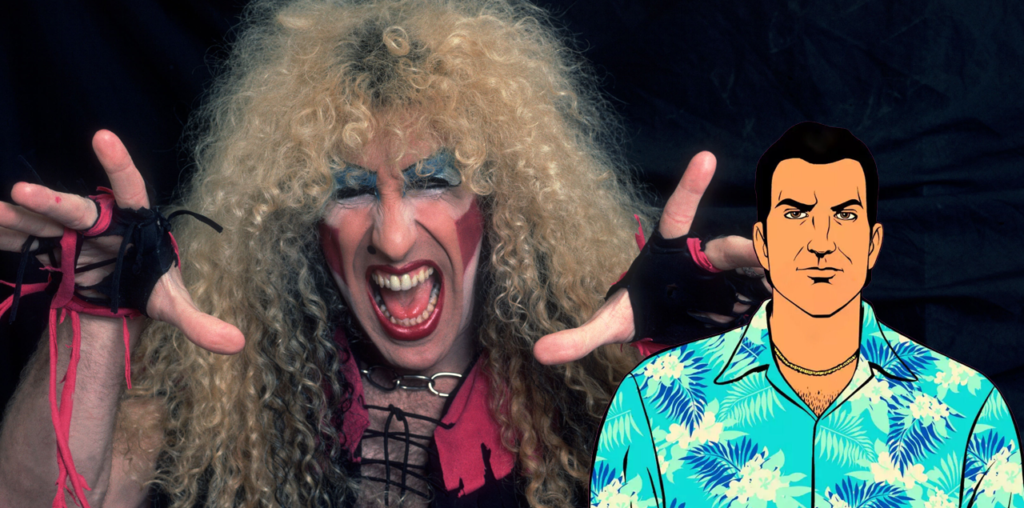
Like the spandex-wearing teenagers of two decades prior, I was smitten: never had I felt more empowered than chucking grenades out of the back of my convertible Stinger while blasting Twisted Sister‘s I Wanna Rock. I was one of a generation of gamers who’d missed out on metal’s most flamboyant and colourful era getting to live it, vicariously, in real time.
And it wasn’t just via V-Rock DJ Lazlow that we got that glam metal education. Vice City also featured a fictional, in-game metal band called Love Fist. A bunch of cocky, permed Scots with the dress sense of Mötley Crüe and the self-awareness of Spinal Tap, they were a perfectly executed send-up of 80s hair metal culture.
“I knew somebody who was working for [Edinburgh-based GTA studio] Rockstar at the time,” says John Ritchie, who voiced Dick, Love Fist’s hapless drummer. “He said, ‘We’re looking for Scottish actors to come and voice some stuff. We’re looking for some kind of Scottish rock band.’
“I only got the script on the day, so I literally knew nothing until I walked in,” he continues. “They said, ‘Have you heard of a band called Mötley Crüe? They’re kind of a Scottish version of that.'”
Love Fist were by no means mere background NPCs: Vice City included multiple missions based around the band, from securing them drugs to protecting them from a would-be assassin.
John, a lifelong metal fan himself, describes Love Fist as a “spot on” parody of 80s hair metal excess, and suggests that the rock music from that decade had a particular brand of immediacy that has helped it endure across generations.
“Just think about how I Wanna Rock starts,” he says. “It’s immediate. It’s right in your face. They’re not messing about! They’re telling you exactly what they want to do. Rock You Like A Hurricane by Scorpions still gets used in stadiums across the US. Everybody knows the intro to She Sells Sanctuary.”
That may well be true, but for me and countless other millennial metalheads who happened to own a PS2 in 2002, it was Grand Theft Auto: Vice City that helped put those songs back on the map. You’d have to think even Love Fist would be proud.
“What would Love Fist be doing now? Oh man, how many of them would still be around?!” wonders John. “Dick’s a drummer, so he’d probably be doing a lot of quiet work for charity. And hitting things.”
Grand Theft Auto VI is out this Thursday, November 19