 Written by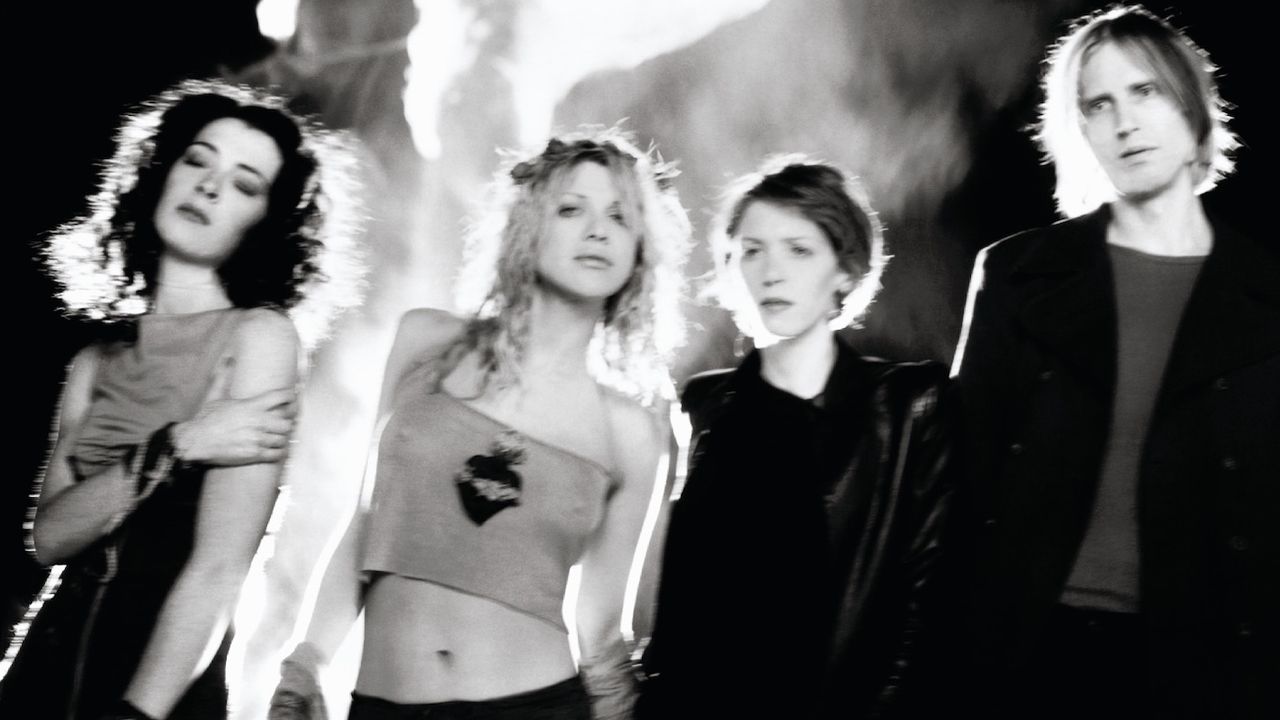
I: VINTAGE
September 2, 1993, the MTV Video Music Awards, Los Angeles’ Universal Amphitheatre. Courtney Love was in attendance with her husband, Kurt Cobain, whose rock band, Nirvana, was up for Best Alternative Video. The couple’s 1-year-old daughter, Frances Bean, perched on Love’s hip, outfitted in a pastel onesie. Cobain wore jeans. As Love told Cindy Crawford, she went “un-grunge” for the occasion, opting for a vintage white gown and Anne Klein heels. She accessorized this upscale version of her broken baby doll “kinderwhore” uniform with her signature bright red lipstick, untouched roots peeking out of her bleached hair.
No score yet, be the first to add.
One month after the ceremony, Love and her band Hole entered the studio to make their second record, Live Through This. In April 1994, days ahead of the album’s release, Cobain died from a self-inflicted gunshot wound. Two months later, Hole’s bassist, Kristen Pfaff, would die of an overdose. The Live Through This rollout was paused until late August, when Love, guitarist Eric Erlandson, drummer Patty Schemel, and replacement bassist Melissa Auf der Maur appeared at 1994’s Reading Festival. “Oh yeah, I’m so goddamn brave,” Love wryly greeted the crowd as she strapped on her guitar. “Let’s just pretend it didn’t happen. Is that what you’re doing, pretending it didn’t happen? Great. Well, I’m not.”
Hole would be on the road for the next year, beginning with Nine Inch Nails’ Self Destruct tour. Their shows had always been wild—the music’s raw noise and Love’s swaggering stage presence inspired catharsis. But now Love was an open wound and was numbing her grief in one way or another. Her performances could be erratic; she’d pause a show to address a heckler, or jump into the audience for a physical confrontation; she’d ramble on about the paparazzi or whatever random subject popped into her mind, yell at her bandmates, smash instruments, knock over mic stands. There was a darkness to the way she threw herself to the wolves, night after night. She was eagerly devoured until she gave security a signal and then emerged, slips ripped to shreds. Love was vilified for Cobain’s death, accused of complicity, exploitation, or worse, resulting in a real sense of danger. There were death threats, and in July 1995, someone threw shotgun shells onto the stage and screamed, “You fucking killed Kurt, bitch!” “Somebody should have locked me in my fucking room for a year,” Love would later say of this period.
Live Through This sold a million copies, and Hole’s videos played constantly on MTV. A whipsmart subject, Love (and occasionally her bandmates) appeared on the covers of all the major music magazines, and her exploits were frequent tabloid fodder: an arrest; allegations of assault, including from Bikini Kill’s Kathleen Hanna; and unscripted antics that led Madonna to declare, “Courtney Love is in dire need of attention.” She spoke directly to her fans (and foes) on AOL message boards, though she was forced to clean up her language after her posts started getting deleted.
By 1996, Love was enough of a mainstream spectacle to be satirized on Saturday Night Live. As portrayed by Molly Shannon in a sketch titled “The Courtney Love Show,” she’s a mascara smear of a woman, a sloppy exhibitionist who nods off in the middle of conversation and lists the “Top 10 bruises on my body.” By then, Hole had finally taken a much-needed break from touring. In the interim, the band released an EP of old material and a compilation. Their only new song was a great cover of Fleetwood Mac’s “Gold Dust Woman,” produced by the Cars’ Ric Ocasek for the soundtrack to The Crow sequel. “Shadow of a woman/Black widow”: who else but Hole could do these lines justice?
PART II: VERSACE
March 24, 1997, the 69th Academy Awards, Los Angeles, Shrine Auditorium and Expo Hall. After several small but strong roles, Love had her big-screen breakthrough in Miloš Forman’s 1996 film The People vs. Larry Flynt. Her performance as the troubled wife of the Hustler publisher had earned widespread acclaim, including a Best Actress – Drama nomination at the Golden Globes. Though snubbed by the Academy, she was invited to present the Best Makeup trophy. After much deliberation, Love chose an elevated version of her 1993 VMAs look, a pearly bias-cut Atelier Versace Spring/Summer 1997 gown. When she walked the red carpet, the dress dripped off her frame, now 20 pounds lighter thanks to a “movie-star” diet. Manolo Blahniks and blunt bangs completed the look; She wore diamonds, but this time, the rhinestone tiara stayed home.
Love’s Hollywood makeover was received with skepticism from those who felt she had slept with the enemy. “So I didn’t go to the Globes and write SLUT on my stomach,” Love said (evoking a famous Hanna stage look). “Hollywood has its rules.” She was an actress before she was a musician, and besides, she’d always said she wanted to be famous. “I think I’ll be a Rockstar,” she wrote in her childhood diary. “Get an Oscar too & Be best friends with Elton jo[hn].” She was learning the ropes from Pat Kingsley, an influential publicist behind Tom Cruise’s ascent. Once unapologetically foul-mouthed, Love now asked writers to censor her cussing, explaining that “in print it always makes you look kind of dumb and raunchy.” Amid all the noise about plastic surgery and being pretty on the outside, critics wondered if Love was still punk. “I mean, somebody wrote, ‘How can she rock in a Versace gown?’” Love told Rolling Stone in 1997. “Well, easy—let me show you.”
Hole spent the second half of 1997 concentrating on their third album, Celebrity Skin. Love had been teasing the title for a couple years, attributing it to a soft-porn magazine (and “’cos I touched a lot of it”). After several unsuccessful writing retreats—New Orleans sessions went up in literal flames—ideas started to flow at Conway Recording studio in Los Angeles. Their muse was all around them: California, a rich psychogeography ripe for deconstruction.
Celebrity Skin is less about those in the spotlight than those who get lost in the shadows along the way: the sold-out sluts, self-destructive pop boys, and “might-have-been”s, all the “beautiful garbage” littering US 101. The dedication reads, “To all the stolen water of Los Angeles and to anyone who ever drowned,” while the back cover pays homage to a doomed Ophelia. The album opens with three jet-engine chords and a wink at Love’s own notoriety. “Oh, make me over/I’m all I wanna be,” she snarls over a buzzing riff. “A walking study/In demonology.” Full of “yeah-ah-ahs” and glittery blown-out guitars, “Celebrity Skin” offers a backstage tour of Hollywood. Love plays the wilted starlet whose soul was her price of entry: “You want a part of me?/Well, I’m not selling cheap.”
On Celebrity Skin, Hole cranked the dial on their “internal AM radio” and channeled 1970s California AOR tunes. Grunge was on its way out, and besides, Hole had always been proud pop fans. Back in 1989, Erlandson responded to an ad Love placed that read, “I want to start a band. My influences are Big Black, Sonic Youth, and Fleetwood Mac.” Hole had spent two albums wiping the muck away until Celebrity Skin emerged, as polished as they would ever get.
Love initially struggled to get the record off the ground and needed someone to light a creative (and competitive) spark in her, so she called up Billy Corgan. (In addition to being Love’s ex-boyfriend, the Smashing Pumpkins frontman had recommended Auf der Maur after seeing her band play in Montreal.) Corgan has co-arrangement credits on five songs, including the title track, and was initially announced as the album’s executive producer. But he left the project to work on the Pumpkins’ Adore, and Hole hired Michael Beinhorn, known for his work with Soundgarden, Red Hot Chili Peppers, and Ozzy Osbourne.
Though Hole’s sound had expanded, their bite remained razor sharp. Case in point: “Awful,” a Trojan horse critique of the music industry. Atop a power-pop interpolation of “Swing Low, Sweet Chariot,” Love calls out executives eager to exploit “all the girls like you.” Bubbly like cherry cola—and are those notes of Neil Diamond or Unrest?—the song’s carbonation goes flat ahead of the final verse, as Love growls, “Oh, just shut up, you’re only 16.” But “Awful” ends with rousing defiance: “If the world is so wrong/Yeah, you can break them all with one song.” “Reasons to Be Beautiful,” co-arranged with Charlotte Caffey of the Go-Go’s, comments on vanity and self-loathing. “Miles and miles of perfect sin/I swear, I said, I fit right in,” Love chants. “I fit right in your perfect skin/I cannot breathe.” Delivered with pinkprick precision, each shifting verse seems to pirouette on the head of a needle.
On the title track, Love describes a woman who has obliterated everything she kissed, and indeed, desire is a corrosive force on Celebrity Skin. “The one I love, I should destroy/My sweet tooth has burned a hole,” Love croons on the dreamy “Hit So Hard.” The conflation of violence and ecstasy echoed by the chorus—“He hit so hard/I saw stars/He hit so hard/I saw God”—evokes “He Hit Me (And It Felt Like a Kiss),” a song Hole had covered. Sublime obliteration is a recurring theme. “Our love is quicksand/So easy to drown”; “I look at him and drown.” “When the water is too deep/You can close your eyes and really sleep tonight,” goes the siren song “Boys on the Radio,” a twinkly homage to troubled musicians Evan Dando, Brian Wilson, and Jeff Buckley after the latter drowned in 1997. “Down by the sea/Is where you drown your scars,” Love sings on “Malibu,” and she sounds radiant atop washes of golden guitars singed with melancholy. “Malibu” pleads with a bright burnout to find salvation, but he’s already doomed. As the sun sets over an ocean of angels, Love’s protagonist walks into the Pacific, the differences between self-destruction and salvation washed away by waves.
Throughout Celebrity Skin, Love addresses the anger, sadness, emptiness, and guilt that accompany a profound loss. She crawls through the wreckage on “Dying,” a downcast song made strangely hypnotic by an electronic flicker that sounds like an EKG sucked through a straw. “Use Once and Destroy” amplifies “the emptiness that’s all you have left” to industrial proportions, powered by Auf der Maur’s massive bassline. “Playing Your Song” is an unmistakable rebuke to her late husband and his former bandmates, Love’s legal adversaries. “Hey, you, so bored and cynical,” she sneers. “It’s fucking wonderful, they sold you out.” Love worked with a vocal coach on Celebrity Skin to soothe her scratchy howl, but here, atop pointedly grunge turmoil, she emits a blast of ragged rage: “I had to tell them you were gone.”
“Reasons to Be Beautiful” begins with a third-person description of Love hanging herself in a cell and concludes by paraphrasing Cobain’s suicide note, itself a nod to Neil Young. “When the fire goes out you better learn to fake,” she sings. “It’s better to rise than fade away.” While Love was expected to write the grieving-widow record, she always loved defying expectations. Celebrity Skin is most subversive when Love lets herself be light. “I can’t believe that I could be happy,” Love sings, starry-eyed, on “Heaven Tonight.” Dedicated alternately to her daughter or boyfriend, it’s a warm, wild horse gallop through a field of California poppies, with Auf der Maur’s backing harmonies adding an angelic glow. There isn’t an ounce of irony clouding her bliss. “What about embracing pop as a lush and wonderful thing, as the greatest escapist fantasy—other than maybe a Spielberg movie—there ever was,” Love said in 1998. “Something that can transport you out of your car and back into your first fuck?”
But the bruise looms larger than the bliss. Celebrity Skin closes with a game of he-loves-me, he-loves-me-not on “Petals.” A version of the chorus first appeared on “Asking for It,” a Live Through This track about sexual violence: “I will tear the petals off of you/…I will make you tell the truth.” Four years later, the line had become a passive observation that the world will devour the innocent.
III: VARNISH
In the video for “Malibu,” Hole appear amid some sort of disaster, per the flames and smoke. But it’s still paradise. Erlandson waxes a surfboard while Auf der Maur sprawls out like a shipwrecked sea maiden. Love wears a sheer, skintight white dress that makes her look like glamorous mermaid roadkill. At the end of the video, she leads a procession of Baywatch babes holding plastic baby dolls. They watch over her as she walks into the ocean.
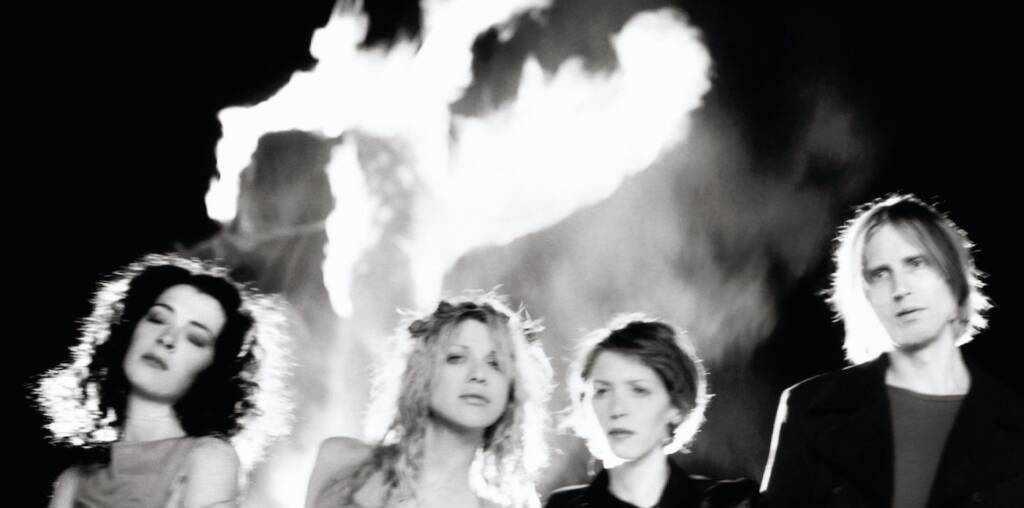
Schemel is notably absent from the “Malibu” video. As described in her 2017 memoir, producer Beinhorn was particularly militant with Schemel, making her play take after take for hours on end; she was later told that he “read the newspaper in the booth with the sound off” the whole time. “After Beinhorn played [Love] some takes and told her I got red-light fever in the studio—that I’d forget what I was doing once he pressed record—she’d approved my replacement, a goateed session drummer named Deen Castronovo,” Schemel wrote. She was essentially fired from the band, though she does appear in the black-and-white album cover snapshot, in which Hole pose in front of burning palm trees, a fantasy on fire. While her bandmates avert their gaze, Love stares into the camera.
Upon release in September 1998, Celebrity Skin became Hole’s biggest commercial success, earning the band three Grammy nominations and their first No. 1 single, on Billboard’s Alternative Airplay chart, for the title track. In the spirit of “I was punk/Now I’m just stupid, I’m so awful,” Hole played up the self-awareness. The band partnered with MTV for a “Celebrity Skin Contest.” Contestants were asked to write 50 words or less on why they wanted to be a celebrity, and the winner would receive film and television opportunities, appear on Entertainment Tonight, feature in Rolling Stone, and host a Hole concert. In a promotional video for the competition, Hole repel pop-up cut-outs of paparazzi with catchphrases like “parasite poo-poo” (Erlandson) and “sucking vampire” (Auf der Maur, hissing). In another, Love offers advice on how to be a celebrity and refers to her infamous 1995 Barbara Walters interview. “You can cry on cue right?” Love asks. “I’ll teach you.”
Publicly, Love committed to a clean lifestyle. Press now mentioned juice machines, personal trainers, yoga teachers, and the desire to be a positive influence (“Madonna was talking to me about responsibility…”). The effects were evident in a beautiful Versace ad campaign photographed by Richard Avedon. Love continued acting, winning hearts in 1999’s 200 Cigarettes. Journalists questioned how she could be on her high horse about authenticity while associating with “superficial” fashion people. “Because rock is so pure,” she shot back.
Ostensibly, there were fewer reasons to hate Courtney Love, but controversy was inevitable. Old ghosts returned, most involving Cobain, including a documentary that accused Love of arranging his murder and nagging accusations that he’d ghostwritten some of Live Through This. To Love, attacks on her creative agency were more distressing than attacks on her personhood: “My monsterfication I can deal with, but when it comes to my writing and his writing—no, the answer is no!” Similar questions of authorship arose ahead of Celebrity Skin thanks to Corgan, who’d called himself “the Svengali.” “There would not be a new Hole album without me,” he told the UK magazine Select prior to its release. “I got [Courtney Love] off her ass and down to the fucking studio.” The pair went back and forth in the press, with Love saying, “I feel it’s silly and somewhat sexist to credit Billy Corgan with things Billy Corgan did not do based on the assumption that accomplished male musicians are somehow superior to accomplished female musicians, such as myself.”
The idea of Courtney Love loomed so large that she struggled to escape it. She was too many things: unpleasant yet endearing; aggressor and casualty; an honest liar; an ambitious mess; and an articulate bad girl. To her critics, her complexity could only be calculated. Ultimately, Love recalled Jean Cocteau’s line about being “a lie that always speaks the truth.” Or, as she herself famously sang, “I fake it so real I am beyond fake.” She wore her contradictions proudly, which only short-circuited more brains. In an interview, Hole discussed whether or not Celebrity Skin would inspire anger. “It won’t piss anybody off,” Love predicted. “It’s supposed to provoke thought.”
Hole struggled in the year after Celebrity Skin. A co-headlining tour with Marilyn Manson was cut short due to financial and personality issues; Schemel was already out, and Auf der Maur left to work with Smashing Pumpkins. The band was tied up in legal battles until Erlandson and Love called it quits in 2002. After releasing her 2004 solo debut, America’s Sweetheart, under her own name, Love resurrected the Hole band name for 2010’s Nobody’s Daughter. (Love later told Pitchfork that this decision was a “mistake”: “Eric was right—I kind of cheapened the name, even though I’m legally allowed to use it.”)
Love’s personal issues in the early 2000s—arrests, bizarre media appearances, guardianship issues, drug abuse—seemed like history repeating itself. This time around, Love had company, as aggressive paparazzi and sensationalist tabloids monetized struggling female celebrities. When I was a preteen in the early 2000s, all I knew about Courtney Love was that people hated her because she was a trainwreck and a whore, whatever that meant. It was a contradictory time to come of age. I could buy a glittery “Girl Power” keychain from Limited Too, but the media I absorbed implied that I should hate myself. I had plenty of positive female role models in pop culture, but few who exemplified a more complicated womanhood. When I discovered Hole, I was entranced by this character who seemed to be so much and survived, somehow.
Ultimately, questions of authenticity don’t really matter when you’re listening to “Northern Star.” Celebrity Skin’s most poetic moment is anguished and abandoned. The album version is overwrought with unnecessary dramatic embellishments like strings and battle drums. But at Glastonbury in 1999, Hole performed the song as it was written, Erlandson on acoustic guitar and Love riffing about loss and loneliness. Dressed like a hot-pink Tinkerbell, Love hops off the stage and wades over to the audience. “No loneliness, no misery is worth you,” she roars in a husky rasp. “I’ll tear his heart out, cold as ice/It’s mine.” Back onstage, surrounded by a group of enraptured young fans, she delivers the final chorus atop an amp. “Feel our hearts, I’m cold as ice,” she hisses, changing the lyrics slightly to be personal. “And you will know the truth.”