 Written by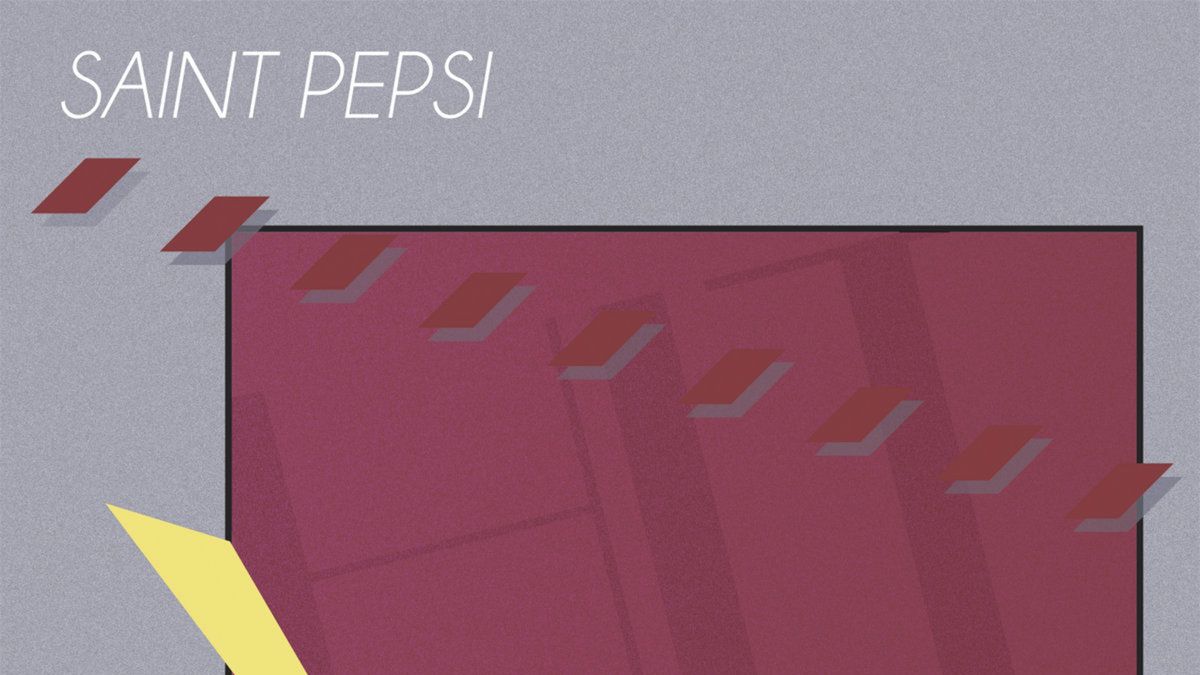
Sitting at home on winter break from Boston College in 2012, Ryan DeRobertis found himself inspired: Blown away by his recent discovery of vaporwave, he wanted to place a fictional celebrity called Saint Pepsi—a romantic personification of 1980s bloated wealth he’d just christened as his musical alter ego—into the genre’s growing canon. Five months later, the project had nine albums and was vaporwave’s next big thing. Less than a year later, Saint Pepsi was dead. Like a real Reaganomic star, his pious persona lived and died by a corporation—burning out in a blaze of glory as soon as the consumerist world he romanticized turned its back on him.
When Pepsi Co. pressured DeRobertis to change the project name, he was at the peak of his 2013 run. He had just released Hit Vibes, the album that marked the culmination of his gradual transition from vaporwave’s classic sound—stretched-out, reverbed, and rearranged samples meant to evoke an uncanny past—towards a burgeoning subgenre called “future funk,” where warped vaporwave sampling techniques interplayed with the disco-centric, heavy-hearted grooves of French house. Future funk was brewing in small circles before Hit Vibes; almost immediately after, the style became arguably the most popular vaporwave spin-off for a decade. After losing Saint Pepsi to trademark law, DeRobertis and future funk took diverging paths—the former towards nu-disco and synthpop, the latter towards a new artistic disposition made up of anime girls and neon colors.
No score yet, be the first to add.
Though Hit Vibes wasn’t technically Saint Pepsi’s final release, his star never shined brighter than when, at the peak of his legendary 2013 run, he wrote the rulebook on future funk with the record’s picture-perfect all-day party. Now reissued on vinyl for the first time since 2015 alongside a new 22-minute mix, Hit Vibes remains the peak of a subgenre it helped launch—an exaggerated ode to lavish living that finds genuine affection and passion within the glut and affluence.
DeRobertis sculpted the Saint Pepsi persona after the soft drink company’s elaborate advertising and marketing efforts during the ’80s: bold magazine ads, massive celebrity endorsements, idyllic commercials on the beach. It’s only right that “Cherry Pepsi,” Hit Vibes’s centerpiece cut, would embody this maximalist persona through its sound, while defining the essence of future funk through its structure. It builds off Sister Sledge’s 1983 track “B.Y.O.B. (Bring Your Own Baby),” only adding souped-up modern electronic percussion. But “Cherry Pepsi” creates something brand new by choosing the loudest, catchiest refrains of the original to dig out of its withering disco grave. The source song’s main synth riff gets a new lease on life, slowed down and cranked up; its bass licks mark ground-shaking beat drops instead of small licks in the original groove; the original chorus gets cut in half on the new hook, but becomes a bigger, more memorable refrain out of those smaller parts. “Cherry Pepsi” is the archetypal future funk track, taking the gaudy energy of the ’80s to new levels for, as Pepsi itself would put it, “a new generation.”
Hit Vibes embraces consumerist maximalism with its tongue held firmly in its cheek. The blown-out horns on the opening track are followed by a pair of silly anachronisms: the glorified 2010s DJ tag (“it’s Saint Pepsi, bitch”) we hear before the delightfully cheugy synths of “Have Faith,” and a sample of Toad screaming from 1996’s Mario Kart 64 that underscores “Better”’s horn runs. On the album’s minute-long interlude, we get a clip from the 1996 film Everyone Says I Love You, where—over a smoothed out soul instrumental—one character, Holden Spence, ostentatiously contemplates buying an engagement ring for his lover, Skylar. (Those characters would eventually inspire DeRobertis’s future nom de plume, Skylar Spence, which he would employ when he left future funk behind.)
This exuberance isn’t without a sentimental heart. The party might be grooving harder than ever on “Around,” but between its pounding kicks, twangy slap bass, and stinging keys is a crystal clear “I love you” from Phil Fearon and Galaxy’s “Wait Until Tonight (My Love).” This love injection makes the track’s ultimate moment—when its midpoint builds to a gorgeous drop after its chopped-up bridge—land just as hard on our beating hearts as it does our grooving souls. The same can be said about the second drop of the lovey “Strawberry Lemonade,” whose first half retains the plunky percussion of Clarence Mann’s “Show Me Girl” while slicing up and rearranging its vocals to fit an affectionate refrain (“girl… I… know”). At the bridge, the groove inclines higher as hi-hats join the fray and we hear Mann scream out, “If you want my love”—and suddenly, we splash into an ocean of glistening synths and tread the pretty waters as everything slowly fades; it’s the most breathtaking moment on an album designed to sweep you away into its joyous world of excess.
For nearly a decade and a half, it seemed like Hit Vibes’s day-long party ended at sunset. “Miss You,” the de facto closer, brings the party’s pace to a serene resolution in a reprise of classically hypnagogic vaporwave: a single echoing vocal refrain and snail-paced drums marks the end of a beautiful day out. But the reissue has come alongside the digital release of “Almost Butterflies,” a new 22-minute mix that ostensibly scores the afterparty we never knew existed. Whereas the sound of Hit Vibes is as bright and beaming as beachside bliss, the sultry dimness of “Almost Butterflies” could only soundtrack a nighttime outing: a cocktail party, a swanky club, a beachside drive. With its funk and disco samples shrouded in phasers, cut-off filters, and a bassy low-end, the mix emphasizes drawn-out, tempered grooves that coast in and out like ocean waves building up and crashing in a seamless cycle—a far cry from Hit Vibes’s traditional album-oriented structure. There might be a curfew on Hit Vibe’s day, but the night in “Almost Butterflies” feels endless.
“Almost Butterflies” is also a fitting coda to Hit Vibes because it feels like future funk returning to where it started. After Hit Vibes, the genre quickly turned in a new direction: a style that overwhelmingly relied on the novelty of nostalgia, Japanese aesthetics, and city pop samples, rather than DeRobertis’s varied palette of soul, disco, and vaporwave proper. But his return to the project feels like an alternate timeline, where the genre followed the template he set. DeRobertis announced this reissue as though Saint Pepsi was at the genesis of his celebrity: “THIS IS JUST THE BEGINNING!!!”. It’s a tease towards new music, but also a stark reminder of the brevity of the project’s original run. Saint Pepsi had a single definitive year in future funk’s hot sun, marked by an album whose rays still shine brighter than any following release in the style it pioneered. If this was only the start, it raises the question: How much hotter will it get?