 Written by
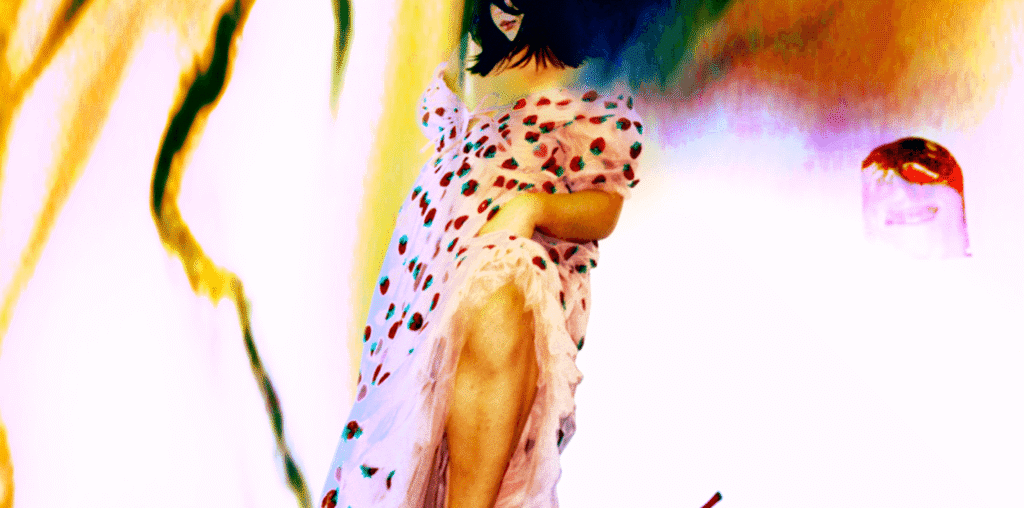
“It’s all about the human as a house,” Kate Bush replied when asked to supply the meaning of “Get Out of My House,” the blood-curdling, The Shining-inspired shriek of a final track on her self-described “she’s-gone-mad” record, 1983’s The Dreaming. Bush’s song envisions a woman battling the monsters she’s imagined her fear has made manifest, braying like a donkey and kicking in doors: “You change, it changes; you can’t escape, so you turn around and face it, scare it away.” Like Bush before her, Bay Area-based experimentalist Lucy Liyou has cultivated an eclectic discography through which to distort and refract her own identity, both as an artist and as a trans woman of color building a home in a world that spurns her.
MR COBRA, Liyou’s new album and theater piece, reckons with a troubling experience that’s only too common: a period in her teenage years during which she “fell in love with a predator.” The narrative follows Liyou’s heroine, named Babygirl, and the titular Mr. Cobra, voiced by Jake Muir, gutting the memories until they spill out in the form of a daring avant-pop opera. Another artist might have couched such boldly confessional writing in music designed not to overtake the gravity of its subject matter, but Liyou weaves disco, ambient pop, and glitchy electronics into songs as funny as they are fearsome, building a maximalist, musique concrète relationship autopsy worthy of the storied “she’s-gone-mad” canon.
No score yet, be the first to add.
“Being in this fascist country reminds me every day that this world wants women like me numb and dead,” Liyou writes in a statement that accompanies the record. “And so why not just laugh, moan, scratch, and implode? Why not make death wait its turn?” On 2023’s ambient sound collage Dog Dreams and last year’s more conventional “songs record” Every Video Without Your Face, Every Sound Without Your Name, she approached these themes with more introspection and intimacy, finding comfort even in their darkest turns. MR COBRA spits the bile back in her own monster’s face. Liyou’s making herself monstrous, too—if only to prove the breadth of her desire, her power to attract and disgust in equal manner.
First staged by Liyou as a one-woman show at Performance Space New York in March, prior to its release as a standalone record in April, MR COBRA solidifies her as an avant-garde curator—not only of sound, but of broader pop culture and camp touchstones that shape the public imagination of what a woman can be. Referencing everyone from Taylor Swift to Mia Farrow to Britney Spears to Faye Dunaway in Joan Crawford drag, Liyou recontextualizes their lyrics and voices on film to serve as lines in her teleplay. Lyrics from “Love Story” become a torch ballad that serves as Babygirl’s plea to her captor, while dialog from Mommie Dearest becomes a tirade from Babygirl’s mother.
Through it all, Liyou refuses to shrink the viscera of the experience into linear storytelling. “Old MacDonald Had a Charm” is a surreal cabaret performance of the similarly titled nursery rhyme that transforms it into a beastly dirge of lost innocence. “What would you as a pathetic middle aged white man desperate for a taste of spry Korean pussy know about the magnitude of a girl like me?” asks a robotic voice-to-text recording that cuts into Babygirl’s striptease. Violent blasts of noise force her captor to reckon with her overflow; the sounds of wounded animals wail over the thrash of cinematic strings and timpani hits, as if to depict a predatory bond bleeding out.
It’s a credit to Liyou’s comfort with discomfort—both her audience’s and her own—that the record successfully navigates so many sharp tonal turns. Even in more straightforward four-on-the-floor standouts like “Crisis (Identity)” and “Constrictor (Haha),” where Liyou shapeshifts into a disco diva, or the spacy, swirling outro of “Romeopathy,” the house’s overstuffed foundation creaks with the anticipation of a jump scare around the corner. If the recorded music has a weakness, it’s that such evocative scenes beg for their visual counterpart; as of this writing, the accompanying theatrical performance is not readily available. Once you’ve seen Liyou prostrate herself before a mannequin, pulling off its limbs as if to devour it, or perform the record’s more accessible interludes by rolling around in piles of garbage on the floor beneath the stage, it’s hard to dissociate the image and the sound.
“This is not music,” Liyou whispers at one point, mid-song, and considering the abstract, hybrid forms her reflections take, that could be true. But you’re unlikely to encounter a record as confronting as MR COBRA and not walk away feeling something, whether your instinct is to recoil in fear or laugh at the audacity of its execution. What could have been an everything-but-the-kitchen-sink exercise instead makes its case as Liyou’s most unique presentation to date. As her in-album avatar struggles to recover her identity from under an abuser’s thumb, Liyou’s artistry sounds fully realized. By the time “Finale (Transition!)” blows up the record to the tune of a grating industrial opera, the music seems ancillary to MR CORBA’s true mission: facing the monster, as a predecessor once put it, and scaring it away.