 Written by
 The Third Ear Band were one of the most successful artists on the Harvest label in its early years, and they were seen alongside some of the biggest names in the burgeoning prog era of the late 60s and early 70s. But the myths spun by mysterious leader Glen Sweeney are sometimes remembered more than their music – which Prog sought to put right in 2019.
When the legend becomes fact, print the legend – so goes the saying. In the case of the Third Ear Band, it’s appropriate. Surely there are few other prog groups with such a miasma of myths circling them.
Is it true they took their name from an obsessed fan who carried around Van Gogh’s severed ear in a bag? Or that the members were pagans involved in alchemy practices? Or that they became an acoustic-oriented band because their electric equipment got stolen?

And is it true that Glen Sweeney, regarded as the band’s main wellspring of creativity, fought in the Second World War? “That last one wouldn’t surprise me,” laughs Peter Jenner, who produced Alchemy, the band’s 1969 debut album.
Jenner was one of the principles in Blackhill Enterprises, who took on management of the Third Ear Band in the late 60s. “I was a hippy and so were they,” he explains. “They were a groovy underground group, and not at all pop. That was enough for me! Although I get a credit for producing Alchemy, all I really did was sit there and let them get on with it. They improvised a lot, which I loved. I never interfered.”
The Third Ear Band had their roots in the famed UFO club in Central London. Freeform musical sessions developed every night, from which came The Giant Sun Trolley, before they released music as the National-Balkan Ensemble in 1968.
A further name change to the Hydrogen Jukebox led to the recording of a somewhat avant-garde live album, with Sweeney using a pair of amplified scissors not only for percussive effect, but also to clip the dress from his girlfriend onstage.
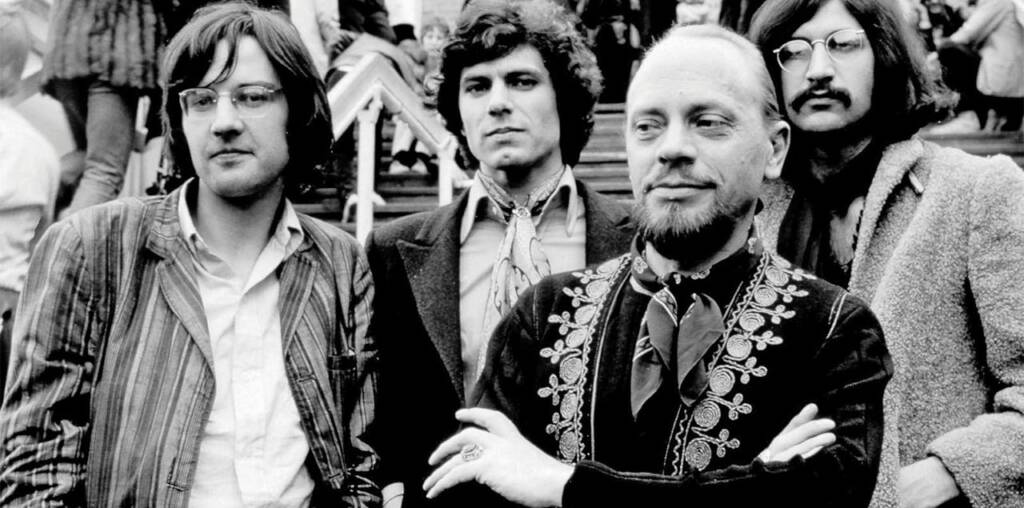
It was during this brief period that their equipment was stolen, and they morphed into the Third Ear Band, an acoustic collective who took inspiration from all parts of the global musical village. At the core were Sweeney (tablas), Paul Minns (oboe), Richard Coff (viola) and Mel Davis (cello) – sadly, all of whom are now dead. One of the first signings to Harvest, Alchemy was a remarkably uninhibited artistic melange.
“The guys never stuck to any rules,” recalls Jenner. “They took risks in a way that was highly progressive. I loved them for it. In some ways, what they were doing was pioneering what we’d call world music today.” Celtic, raga, Chinese, Indian and Native American daubs abound throughout Alchemy. And there were rumours the band were actively involved in mysticism.
But guitarist Denim ‘Denny’ Bridges, who joined in 1970, has his own views: “I believe Glen was very knowledgeable about the subject. If he felt that using alchemy and magick imagery would get us attention, then he would exploit it as much as possible.”
By the time Bridges joined in 1970, the band had released their self-titled second album and had also recorded the soundtrack for a TV production of the historical romance Abelard And Heloise the same year. They’d also gained a significant profile from appearing on the bill for three of the celebrated free concerts in Hyde Park of 1969/70, organised by Blackhill Enterprises, playing at events headlined by Blind Faith, the Rolling Stones and Pink Floyd; they also played the Isle Of Wight Festival in 1969.
“We thought it would help their profile,” explains Jenner. “So we put them in as the opening act. Nobody seemed to mind them being on the bill, and one of the legends that came out from the festivals was that the Third Ear Band inspired good weather. Whenever they came onstage it was sunny – Mind you, it was the summer time. But having a reputation for bringing a positive vibe didn’t do them any harm.”
Bridges recalls: “I was at the Blind Faith show so I knew who they were when I joined. I answered an advert in Melody Maker and went to their rehearsal place in Balham, South London. The fact I had a double-neck guitar probably put me ahead of the field for the job. They wanted to move away from the medieval style they’d been known for and become more electric. I did find their use of improvisation intriguing, but the way they outlined the new musical direction was rather inspiring.”
The band’s next project was to prove fascinating – yet it also sowed the seeds for them splitting up. They were commissioned by Roman Polanski to create the music for his adaptation of Macbeth.
“Polanski wanted the kind of music that the Third Ear Band were known for performing,” says Bridges. “It fitted the way he was going to interpret Shakespeare. Everything we did had to be run past him, and there were some pieces he rejected, but for the most part we got on with things the way he wanted. It was certainly a challenge, but one I feel we rose to meet.”
We wanted to get away from the medieval sound. But Macbeth dragged us back into that
The film came out in 1971, with the soundtrack released the following year. Since then it’s been claimed that children’s TV presenter Keith Chegwin was in the band for that period; but Bridges puts it into context. “He did the vocals for Fleance on the album. But that’s because he sang it in the film. He was an actor who was part of the cast; he certainly was not in the Third Ear Band at any point.”
The Macbeth soundtrack reinforced the group’s acoustic outlook at a time when they were hoping to move away from it. Bridges belies that led to the band’s demise soon after the album was released.
“Paul Buckmaster was starting to earn a reputation as an arranger, in which he’d end up building such a successful career. Eventually he decided to leave and concentrate on that side of things.
“Paul and I were likeminded in wanting to get away from the medieval sound. But Macbeth dragged us back into that – even though I’d been brought in because they were keen to go electric. So when Paul quit, I felt I should follow suit. There were also a lot of political issues going on – the band didn’t so much come to an end as fall apart.”
“The reason for the split was quite simple,” says Andrew King, who managed the band for Blackhill, and also produced Third Ear Band and Macbeth. “They couldn’t make enough money.”
Just before they came to a halt, the band had begun work on a new album. “We did record some electric tracks,” says Bridges. “But then Harvest decided not to keep us on the roster. I think we’d had a three-album deal and it had run out with Macbeth. Obviously losing the deal hastened the end for the band as well.”
Bridges fondly remembers their activity on the live front during his two-year tenure. “We only did about 30 gigs, but the we got some significant dates. We opened for Centipede, the massive jazz/progressive ensemble led by Keith Tippett – it didn’t get much bigger than that. We did a number of shows supporting Pink Floyd around England. In terms of high-profile opportunities, we did well when it came to tours.”
While the band did return during the late 80s, it’s those few years in the late 60s and early 70s for which they’re rightly celebrated. But there are still mysteries that have to be resolved – for instance, did Sweeney actually fight in World War II? “Well, he was old enough,” laughs King. “And I believed him when he said he was involved.”
People always talk about them as if they were obscure. But they were more successful than most on the Harvest label
“It wouldn’t surprise me,” adds Bridges. “We were all in our early 20s back then, whereas Glen was so much older. But a lot of the stories were actually spread by Glen himself. He was great at self-promotion. He was also excellent at spreading confusion. There are loads of songs out there that all have the same title. You also have tracks with multiple titles depending on where they come from. You never quite know what you’re listening to!
“But that was typical of Glen – he loved keeping things mysterious, especially when it came to the truth about himself.”
One story about Sweeney suggests he spent much of the war being pampered by six rich Egyptian ladies in a Cairo mansion. “It’s the sort of existence Glen would fantasise about leading,” says King. “And it might well be true. But none of us would have any idea whether he was making it up or not. He was such an entertaining character, though, and very much the band leader.”
Which leaves the truth behind the origin of the band name. Did it come from an obsessed fan who stalked them and carried Van Gogh’s ear around? Maybe it came from the title of a novel by German-American author Curt Siodmak, which has also been intimated; but Siodmak’s book came out in 1971, after the band had adopted their name.
Bridges feels the truth is a little more prosaic. “I never heard the tale about the Van Gogh ear! But I think the name came from the idea of the third eye. And since this was music, it made sense to use ‘ear’ instead of ‘eye’.
“I know that’s boring – but when you delve behind the stories Glen loved to spread, you normally find the facts aren’t as flamboyant as he liked to make out.”
The 2019 reissues of Third Ear Band’s albums highlight that, even now, no one sounds quite as bonkers, eclectic and free-thinking as they did. “People always talk about them as if they were so obscure,” concludes King. “But they were more successful than most on the Harvest label. They sold a lot of records.”